

Volkswagen: The Difficult Path to an Electric Future
VW is likely going through one of the most challenging phases in its history. The transition to electric mobility is expensive and not straightforward, which is why the company must drastically cut costs.
Operations are currently a mixed bag: while the traditional internal combustion engine business continues to perform solidly and generate the necessary profits, the new electric division has yet to gain real momentum. For investors, however, this period of weakness could present opportunities, as the stock is currently attractively valued—at least by traditional valuation methods such as the P/E ratio. In addition, VW offers a fairly high dividend yield—partly, of course, because the share price is where it is right now. Investors who believe in a successful long-term turnaround for the Wolfsburg-based company might find a classic value stock here, on the verge of a turnaround.
Compounding the group’s challenges, however, is the current situation in the enormously important Chinese market. In a market where Volkswagen dominated for decades, local manufacturers have taken the lead in both technology and pricing for electric vehicles. To counter this trend both domestically and abroad, management must now make far-reaching and often very painful decisions. The intense discussions surrounding potential plant closures in Germany and tough negotiations with the unions show just how great the pressure actually is. For VW, it is no longer just about new models, but about a fundamental realignment of the entire organization in order to remain globally competitive.
Nevertheless, the current chart could point to an interesting rebound opportunity. VW is trading just above the EUR 70 mark, which means the bottom is well supported. If the price now moves back toward EUR 76–77, a rebound toward EUR 90–100 could begin. On the downside, it must not fall below EUR 69; otherwise, the price could slide significantly further.
BYD: On a Conquest Course with Aggressive Pricing
At first glance, BYD’s chart may look disappointing: the stock is trading around EUR 8.80, well over 10% below the 200-day SMA, and in a long-term downtrend. This is surprising, given that the Chinese automaker’s operations are actually performing exceptionally well. In August, the company set a new record, exporting 189,000 vehicles. As a result, management confidently raised its annual forecast to 1.9 to 2.0 million units.
BYD is now increasingly using price as a competitive advantage in Europe as well. The new Dolphin G DM-i plug-in hybrid starts at EUR 28,990, making it EUR 4,000 to 5,000 cheaper than the all-electric version. The vehicle combines a 95-PS gasoline engine with an electric motor, delivering a system output of either 176 or 212 PS. According to the manufacturer, the built-in 18.3-kWh battery (in the 212 PS model) provides a pure electric range of 105 km; the vehicle is said to have a total range of around 1,040 km. To win the trust of European customers, BYD also highlights rigorous battery testing covering 30,000 km and approximately 350 fast charges. It will be interesting to see whether this value-for-money strategy can take market share away from other manufacturers.
At the same time, BYD is already strategically preparing for the next political hurdles. The special tariffs imposed by the European Union on electric vehicles produced in China could somewhat dampen the aggressive competitive pricing in the future. However, management is taking steps to circumvent these tariffs and establish itself as a local player in the long term. To that end, the company is aggressively pushing forward with building its own production facilities in Europe. Once these factories are fully operational in the coming years, the pressure on European automakers is likely to increase noticeably once again.
From a purely technical charting perspective, BYD also has a chance for a rebound. For this to happen, the stock would need to find support above EUR 8. Then, prices above EUR 10 could carry the stock back toward EUR 13-14. Given the sales figures, the fundamental upside potential certainly exists.
Globex Mining: Solid Fundamentals and Chart Breakout
Turning our attention away from the automotive industry, we look at the Canadian resource company Globex Mining. Interesting developments are underway, as the company, a so-called “project generator”, is in excellent financial shape. Its coffers are well-stocked with nearly CAD 40 million in cash and securities.
Globex owns over 260 mineral projects, primarily in the mining-friendly regions of Quebec and Ontario. Revenue flows in regularly through option deals, project sales and royalties. This significantly diversifies risk compared to companies that operate only a single mine.
Major drilling programs are currently underway. At its Wood/Central Cadillac gold project, the company is currently drilling 4,800 m. The work, involving 11 drill holes, is taking place in the immediate vicinity of the already producing LaRonde and Westwood mines. Subsequently, an additional 1,335 m are scheduled to be drilled on the Rouyn-Merger property.

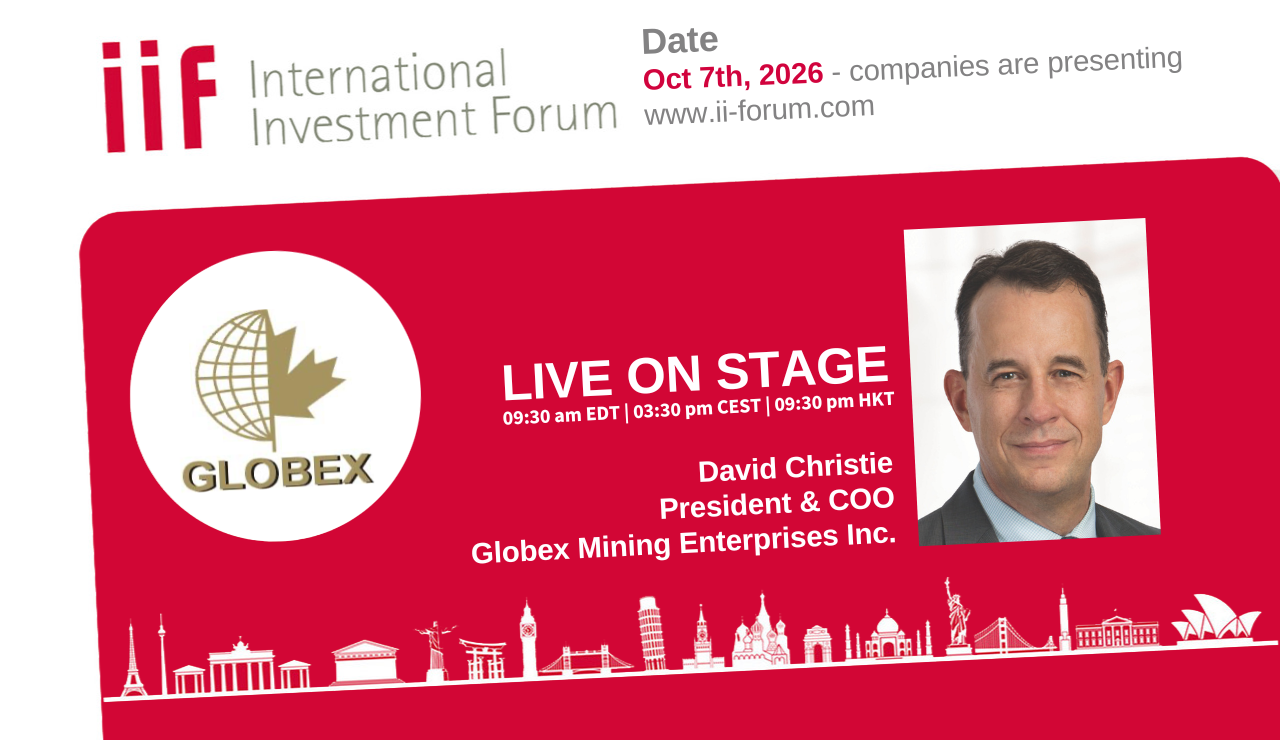
There was also good news recently from the Duquesne West project, in which Globex holds a 50% interest through a subsidiary. Partner Emperor Metals reported strong near-surface drill results, including 24.1 m at 2.6 g/t gold (drill hole DQ26-52) and 14.3 m at 2.2 g/t gold (DQ26-53). **With more than 20,000 m of drilling completed in the 2026 program alone, and well over 120,000 m drilled at the project to date, the project is now being advanced toward an initial economic assessment.
Globex is also benefiting from a strong global commodities backdrop. With precious metal prices at elevated levels and demand for industrial metals continuing to grow, projects in politically stable regions such as North America are increasingly attracting the attention of major mining companies.
This is where the royalty and option model shows its strength: when partner companies increase budgets for exploration and mine development due to high commodity prices, Globex benefits directly without bearing the enormous investment costs or inflation risks of mine construction.
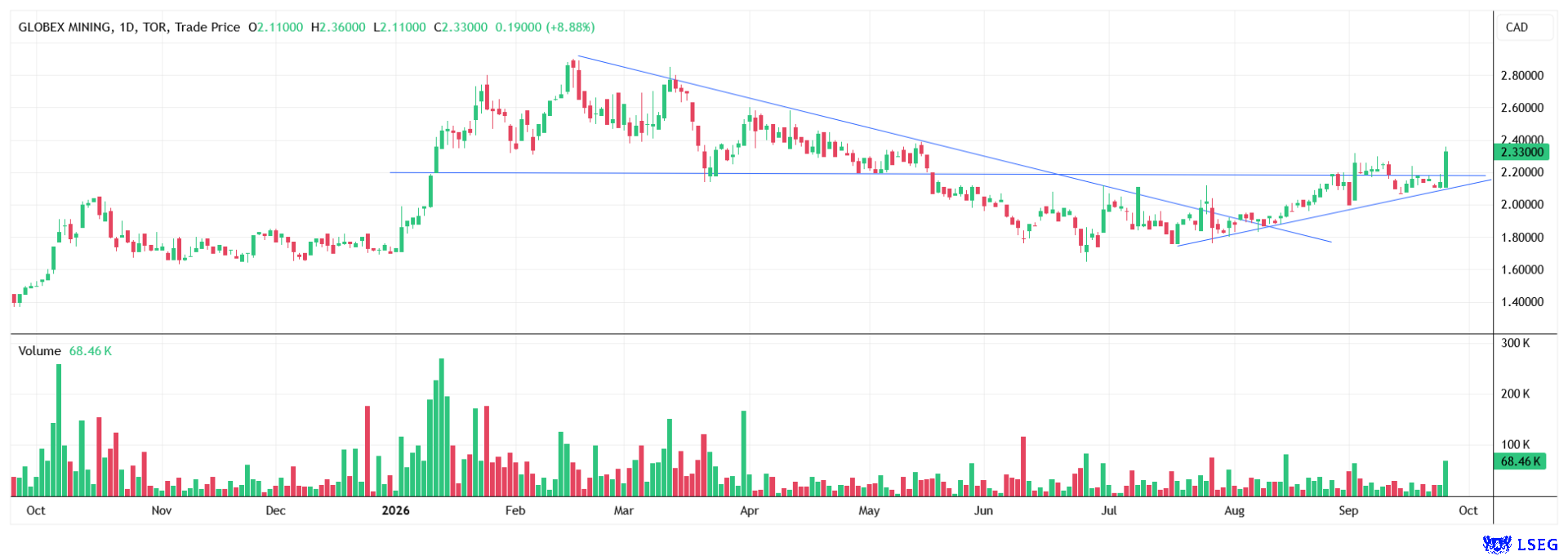
The stock is reacting positively to these operational advances. Most recently, the price broke out above the resistance level of CAD 2.20 to 2.25 amid higher trading volume. If this upward trend continues, the CAD 2.60 or 2.80 marks could be the next targets.

While Volkswagen is going through a tough restructuring phase, the stock presents itself as an attractive dividend play and a rebound candidate. With strong export figures and affordable hybrids, BYD demonstrates just how aggressively Asian manufacturers intend to take over the global market. Here, too, a V-shaped upward move could follow. Globex Mining remains a solid core holding in the commodities sector. Its diversified, relatively low-risk business model, steady drilling progress, and recently improved chart pattern could make the stock an interesting addition to more broadly diversified portfolios.
Conflict of interest
Pursuant to §85 of the German Securities Trading Act (WpHG), we point out that Apaton Finance GmbH as well as partners, authors or employees of Apaton Finance GmbH (hereinafter referred to as “Relevant Persons”) may hold shares or other financial instruments of the aforementioned companies in the future or may bet on rising or falling prices and thus a conflict of interest may arise in the future. The Relevant Persons reserve the right to buy or sell shares or other financial instruments of the Company at any time (hereinafter each a “Transaction”). Transactions may, under certain circumstances, influence the respective price of the shares or other financial instruments of the Company.
In addition, Apaton Finance GmbH is active in the context of the preparation and publication of the reporting in paid contractual relationships.
For this reason, there is a concrete conflict of interest.
The above information on existing conflicts of interest applies to all types and forms of publication used by Apaton Finance GmbH for publications on companies.
Risk notice
Apaton Finance GmbH offers editors, agencies and companies the opportunity to publish commentaries, interviews, summaries, news and the like on news.financial. These contents are exclusively for the information of the readers and do not represent any call to action or recommendations, neither explicitly nor implicitly they are to be understood as an assurance of possible price developments. The contents do not replace individual expert investment advice and do not constitute an offer to sell the discussed share(s) or other financial instruments, nor an invitation to buy or sell such.
The content is expressly not a financial analysis, but a journalistic or advertising text. Readers or users who make investment decisions or carry out transactions on the basis of the information provided here do so entirely at their own risk. No contractual relationship is established between Apaton Finance GmbH and its readers or the users of its offers, as our information only refers to the company and not to the investment decision of the reader or user.
The acquisition of financial instruments involves high risks, which can lead to the total loss of the invested capital. The information published by Apaton Finance GmbH and its authors is based on careful research. Nevertheless, no liability is assumed for financial losses or a content-related guarantee for the topicality, correctness, appropriateness and completeness of the content provided here. Please also note our Terms of use.
Stockhouse does not provide investment advice or recommendations. All investment decisions should be made based on your own research and consultation with a registered investment professional. The issuer is solely responsible for the accuracy of the information contained herein. For full disclaimer information, please click here.