


The Apple Principle: Net Profit Without Operational Risk
The best analogy for a functioning royalty system comes, of all places, from the tech industry. Tech giant Apple does not manufacture the majority of its iPhones itself, nor does it bear the business risk of the countless app developers on its platform. Instead, the company provides the crucial digital infrastructure through its iOS ecosystem and secures a largely risk-free revenue share of up to 30% via the App Store. It is the ultimate, crisis-proof business model with extremely high margins, as this revenue requires virtually no operational effort on the company’s part. The stock price over the past 15 years speaks volumes and demonstrates just how valuable this “toll booth” logic is for long-term wealth accumulation.Altius Renewable Royalties: The Pioneer on a Large Scale
Specialized financiers are applying precisely this licensing logic to the global energy transition. While an industry heavyweight like Altius Renewable Royalties is already successfully applying this model on a large, institutional scale to North American wind and solar power plants, a largely untapped return potential is opening up for investors in the smaller, more agile segment. Altius Renewable Royalties focuses primarily on the very large, established operators, which offer maximum security but, in the current market environment, also come with lower returns on capital. The market for these large-volume transactions is highly competitive, as institutional investors are desperately seeking stable ESG investments.RE Royalties occupies the lucrative niche of mid-sized developers
This is exactly where RE Royalties comes into play. The company adapts the crisis-proof royalty structure and specifically targets the niche of mid-sized green energy developers, who are often overlooked by traditional major banks and large financial institutions. The key advantage for investors compared to traditional cleantech investments lies in the legal security: RE Royalties provides operators with the necessary growth capital and, in return, receives direct, contractually guaranteed revenue shares from the electricity generated. If a project developer goes under or construction costs rise during the construction phase, RE Royalties’ claim to payments from the actual electricity production of the operational plants generally remains completely unaffected. This makes the business model extremely resilient to the typical growing pains of young cleantech companies. Thanks to this secure structure, the management team, led by CEO Bernard Tan, can ensure that incoming capital flows are immediately available for new investments or attractive distributions to shareholders. A recent example of this expansionary momentum is RE Royalties’ ongoing investment in Solaris Energy’s US solar portfolio. Here, the company recently released another tranche of USD 800,000 as part of a larger financing agreement totalling USD 4.8 million. Such deals underscore the agile team’s ability to channel capital quickly and highly profitably into high-yield projects while major banks are still busy with risk assessments.Strong numbers and a dividend that turns heads
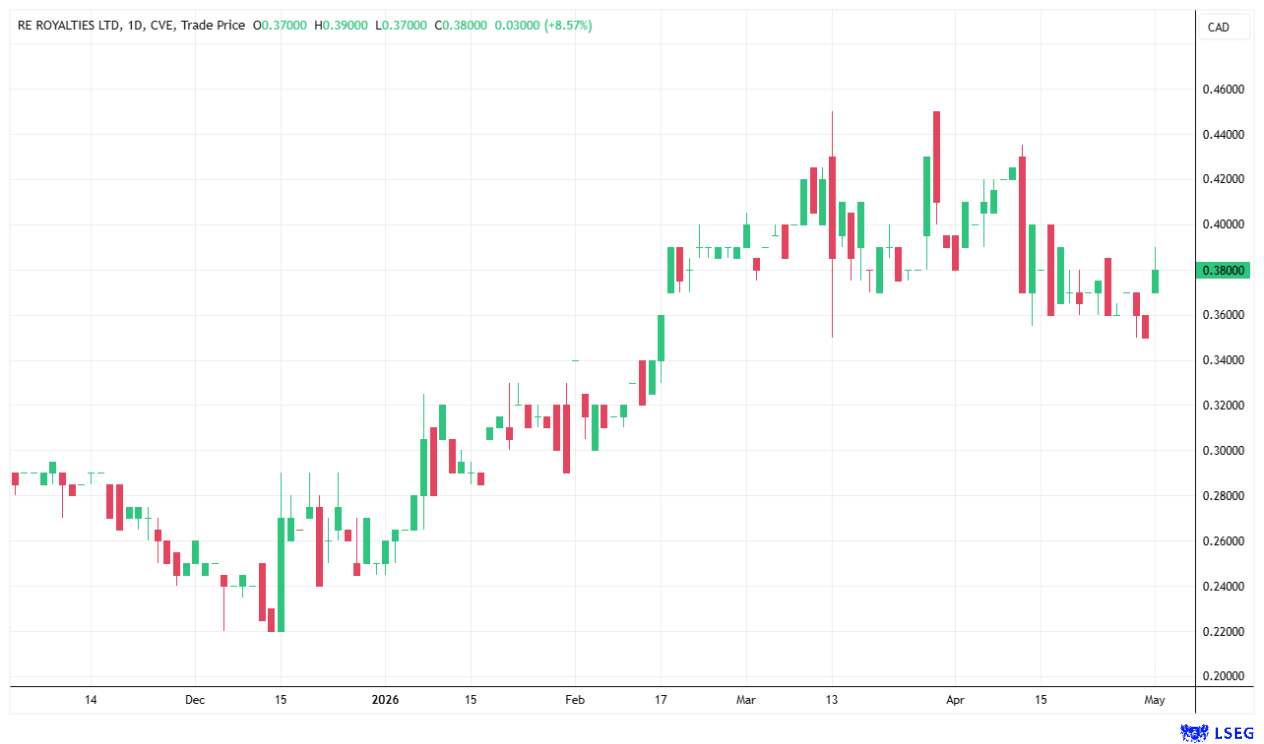
The company’s hard numbers demonstrate that this model also works exceptionally well for smaller, focused players. Despite a volatile market environment across the entire cleantech sector, RE Royalties has so far paid a reliable quarterly dividend of CAD 0.01 per share. At the current share price of around CAD 0.27, this corresponds to a projected dividend yield of over 14%—a figure that investors in traditional energy utilities or major tech giants can only dream of. The most recent dividend payment was made in January. In the future, RE Royalties will shift its dividend policy to an annual payout to align the distribution structure even more efficiently with long-term cash flows from power purchase agreements, optimize compound interest effects within the portfolio, and reduce administrative costs. With a pipeline of approximately CAD 20 million in letters of intent for upcoming projects and an additional CAD 200 million in potential deals under review, the foundation for growth in the coming years is firmly in place.
Conclusion: RE Royalties as a green toll booth – investors just need to cash in
The story of RE Royalties shows that while many investors are still investing in highly volatile, operationally vulnerable business models, RE Royalties is positioning itself as the green toll booth of the energy transition. By cleverly shifting to the high-yield niche of mid-sized project developers, the company avoids the fierce price war in the institutional segment where giants like Altius Renewable Royalties operate. The company relies on reliable, contractually protected income, much like its prominent Silicon Valley counterparts, and thanks to this clear focus, it offers investors one of the most exciting opportunities in the energy sector. The electricity flows, and RE Royalties earns. Investors can participate at attractive terms.
Conflict of interest
Pursuant to §85 of the German Securities Trading Act (WpHG), we point out that Apaton Finance GmbH as well as partners, authors or employees of Apaton Finance GmbH (hereinafter referred to as “Relevant Persons”) may hold shares or other financial instruments of the aforementioned companies in the future or may bet on rising or falling prices and thus a conflict of interest may arise in the future. The Relevant Persons reserve the right to buy or sell shares or other financial instruments of the Company at any time (hereinafter each a “Transaction”). Transactions may, under certain circumstances, influence the respective price of the shares or other financial instruments of the Company. In addition, Apaton Finance GmbH is active in the context of the preparation and publication of the reporting in paid contractual relationships. For this reason, there is a concrete conflict of interest. The above information on existing conflicts of interest applies to all types and forms of publication used by Apaton Finance GmbH for publications on companies.Risk notice
Apaton Finance GmbH offers editors, agencies and companies the opportunity to publish commentaries, interviews, summaries, news and the like on news.financial. These contents are exclusively for the information of the readers and do not represent any call to action or recommendations, neither explicitly nor implicitly they are to be understood as an assurance of possible price developments. The contents do not replace individual expert investment advice and do not constitute an offer to sell the discussed share(s) or other financial instruments, nor an invitation to buy or sell such. The content is expressly not a financial analysis, but a journalistic or advertising text. Readers or users who make investment decisions or carry out transactions on the basis of the information provided here do so entirely at their own risk. No contractual relationship is established between Apaton Finance GmbH and its readers or the users of its offers, as our information only refers to the company and not to the investment decision of the reader or user. The acquisition of financial instruments involves high risks, which can lead to the total loss of the invested capital. The information published by Apaton Finance GmbH and its authors is based on careful research. Nevertheless, no liability is assumed for financial losses or a content-related guarantee for the topicality, correctness, appropriateness and completeness of the content provided here. Please also note our Terms of use.Stockhouse does not provide investment advice or recommendations. All investment decisions should be made based on your own research and consultation with a registered investment professional. The issuer is solely responsible for the accuracy of the information contained herein. For full disclaimer information, please click here.