


Rock Tech Lithium: On the Path to Becoming the Western Lithium Hub
Rock Tech Lithium is pursuing one of the most ambitious strategies in the Western lithium sector: the company aims not only to be a raw material supplier but also to create a fully integrated platform—from mining and processing to finished lithium hydroxide for the battery industry. With the Georgia Lake project in Ontario, the planned Red Rock converter in Canada, and the lithium hydroxide plant in Guben, Germany, Rock Tech is addressing precisely one of the biggest bottlenecks of the energy transition—the lack of independent processing of critical battery raw materials outside of China. While China currently controls a significant portion of global lithium processing, North America and Europe are investing heavily in their own supply chains.
An important strategic step is the expansion of the Canadian project portfolio through the Victory Project in northwestern Ontario. Through an option agreement, Rock Tech has secured access to a 9,875-hectare lithium property that complements the existing Georgia Lake Project and could create additional long-term raw material options for the planned Ontario supply chain. Of particular interest are two known spodumene-bearing pegmatite deposits, where spot samples have returned grades of up to 5.11% Li₂O at the Last Resort target and up to 3.48% Li₂O at the Bounty pegmatite. Both deposits are located about 6 km apart, thereby opening up a larger exploration window. At the same time, the project boasts a key infrastructure advantage: its proximity to the Trans-Canada Highway, the rail network, and power supplies makes Victory a strategically well-positioned component within Canada’s lithium strategy. The agreement also demonstrates management’s capital-conscious approach. For the full acquisition of Victory, a total of CAD 600,000 in cash payments, shares valued at CAD 400,000, and exploration services worth CAD 500,000 are planned over a 24-month period. This allows Rock Tech to assess the geological potential in stages without incurring significant short-term financial burdens.
At the same time, Rock Tech is working intensively to further develop the existing Georgia Lake project commercially. The original pre-feasibility study from 2022 had already reported an after-tax NPV of USD 146 million, an after-tax IRR of 35.6%, and a planned production of approximately 100,000 metric tons of spodumene concentrate per year. However, the real strategic advantage lies in processing expertise. With the Red Rock Converter, Rock Tech is establishing its own lithium refining capacity for North America, enabling the direct production of lithium hydroxide for the battery and automotive industries. The planned facility is expected to supply up to 32,000 metric tons of lithium chemicals per year; in addition, a European production platform is being established in Guben with a planned capacity of 24,000 metric tons of lithium hydroxide annually. The EU has already classified the German converter as a strategic project under the Critical Raw Materials Act, underscoring the facility’s political significance. Momentum surrounding Red Rock has recently increased significantly. The strategic partnership with Siemens, as well as the planned investment by Canadian infrastructure investor BMI, could mark an important step in financing. BMI intends to contribute up to CAD 200 million to the project, thereby supporting a significant portion of the future capital structure. After a long period of high inventory levels, demand for lithium is now noticeably stabilizing. This serves as a launchpad for Rock Tech Lithium shares, which have recently experienced a sharp price correction. A NASDAQ listing is planned for the future—the Canadian commodities company Almonty Industries completed this step and ultimately saw its share price increase more than tenfold. Risk-aware investors are building up their positions!
BASF: The Clear Global Market Leader in Cathode Materials
The global race for market leadership in electric mobility has long since moved beyond the asphalt and is now being decided primarily in the chemistry labs of battery suppliers. As an early pioneer, the chemical company BASF has established a key technological position through massive investments in state-of-the-art production facilities for cathode materials. The groundbreaking industry report “Battery Materials Industry Outlook” by DataM Intelligence underscores this dominant position and forecasts steep annual growth of 21% for the cathode materials market. BASF aims to achieve a global market share of over 10% in this battery segment by the target year of 2030. To drive this ambitious goal forward, total investments of EUR 3.5 to 4.5 billion are being allocated to expand the global battery value chain as part of the Group’s long-term strategy. The study’s findings indicate that this financial effort will generate segment revenue exceeding EUR 7 billion, representing 11% of total revenue. The Group’s technological maturity is already evident in practice, as its European production sites currently supply cathode material to equip approximately 400,000 fully electric vehicles annually. BASF shares have shown a 7% gain over the past 12 months, but have recently consolidated by just under 20%. With a 2026 P/E ratio of 17 and little economic growth, the Ludwigshafen-based company’s momentum remains subdued.
Mercedes and Porsche: Major Efforts Will Be Necessary
The German automotive industry is facing one of its greatest tests in recent decades. In light of plummeting sales in the key Chinese market and stagnating demand for electric vehicles in Europe, premium manufacturers Mercedes-Benz and Porsche are coming under significant pressure. At Mercedes, this has led to a package of drastic measures. The executive board plans to scrap the 35-hour workweek. It is demanding an unpaid return to the 40-hour workweek for approximately 90,000 employees covered by collective bargaining agreements to drastically reduce production costs in Germany. To boost operational efficiency, working from home is to be phased out, and, as an urgent measure to secure liquidity, the special collective bargaining bonus for employees, originally due in July, has been postponed until next year. On the European market, the company is responding with temporary deep discounts of up to 30% on in-stock EQE and EQS electric models to artificially prop up sales. The tone is similar at sports car manufacturer Porsche, where the executive board is spinning the bad news as a “package for the future.” In addition to cutting 7,900 jobs, production is now set to be scaled back to protect the company’s exclusive pricing strategy. As a structural measure, three subsidiaries—currently employing 500 people—will be closed, and in China the company is also streamlining its dealer network. The company intends to move away from the rigid 80% electric vehicle target by 2035 and instead focus on a market-driven mix of electric, hybrid, and internal combustion engine vehicles in the future. In our view, these measures offer real hope that the two Swabian premium brands will indeed survive the greatest automotive crisis of the postwar era. Whether the share prices of EUR 43.70 and EUR 45.20 have already “hit bottom” remains a philosophical question. For this is directly linked to the likelihood of Germany’s survival as an industrial hub, which has been in intensive care since the “traffic light” coalition government’s transformation decisions.

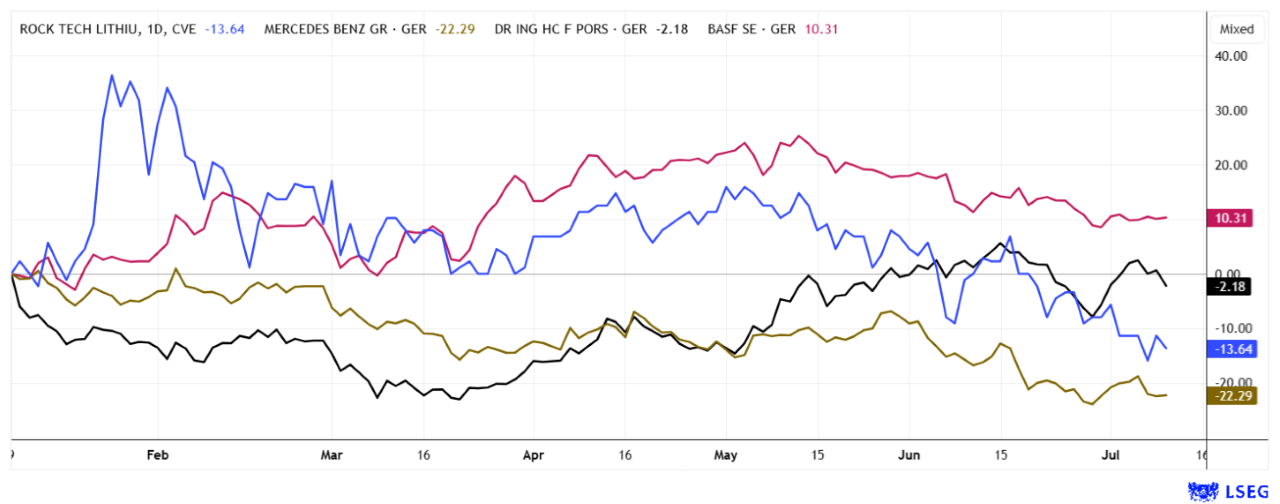
The future of mobility will be shaped not only by innovative vehicles, but by the entire infrastructure encompassing energy, raw materials, and processing capacities. The automotive industry is increasingly facing political mandates to transition from internal combustion engines to electric mobility and must implement tough restructuring measures. In this broader context, investors are also turning their attention to companies that supply critical materials for the new value chain. Rock Tech has consistently expanded its lithium projects in recent years and, with its own resources as well as planned processing plants in Canada and Europe, could become a key component of the Western battery supply chain. The stock is undervalued!
Conflict of interest
Pursuant to §85 of the German Securities Trading Act (WpHG), we point out that Apaton Finance GmbH as well as partners, authors or employees of Apaton Finance GmbH (hereinafter referred to as “Relevant Persons”) currently hold or hold shares or other financial instruments of the aforementioned companies and speculate on their price developments. In this respect, they intend to sell or acquire shares or other financial instruments of the companies (hereinafter each referred to as a “Transaction”). Transactions may thereby influence the respective price of the shares or other financial instruments of the Company.
In this respect, there is a concrete conflict of interest in the reporting on the companies.
In addition, Apaton Finance GmbH is active in the context of the preparation and publication of the reporting in paid contractual relationships.
For this reason, there is also a concrete conflict of interest.
The above information on existing conflicts of interest applies to all types and forms of publication used by Apaton Finance GmbH for publications on companies.
Risk notice
Apaton Finance GmbH offers editors, agencies and companies the opportunity to publish commentaries, interviews, summaries, news and the like on news.financial. These contents are exclusively for the information of the readers and do not represent any call to action or recommendations, neither explicitly nor implicitly they are to be understood as an assurance of possible price developments. The contents do not replace individual expert investment advice and do not constitute an offer to sell the discussed share(s) or other financial instruments, nor an invitation to buy or sell such.
The content is expressly not a financial analysis, but a journalistic or advertising text. Readers or users who make investment decisions or carry out transactions on the basis of the information provided here do so entirely at their own risk. No contractual relationship is established between Apaton Finance GmbH and its readers or the users of its offers, as our information only refers to the company and not to the investment decision of the reader or user.
The acquisition of financial instruments involves high risks, which can lead to the total loss of the invested capital. The information published by Apaton Finance GmbH and its authors is based on careful research. Nevertheless, no liability is assumed for financial losses or a content-related guarantee for the topicality, correctness, appropriateness and completeness of the content provided here. Please also note our Terms of use.
Stockhouse does not provide investment advice or recommendations. All investment decisions should be made based on your own research and consultation with a registered investment professional. The issuer is solely responsible for the accuracy of the information contained herein. For full disclaimer information, please click here.