


Drone Economy Instead of Steel Giants: The Defence Sector Is Currently Reorganizing Itself
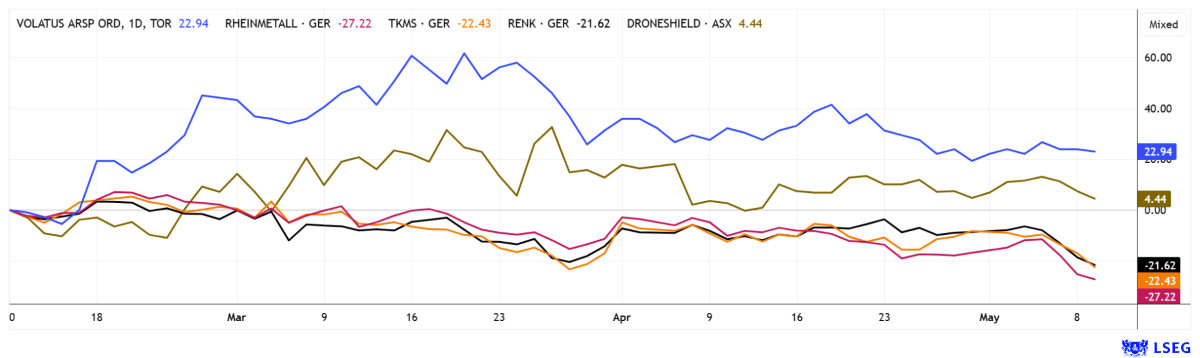
The global defence market is currently undergoing a tectonic shift. While classic heavyweights such as Rheinmetall, RENK, or TKMS are still benefiting from the waning rearmament boom and the filling of procurement gaps from recent years, strategic capital is now visibly shifting toward autonomous systems and AI-supported security architecture. According to NATO and SIPRI analyses, global spending on unmanned systems is now growing at double-digit rates annually; the market for military drones could thus reach USD 80 to USD 100 billion by 2030. This is precisely where the new value chain of modern defence is emerging. In the future, it will not be the tank alone that determines superiority in rough terrain, but rather the capability for real-time reconnaissance, electronic warfare, and autonomous mission control. Drones are thus evolving from tactical supplements into a critical infrastructure of the modern security economy, comparable to satellite communications or cyber defence. Companies like Volatus Aerospace occupy precisely this technological intersection and benefit from a market that is accelerating structurally.
High barrier to entry: The real moat lies in the systems business
The most exciting development in the drone sector is not taking place in hardware, but in integrated platform models. This is precisely where Volatus differs fundamentally from many traditional defence companies. While conventional providers primarily sell large, project-based contracts, Volatus relies on a scalable ecosystem comprising drone operations, data analysis, maintenance, software integration, and training. This structure generates recurring revenue from many segments with significantly greater predictability than pure one-time sales. The recent NATO-related training contract is particularly strategic in this regard. In the defence industry, training is considered a gateway to operational security structures, as those who train personnel become part of a nation’s operational architecture in the long term. DroneShield is already successfully leveraging precisely this multiplier effect in the field of electronic drone defence.
But Volatus can do much more. The company combines operational flight expertise with infrastructure and data services. This approach is more economically aligned with that of a security-critical technology provider than with a traditional defence contractor. This creates higher barriers to entry, strong customer loyalty, and potentially higher-margin follow-on business over the years. If one segment performs poorly, the sector’s breadth provides a natural hedge. It does not get much better than this, as Volatus can generate high-margin revenues while flexibly financing ongoing investments.
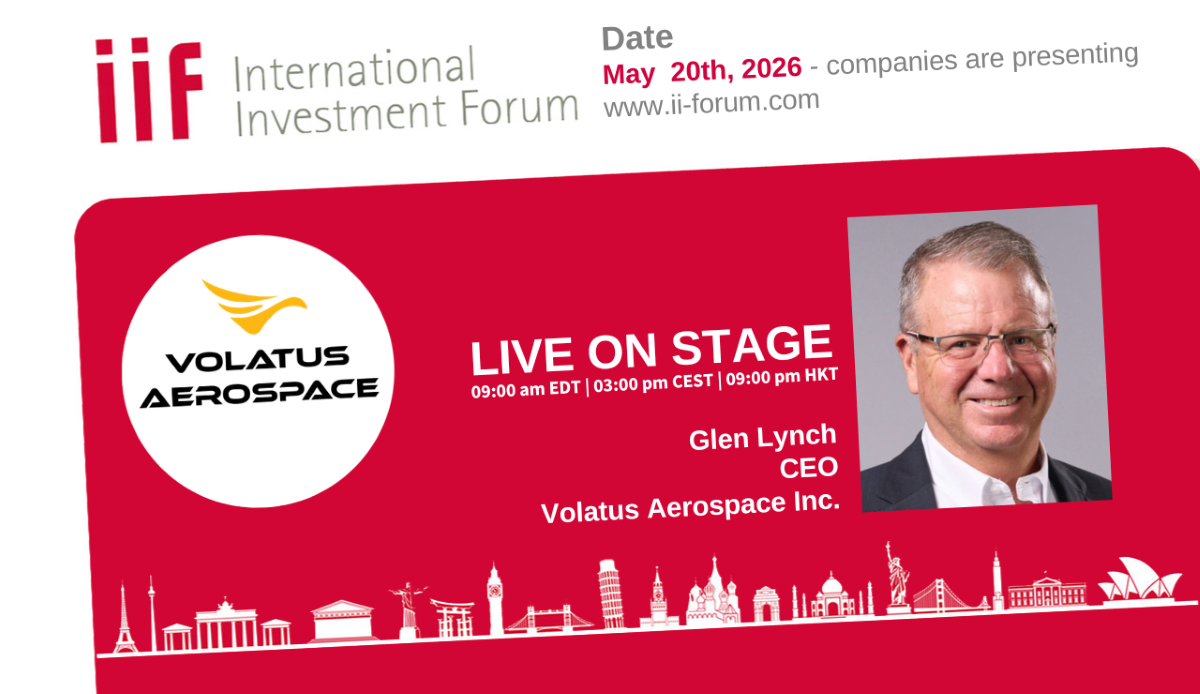
CEO Glen Lynch will outline his medium-term strategy on May 20 at the 19th International Investment Forum. Click here to register.

Note: The capital market is still underestimating the next wave in defence
From an analytical perspective, the actual investment cycle in the field of autonomous defence systems did not begin until 2025. Leading the way globally, the US administration is now discussing defence budgets of around USD 1.5 trillion for 2027, with autonomous systems and AI applications among the fastest-growing segments. At the same time, the stock market clock is ticking counterclockwise: Technical market indicators for traditional defence stocks are currently showing increasing signs of overheating. At such junctures, institutional capital often begins to rotate into the next growth phase. Volatus Aerospace appears to be a typical early-stage beneficiary of an emerging infrastructure market. The platform is in place, initial government references already exist, and global demand for integrated drone solutions is growing exponentially.
The next investment cycle will be massive! Volatus Aerospace is now an established player in a disruptive market, and momentum is noticeably picking up! The stock (FLT) was recently trading at around EUR 0.41 or CAD 0.66, while published analyst estimates currently suggest a price range of approximately CAD 0.90 to 1.25. For risk-aware investors, this presents a good entry point, because while established defence stocks have already priced in high expectations, the actual revaluation in the drone tech sector may only be just beginning.
Conflict of interest
Pursuant to §85 of the German Securities Trading Act (WpHG), we point out that Apaton Finance GmbH as well as partners, authors or employees of Apaton Finance GmbH (hereinafter referred to as “Relevant Persons”) currently hold or hold shares or other financial instruments of the aforementioned companies and speculate on their price developments. In this respect, they intend to sell or acquire shares or other financial instruments of the companies (hereinafter each referred to as a “Transaction”). Transactions may thereby influence the respective price of the shares or other financial instruments of the Company.
In this respect, there is a concrete conflict of interest in the reporting on the companies.
In addition, Apaton Finance GmbH is active in the context of the preparation and publication of the reporting in paid contractual relationships.
For this reason, there is also a concrete conflict of interest.
The above information on existing conflicts of interest applies to all types and forms of publication used by Apaton Finance GmbH for publications on companies.
Risk notice
Apaton Finance GmbH offers editors, agencies and companies the opportunity to publish commentaries, interviews, summaries, news and the like on news.financial. These contents are exclusively for the information of the readers and do not represent any call to action or recommendations, neither explicitly nor implicitly they are to be understood as an assurance of possible price developments. The contents do not replace individual expert investment advice and do not constitute an offer to sell the discussed share(s) or other financial instruments, nor an invitation to buy or sell such.
The content is expressly not a financial analysis, but a journalistic or advertising text. Readers or users who make investment decisions or carry out transactions on the basis of the information provided here do so entirely at their own risk. No contractual relationship is established between Apaton Finance GmbH and its readers or the users of its offers, as our information only refers to the company and not to the investment decision of the reader or user.
The acquisition of financial instruments involves high risks, which can lead to the total loss of the invested capital. The information published by Apaton Finance GmbH and its authors is based on careful research. Nevertheless, no liability is assumed for financial losses or a content-related guarantee for the topicality, correctness, appropriateness and completeness of the content provided here. Please also note our Terms of use.
Stockhouse does not provide investment advice or recommendations. All investment decisions should be made based on your own research and consultation with a registered investment professional. The issuer is solely responsible for the accuracy of the information contained herein. For full disclaimer information, please click here.