

From Plant Engineering to Energy Provider: A.H.T. Syngas Plans to Boost Margins Through Contracting
Small but mighty! Anyone who really thinks through the energy transition comes to the conclusion that the revolution is taking place not in billion-dollar projects, but right on the ground in industry. One example is the German Greentech specialist A.H.T. Syngas Technology (A.H.T. for short), which replaces fossil natural gas by gasifying biogenic waste materials. The company uses a patented twin-fire gasification process to generate clean electricity, heat, and synthesis gas from local waste such as wood, sewage sludge, or screening residues. When compared technologically with traditional competitors, such as pure biogas plants with biological digesters, A.H.T.’s high-temperature thermochemical process offers a decisive advantage: it is extremely flexible in its feedstock. While biological systems are limited to specific, often expensive agricultural feedstocks and are sensitive to changes in substrate, A.H.T. technology easily processes even difficult, non-edible waste materials and converts them into high-purity, low-tar synthesis gas. This gas can be flexibly used to decarbonize industrial processes and also serves as an ideal basis for the synthesis of green hydrogen, methanol, or e-fuels.
CEO Gero Ferges recently provided more detailed insights during the 19th International Investment Forum.
A recent case study from a German industrial plant impressively demonstrates just how profitable this technological approach is in practice. With an investment of just EUR 1.6 million for the A.H.T. plant, the customer saves EUR 600,000 annually in natural gas procurement costs. At the same time, the site’s carbon footprint is reduced by 1,500 metric tons of CO₂ per year. This payback period of less than three years underscores the economic superiority of decentralized circular solutions over complex, centralized large-scale projects. Another growth driver is the company’s newly patented hydrogen unit. From 1.7 metric tons of biomass, the standardized system generates 210 kg of pure hydrogen per hour. In Germany, this production qualifies for greenhouse gas reduction certificates (GHG quota), which currently generate additional, highly profitable revenue for A.H.T. of around EUR 15 per kilogram of hydrogen and massively increase profitability for investors. A.H.T. is currently undergoing a strategic transformation from a pure plant builder to an independent energy producer. CEO Gero Ferges explained at the International Investment Forum (IIF) that operating the plants in-house is expected to increase current profit margins from approximately 10% to as much as 18%.
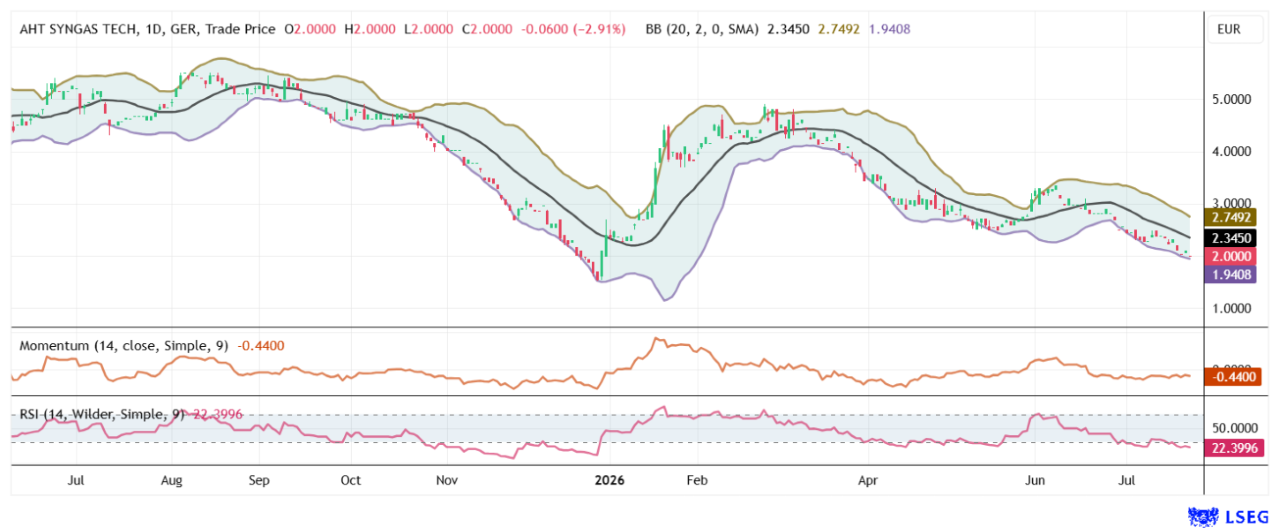
Based on this scalable model, the research firm GBC Research forecasts a steep growth curve for the company. Following expected revenue of EUR 9 million in 2026, revenue is projected to climb to around EUR 23 million by 2028. This expansion is supported by a strong project pipeline in core markets such as Germany and Poland, where 17 major projects are already in the works. Since management and employees hold approximately 40% of the shares, the interests of senior management are perfectly aligned with those of the shareholders. Given its fundamental undervaluation and high strategic relevance to the industry, this small-cap stock is also considered an attractive acquisition target for larger energy conglomerates. Extremely exciting—and an enticing chart…
E.ON: Another Step Toward Growth in the UK
Good news from E.ON! The planned acquisition of the British electricity provider Ovo Energy strengthens E.ON’s strategic business model by massively expanding the customer base for decentralized energy services and smart grid solutions in the key UK market. Investors view the acquisition as a catalyst for digital decarbonization solutions, as the integration of modern customer platforms scales the rollout of heat pumps, solar systems, and home storage units and generates reliable cash flows that comply with the EU taxonomy. In the short term, however, the deal faces regulatory headwinds, as the UK Competition and Markets Authority (CMA) has launched an investigation to rule out dominant market positions and potential disadvantages for consumers in the UK residential market. Should the acquisition successfully clear antitrust hurdles, E.ON will significantly strengthen its position as a leading European platform provider. In addition, consolidating IT infrastructure will reduce operating costs and enable profitable green transformation of the retail markets. Analysts on the LSEG platform expect the stock, which has risen 20% since the start of the year, to gain another 6% to EUR 20.53. With a 3.5% dividend yield, E.ON is a long-term portfolio anchor without spectacular price movements.
Nel ASA and ITM Power: Back in Investors’ Focus Thanks to European Subsidies
Has the sell-off among “hydrogen experts” already ended? It could be, as the European Union is reestablishing hydrogen as an attractive investment opportunity through massive subsidy programs to drive the decarbonization of industry. Among the most important funding sources in Brussels is the EU Innovation Fund, which is providing a budget of EUR 2.9 billion in a current call for proposals for “NetZero” technologies alone. In support of this, the European Hydrogen Bank (EHB) is injecting significant funds into the market through its auctions, with the most recent auction round totaling EUR 1.3 billion. These reliable, multi-billion-euro subsidies mitigate the high financial risk for private investors and ensure the economic scalability of large-scale industrial projects.
Norwegian electrolysis pioneer Nel ASA is specifically leveraging this support from Brussels to expand its core industrial infrastructure. The company has secured a formal funding commitment of a substantial EUR 135 million from the EU Innovation Fund. This capital injection covers up to 60% of the eligible costs for the large-scale industrialization of its new pressurized alkaline electrolyzer platform at the Herøya site. The goal of the project is to gradually increase production capacity to up to 4 gigawatts per year. Thanks to this massive EU funding, Nel ASA can drastically reduce investment costs for customers and finally make green hydrogen competitive. The stock experienced a surge in May with a 100% jump, but by the end of July, all that momentum had evaporated, as the Q2 results—featuring another loss and a decline in revenue—were not a highlight for investors.
The British H2 specialist ITM Power is also strengthening its market position in continental Europe through substantial EU subsidies. The European executive agency CINEA confirmed to the company the release of a remaining tranche of EUR 32.4 million in EU funding. This financing will go directly toward the renowned large-scale Refhyne II project, which involves the construction of a 100-megawatt plant. This European expansion strategy is supported by government funding packages worth billions in the company’s home market of the UK and an expanded presence in the German hydrogen network. Thanks to this reliable funding framework, ITM Power is making decisive progress in the automated mass production of highly efficient PEM stacks. Here, too, there was a rebound in May with a rapid tripling of the share price, though 50% of that gain was subsequently lost. The next earnings report is expected on August 13. ITM management anticipates that the company will reach operational breakeven by 2029/30. Well then!
Alternative energies have long been more than just a climate project—they are Europe’s strategic way out of the energy crisis because they reduce dependencies. E.ON, ITM Power, and Nel ASA are leading the way in building modern grids and an innovative hydrogen infrastructure, even if the major public investment push has so far lagged behind the political rhetoric. A.H.T. Syngas adds an exciting new component: the conversion of waste into synthesis gas combines the circular economy with energy production, turning waste disposal problems into new value creation.
Conflict of interest
Pursuant to §85 of the German Securities Trading Act (WpHG), we point out that Apaton Finance GmbH as well as partners, authors or employees of Apaton Finance GmbH (hereinafter referred to as “Relevant Persons”) currently hold or hold shares or other financial instruments of the aforementioned companies and speculate on their price developments. In this respect, they intend to sell or acquire shares or other financial instruments of the companies (hereinafter each referred to as a “Transaction”). Transactions may thereby influence the respective price of the shares or other financial instruments of the Company.
In this respect, there is a concrete conflict of interest in the reporting on the companies.
In addition, Apaton Finance GmbH is active in the context of the preparation and publication of the reporting in paid contractual relationships.
For this reason, there is also a concrete conflict of interest.
The above information on existing conflicts of interest applies to all types and forms of publication used by Apaton Finance GmbH for publications on companies.
Risk notice
Apaton Finance GmbH offers editors, agencies and companies the opportunity to publish commentaries, interviews, summaries, news and the like on news.financial. These contents are exclusively for the information of the readers and do not represent any call to action or recommendations, neither explicitly nor implicitly they are to be understood as an assurance of possible price developments. The contents do not replace individual expert investment advice and do not constitute an offer to sell the discussed share(s) or other financial instruments, nor an invitation to buy or sell such.
The content is expressly not a financial analysis, but a journalistic or advertising text. Readers or users who make investment decisions or carry out transactions on the basis of the information provided here do so entirely at their own risk. No contractual relationship is established between Apaton Finance GmbH and its readers or the users of its offers, as our information only refers to the company and not to the investment decision of the reader or user.
The acquisition of financial instruments involves high risks, which can lead to the total loss of the invested capital. The information published by Apaton Finance GmbH and its authors is based on careful research. Nevertheless, no liability is assumed for financial losses or a content-related guarantee for the topicality, correctness, appropriateness and completeness of the content provided here. Please also note our Terms of use.
Stockhouse does not provide investment advice or recommendations. All investment decisions should be made based on your own research and consultation with a registered investment professional. The issuer is solely responsible for the accuracy of the information contained herein. For full disclaimer information, please click here.