

“Once Dependent, Always Dependent”
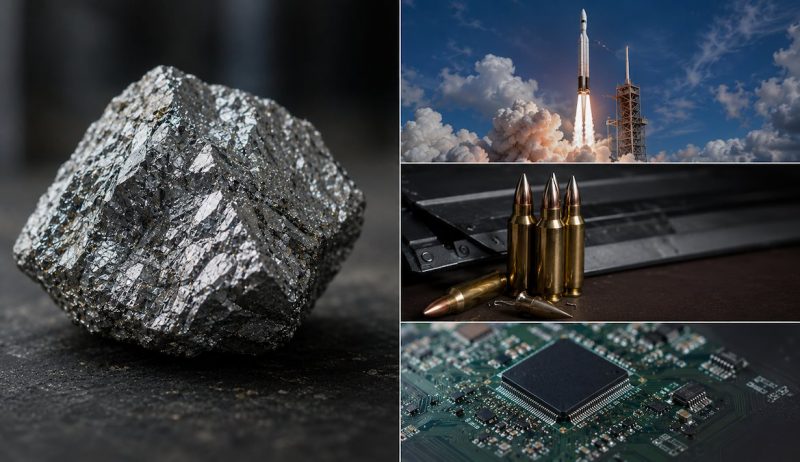
Last Tuesday, the NZZ published an article titled “Once Dependent, Always Dependent,” using tungsten as an example to illustrate how difficult it is for Europe and other Western nations to reduce their dependence on China for raw materials. Tungsten has the highest melting point of all chemical elements, and its hardness makes it virtually irreplaceable for numerous industrial applications, such as hardened tools, electric vehicles, and armour-piercing ammunition. Europe’s dependence on it is correspondingly severe. Over the decades, China has monopolized not only production but also, in some cases, processing. As a result, the Chinese government can now leverage its market power through export restrictions. At the same time, Europe lacks significant strategic reserves and suppliers. New mines take many years to reach production, which is why the industry views additional production outside of China and a higher recycling rate as crucial to alleviating the structurally tight supply situation. And fortunately, there is still Almonty Industries.
While new mining projects often fail due to protracted permitting processes, opposition, and high investment barriers, Almonty Industries focused on existing mines early on. CEO Lewis Black purchased already developed sites during periods of low tungsten prices, thereby shortening development times. With the Panasqueira mine in Portugal, Almonty owns a tungsten mine that has been in production for more than 135 years, providing the company with an operational base within the EU. While numerous European mines disappeared in the past under pressure from low Chinese prices, the expertise, infrastructure, and skilled workforce there were preserved. Panasqueira’s production capacity is currently being expanded. However, the hope for Western tungsten supply, and the driver behind Almonty shares, lies in South Korea.
Sangdong Mine Essential for Western Tungsten Supply
That is where the Sangdong Mine is located. It is situated in a politically stable, Western-oriented jurisdiction and, once ramped up, is expected to make a significant contribution to supply outside of China. In the first expansion phase, production of approximately 2,300 metric tons of tungsten concentrate per year is expected, which would allow Sangdong to cover about 5% of Western demand. Almonty plans to begin the second expansion phase later this year to double production capacity once again and thereby further increase its importance to the West.
Almonty Industries: Shares Stage a Comeback, Surging 30%
With the ramp-up of production in Sangdong, Almonty shares were among the top performers in the first few months of the year. By April, the stock had surged on the NASDAQ from USD 8 to over USD 23. In recent weeks, there was then an unsurprising, albeit sharp, correction to just under USD 11. Last week, Almonty shares made a spectacular comeback, gaining nearly 30%. Next, the downward trend could be broken, and the stock could set its sights on the previous high. Analysts remain bullish. Cantor Fitzgerald recommends buying Almonty shares with a price target of USD 25.50. Experts expect the commodities company to post earnings of USD 3.07 per share next year. The stock is currently trading just above USD 14. Analysts at D.A. Davidson even estimate the fair value of Almonty shares at USD 33.
Indus Benefits from Tungsten Shortage
The tungsten shortage is bringing joy to Indus shareholders this year. This is because the holding company is active in the tungsten carbide trade through a subsidiary. Due to higher prices, the company has been able to raise its annual forecast twice within just a few months. In an interview with “4investors.de”, Indus CEO Johannes Schmidt describes the tungsten market as exceptionally tight. According to his estimate, about 80% of the world’s mined tungsten comes from China, which has been putting additional pressure on supply since early 2025 through restrictive export controls. Since tungsten carbide is virtually impossible to replace economically in many applications due to its extreme hardness, the industry cannot decouple itself from China in the short term. Indus is therefore attempting to secure its own supply through more diversified sources, long-term supply agreements, and a higher recycling rate. Schmidt does not expect any fundamental shift in China’s dominance until the long term.
The Indus CEO also continues to view the price situation as exceptional. According to him, tungsten carbide prices have roughly tripled since early 2026, and most recently, prices have stabilized at a very high level. It remains unclear when prices will return to normal. Incidentally, some argue that the current price level of around USD 3,000 per MTU is more likely the new normal, since China had kept prices artificially low to drive Western companies out of the market and can no longer afford to do so. And new Western mining projects require relatively high prices for development to be profitable. Sangdong is an exception. At this high-grade mine, Almonty produces at a cost of less than USD 130 per MTU. The current margin is therefore enormous.
For Indus, the high prices currently mean higher revenue and earnings, but they also increase the amount of capital tied up in working capital. Indus shares should continue to benefit from this trend. Following the upward revision of the forecast, analysts at NuWays confirmed their “Buy” recommendation and raised the price target from EUR 37 to EUR 41. On Friday, the share closed at around EUR 31.20.
US Government Fuels Tungsten Demand
And here is another driver for the tungsten market. The US’s empty ammunition depots are increasingly becoming a security concern. After months of heavy strain due to international conflicts, Washington must now replenish its stockpiles at an enormous pace. The government is pushing the defence industry to make a production leap the likes of which the sector has hardly seen in decades. Lockheed Martin, for example, is expected to massively ramp up production of key guided missiles, while production capacity for the Tomahawk, manufactured by Raytheon, is also set to expand significantly. This is a game-changer for the tungsten market. The US has no domestic tungsten production, and as of January 1, 2027, the US Department of Defense will generally be prohibited from procuring certain tungsten products that were mined, refined, separated, smelted, or produced in China. Almonty should also benefit from this, especially since it is currently bringing a mine into production in the US.
Investors looking to profit from the tungsten boom really cannot ignore Almonty Industries. While the stock is volatile, the fundamentals point to further price increases. According to analysts, a 100% gain from current levels is possible. And virtually all research studies are based on low tungsten prices in the coming years. Companies like Indus may benefit in the short term, but they also face supply risks, and tungsten is just one part of their business.
Conflict of interest
Pursuant to §85 of the German Securities Trading Act (WpHG), we point out that Apaton Finance GmbH as well as partners, authors or employees of Apaton Finance GmbH (hereinafter referred to as “Relevant Persons”) currently hold or hold shares or other financial instruments of the aforementioned companies and speculate on their price developments. In this respect, they intend to sell or acquire shares or other financial instruments of the companies (hereinafter each referred to as a “Transaction”). Transactions may thereby influence the respective price of the shares or other financial instruments of the Company.
In this respect, there is a concrete conflict of interest in the reporting on the companies.
In addition, Apaton Finance GmbH is active in the context of the preparation and publication of the reporting in paid contractual relationships.
For this reason, there is also a concrete conflict of interest.
The above information on existing conflicts of interest applies to all types and forms of publication used by Apaton Finance GmbH for publications on companies.
Risk notice
Apaton Finance GmbH offers editors, agencies and companies the opportunity to publish commentaries, interviews, summaries, news and the like on news.financial. These contents are exclusively for the information of the readers and do not represent any call to action or recommendations, neither explicitly nor implicitly they are to be understood as an assurance of possible price developments. The contents do not replace individual expert investment advice and do not constitute an offer to sell the discussed share(s) or other financial instruments, nor an invitation to buy or sell such.
The content is expressly not a financial analysis, but a journalistic or advertising text. Readers or users who make investment decisions or carry out transactions on the basis of the information provided here do so entirely at their own risk. No contractual relationship is established between Apaton Finance GmbH and its readers or the users of its offers, as our information only refers to the company and not to the investment decision of the reader or user.
The acquisition of financial instruments involves high risks, which can lead to the total loss of the invested capital. The information published by Apaton Finance GmbH and its authors is based on careful research. Nevertheless, no liability is assumed for financial losses or a content-related guarantee for the topicality, correctness, appropriateness and completeness of the content provided here. Please also note our Terms of use.
Stockhouse does not provide investment advice or recommendations. All investment decisions should be made based on your own research and consultation with a registered investment professional. The issuer is solely responsible for the accuracy of the information contained herein. For full disclaimer information, please click here.