


Rheinmetall: Uncertainties Slow Profit Momentum
As expected, the Düsseldorf-based defence conglomerate Rheinmetall recently delivered impressive figures and reported its strongest quarter in the company’s history for Q2 2026. The DAX-listed company’s revenue soared by 69% to approximately EUR 3.29 billion, while operating profit surged by as much as 115% to EUR 562 million. However, operational hurdles lurk behind this extraordinary boom: delays in major Bundeswehr projects and the surprise cancellation of the F126 frigate program forced Rheinmetall to slightly lower its full-year revenue forecast to between EUR 13.7 and 14.2 billion. To expand its capacity for artillery ammunition and weapons systems, the group relies on a smooth flow of supplies of specialty steels and electronic components. If geopolitical tensions restrict access to these industrial metals, Rheinmetall will have to counteract this with costly stockpiling. This weighs on free cash flow, which surprisingly stood at minus EUR 1.6 billion in the first half of the year. Nevertheless, the long-term outlook has convinced LSEG analysts. Given the well-filled order book, they see an average price potential of around 65% to approximately EUR 1,642 within the next 12 months. The key question remains whether Rheinmetall can secure its supply of raw materials even in an increasingly protectionist environment. From a technical analysis perspective, the stock has already tested the support zone between EUR 950 and 1,000 twice. At prices around EUR 997, the 2028 P/E ratio already drops to 13. Analysts are now revising their long-term revenue outlook slightly downward; however, with revenue projected at EUR 41.7 billion for 2030, up from around EUR 14 billion in 2026, medium-term expectations remain robust, especially since the P/S ratio over a 5-year horizon is now only 1.
Airbus: Between Supply Chain Strains and an Order Boom
European aviation giant Airbus is also demonstrating operational resilience, but is increasingly feeling the effects of global bottlenecks in raw material procurement. In the first half of the year, revenue climbed 12% to EUR 33.2 billion, while adjusted EBIT reached EUR 2.7 billion. Free cash flow, however, remains negative at EUR 1.2 billion, primarily because Airbus has had to significantly increase its inventory levels due to delayed supplier deliveries. Especially in the final assembly of modern commercial aircraft, every material that arrives on time counts: if critical lightweight materials are missing, the entire production chain grinds to a halt.
However, several major orders from Vietnam offer cause for optimism. Vietravel Airlines has signed an agreement to purchase 50 aircraft from the A220 and A321 families, while Vietnam Airlines signed an agreement for 5 A350-900s. These deals underscore the persistently high demand for Airbus aircraft; nevertheless, the stock is trading within its 52-week range and remains below its year-to-date high. It therefore remains crucial whether Airbus can translate the strong order intake into further growth and, at the same time, into greater operational delivery capacity. Despite the existing challenges, management is sticking to its annual target of delivering around 870 commercial aircraft. The picture is not entirely flawless, however, as Airbus is still in negative territory in terms of returns for the current year. The new Vietnam orders nevertheless provide important evidence that demand remains intact. From a fundamental perspective, the projected growth remains impressive. The 5-year revenue forecast rises from EUR 80.8 billion in 2026 to a staggering EUR 117.2 billion in 2030. Over the same period, the P/E ratio drops from the current 27 to below 13. Perhaps the stock will gain new momentum in the EUR 185 to 195 range!
Almonty Industries Heads to Africa: Rwanda Becomes a New Cornerstone of the Global Tungsten Strategy
CEO Lewis Black likes to surprise his community. Now he is setting his sights on the African continent. The reason: in light of Chinese export restrictions and rising demand from the defence, electronics, and high-tech industries, tungsten is becoming one of the most strategically scarce metals in the Western world. Since China continues to dominate global production and processing, the search for reliable sources outside the country is gaining increasing geopolitical and industrial significance. Africa is increasingly coming into focus in this context, as the continent possesses significant tungsten deposits and established production structures—though these have so far been largely fragmented and technologically underdeveloped. With its global portfolio, Almonty Industries sees itself as a bridge-builder for a Western tungsten supply chain—from its own large-scale Sangdong mine in South Korea, through European projects, to the now-planned expansion of production and processing in Africa.
With its entry into Rwanda, Almonty Industries is now driving another strategic stake in the global race for what will be a scarce tungsten supply in the future. Together with the Rwandan government, a joint venture is being established in which Almonty holds a 75% stake and the government a 25% stake; in return, the government is contributing an exploration concession covering approximately 32 km² in Shyorongi as well as a processing license. However, what matters most is not so much the exploration potential as the immediate access to existing material, since Almonty can acquire ore, pre-concentrates, and processing residues from existing mine operators, process them, and initially export them. This creates a potential flow of material even before the company develops its own mine in Rwanda or builds a central processing plant.
In an interview with IIF host Lyndsay Malchuk, CEO Lewis Black reflects on Almonty’s opportunities during these challenging times.
Of particular interest is the planned use of a mobile processing plant that can be deployed directly at existing tailings sites, thereby reducing logistics and lead times. Rwanda is among the world’s top 10 tungsten producers and is also the only African country in this elite group. By consolidating many individual mining areas, Almonty now aims to unify this fragmented production structure. This involves collecting ore across the region, centralizing processing, improving traceability, and integrating into a central processing infrastructure. For Almonty, this adds another pillar of business alongside Sangdong in South Korea—one not based exclusively on a single large mine but on consolidating multiple sources along the value chain.
The timing is noteworthy because, starting in January 2027, the US will tighten its procurement rules for certain tungsten products, making traceability back to the ore’s origin a key factor. The agreement thus aligns perfectly with Almonty’s positioning as a Western-oriented supplier of conflict-free tungsten outside of China. The political dimension is particularly significant, as the partnership was initiated by the US Department of State as part of the US-Rwanda Agreement signed in 2025 and directly links securing raw materials to US industrial and security policy. This not only gives Almonty a local government partner in Rwanda but also increasingly positions the company within a critical raw materials network supported by Western governments. At the same time, the announcement remains, for now, a strategic development rather than a new contribution to production, as the central processing plant, additional tailings agreements, and exploration in Shyorongi must first be implemented. Nevertheless, CEO Lewis Black is always a source of new momentum! Investors should once again skillfully capitalize on the current consolidation in the stock!

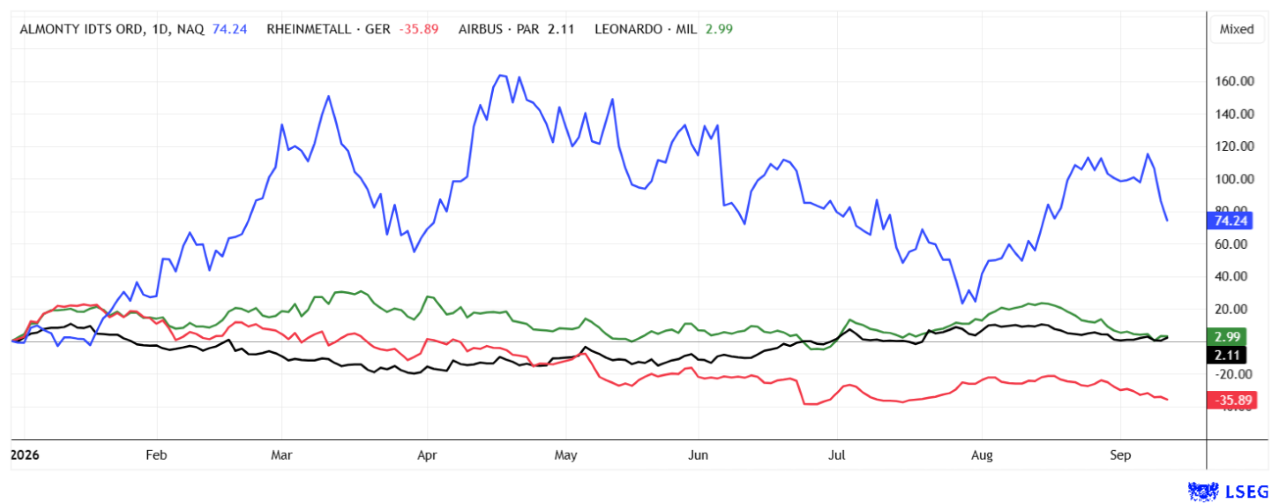
Following the exceptionally strong price gains of recent years, stocks in the defence and strategic metals sectors are currently taking a breather. Price gains of more than 2,000% for Almonty and Rheinmetall since 2022 illustrate the revaluation these sectors have already undergone. At the same time, valuations for companies with sound fundamentals have become more attractive relative to their long-term growth prospects. A balanced investment strategy is advisable given the high volatility!
Conflict of interest
Pursuant to §85 of the German Securities Trading Act (WpHG), we point out that Apaton Finance GmbH as well as partners, authors or employees of Apaton Finance GmbH (hereinafter referred to as “Relevant Persons”) currently hold or hold shares or other financial instruments of the aforementioned companies and speculate on their price developments. In this respect, they intend to sell or acquire shares or other financial instruments of the companies (hereinafter each referred to as a “Transaction”). Transactions may thereby influence the respective price of the shares or other financial instruments of the Company.
In this respect, there is a concrete conflict of interest in the reporting on the companies.
In addition, Apaton Finance GmbH is active in the context of the preparation and publication of the reporting in paid contractual relationships.
For this reason, there is also a concrete conflict of interest.
The above information on existing conflicts of interest applies to all types and forms of publication used by Apaton Finance GmbH for publications on companies.
Risk notice
Apaton Finance GmbH offers editors, agencies and companies the opportunity to publish commentaries, interviews, summaries, news and the like on news.financial. These contents are exclusively for the information of the readers and do not represent any call to action or recommendations, neither explicitly nor implicitly they are to be understood as an assurance of possible price developments. The contents do not replace individual expert investment advice and do not constitute an offer to sell the discussed share(s) or other financial instruments, nor an invitation to buy or sell such.
The content is expressly not a financial analysis, but a journalistic or advertising text. Readers or users who make investment decisions or carry out transactions on the basis of the information provided here do so entirely at their own risk. No contractual relationship is established between Apaton Finance GmbH and its readers or the users of its offers, as our information only refers to the company and not to the investment decision of the reader or user.
The acquisition of financial instruments involves high risks, which can lead to the total loss of the invested capital. The information published by Apaton Finance GmbH and its authors is based on careful research. Nevertheless, no liability is assumed for financial losses or a content-related guarantee for the topicality, correctness, appropriateness and completeness of the content provided here. Please also note our Terms of use.
Stockhouse does not provide investment advice or recommendations. All investment decisions should be made based on your own research and consultation with a registered investment professional. The issuer is solely responsible for the accuracy of the information contained herein. For full disclaimer information, please click here.