

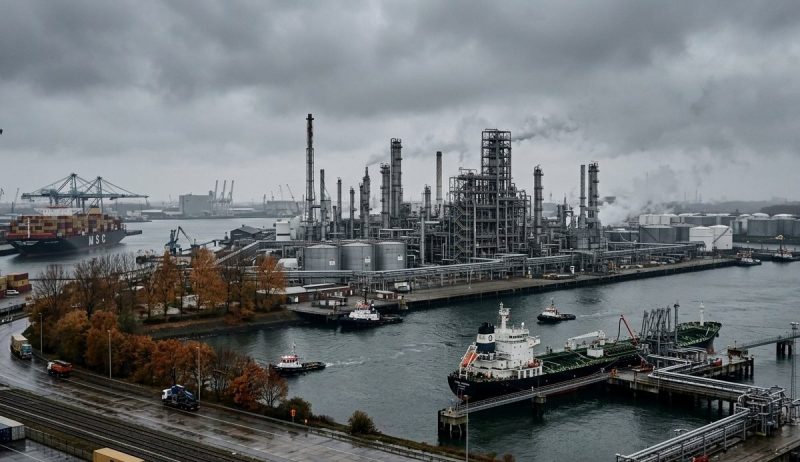
Shell: King of Europe
If you have ever visited the port of Rotterdam, you will have seen it: the Shell Pernis refinery. It is Europe’s largest integrated refinery and chemical complex, covering about 550 hectares—roughly 770 soccer fields. The facility can process more than 400,000 barrels of crude oil per day, equivalent to around 64 million litres. At present, diesel production is receiving particular media attention, as fuel prices have surged.
The refinery is currently generating good revenue for Shell—and, above all, strong margins. But it also highlights Europe’s problems in the energy market. While Pernis is the undisputed number one on the continent, it does not even rank among the top 20 globally. Global mega-refineries are primarily located in Asia, the Middle East, and the US, and operate in a completely different league.
Nevertheless, Shell is a stock worth considering for investors. This year, as a result of the war in the Gulf, the company has benefited not only from higher crude oil and natural gas prices but also from significantly higher refining margins. The facilities in Rotterdam have been operating at full capacity for some time. This is evident from the second-quarter figures. Revenue rose by 45% to USD 94.7 billion, and adjusted profit reached USD 9.8 billion, up 128%. Thanks to strong free cash flow of USD 17.5 billion in Q2 alone, Shell is actively buying back its own shares. Management announced a new USD 3 billion share buyback program. In the second half of the year, Shell could also benefit from its cost-cutting measures.
The stock is currently trading just below its multi-year high. Investors looking to get in should wait for a correction like the one in September and buy in tranches.
Zefiro Methane: Someone Has to Clean Up the Mess
Investors who want to avoid war profiteers or expect the oil market to calm down should take a closer look at Zefiro Methane. The company specializes in cleaning up environmental liabilities. Using its own technology, teams, and equipment, Zefiro professionally plugs orphaned oil and gas wells. The focus is on the North American market, particularly the US. In the US alone, at least two million abandoned wells are estimated to be leaking climate-damaging methane. Zefiro CEO Catherine Flax even estimates the number to be as high as three million wells. There are few competitors in this business, as Flax recently emphasized to investors in Munich.
To see Zefiro Methane’s work and the challenges it is addressing, we recommend watching the documentary: “The Hazard Below.”
https://www.youtube.com/watch?v=3MrjCUk5_QU
Despite the doomsday predictions, environmental damage still needs to be addressed in the United States. The federal government in Washington, D.C., as well as individual states, have taken action and so far allocated more than USD 4.5 billion to companies tasked with properly plugging abandoned oil and gas wells. Zefiro itself, for example, recently reported an USD 11.5 million contract for a project in the Great Lakes region of the northeastern United States.
The potential for further growth in this market is significant, with AI data-centre developers now creating an additional source of demand. These projects, many of which involve investments worth billions of dollars, can face costly delays if environmental and permitting requirements are not addressed in time. Zefiro Methane has already secured contracts in this emerging segment.
Zefiro Methane’s share price has eased somewhat in recent weeks. For long-term investors, the pullback could provide an opportunity to take a closer look at the small-cap stock, which has a market capitalization of approximately EUR 40 million. Research firm GBC remains optimistic about the Canadian company, with a price target of CAD 2.12, more than three times the current share price.
TotalEnergies: The Refinery Brings in the Money
An oil refinery also greets tourists in Normandy. Gonfreville-l’Orcher (near Le Havre) is home to TotalEnergies’ largest refinery, which the company owns outright. It can process up to 250,000 barrels per day and accounts for about one-eighth of France’s refining capacity.
Unlike Shell, Total is always a political issue in France, especially during times of high fuel prices. In recent months, there have been repeated initiatives in French politics, particularly from the Ministry of Finance and the Ministry of the Budget, to impose a windfall tax on TotalEnergies due to its high profits in the refining and energy sectors. The company subsequently threatened to lift the voluntary price cap on fuel at its approximately 3,000 Total gas stations in France.
As an investor in France, one must always take this political landscape into account. In any case, TotalEnergies is currently a true war profiteer. The company increased its revenue in the second quarter by 38.2% to USD 61.77 billion. Bottom line: net income even doubled to USD 5.44 billion. Like its competitor Shell, TotalEnergies is also relying on share buybacks to let shareholders share in its success. Most recently, the ongoing program was extended to at least USD 750 million per quarter.
TotalEnergies’ stock has recently corrected by about 10%. Investors who are not afraid of political risks and expect oil prices to remain high can certainly build positions here.
Investors in Shell and TotalEnergies are positioning themselves for a prolonged period of elevated oil and diesel prices. Zefiro Methane, meanwhile, takes a different approach, focusing on remediating and plugging abandoned oil and gas wells to reduce methane emissions and address environmental liabilities.
Conflict of interest
Pursuant to §85 of the German Securities Trading Act (WpHG), we point out that Apaton Finance GmbH as well as partners, authors or employees of Apaton Finance GmbH (hereinafter referred to as “Relevant Persons”) may hold shares or other financial instruments of the aforementioned companies in the future or may bet on rising or falling prices and thus a conflict of interest may arise in the future. The Relevant Persons reserve the right to buy or sell shares or other financial instruments of the Company at any time (hereinafter each a “Transaction”). Transactions may, under certain circumstances, influence the respective price of the shares or other financial instruments of the Company.
In addition, Apaton Finance GmbH is active in the context of the preparation and publication of the reporting in paid contractual relationships.
For this reason, there is a concrete conflict of interest.
The above information on existing conflicts of interest applies to all types and forms of publication used by Apaton Finance GmbH for publications on companies.
Risk notice
Apaton Finance GmbH offers editors, agencies and companies the opportunity to publish commentaries, interviews, summaries, news and the like on news.financial. These contents are exclusively for the information of the readers and do not represent any call to action or recommendations, neither explicitly nor implicitly they are to be understood as an assurance of possible price developments. The contents do not replace individual expert investment advice and do not constitute an offer to sell the discussed share(s) or other financial instruments, nor an invitation to buy or sell such.
The content is expressly not a financial analysis, but a journalistic or advertising text. Readers or users who make investment decisions or carry out transactions on the basis of the information provided here do so entirely at their own risk. No contractual relationship is established between Apaton Finance GmbH and its readers or the users of its offers, as our information only refers to the company and not to the investment decision of the reader or user.
The acquisition of financial instruments involves high risks, which can lead to the total loss of the invested capital. The information published by Apaton Finance GmbH and its authors is based on careful research. Nevertheless, no liability is assumed for financial losses or a content-related guarantee for the topicality, correctness, appropriateness and completeness of the content provided here. Please also note our Terms of use.
Stockhouse does not provide investment advice or recommendations. All investment decisions should be made based on your own research and consultation with a registered investment professional. The issuer is solely responsible for the accuracy of the information contained herein. For full disclaimer information, please click here.