


Bank of America Warns Against the Flight to Short-Term Securities
The US debt spiral is accelerating. With total debt exceeding 120% of GDP, the Treasury Department in Washington is heading toward a dilemma. To reduce the Treasury’s direct interest expenses, it has shifted its issuances toward short-term securities. By 2025, short-term Treasury bills already accounted for about 84% of gross new government debt issuance. While this drastic step temporarily pushes down yields on 10-year government bonds by about 25 basis points, it carries a risk of debt restructuring. In this context, Michael Hartnett of Bank of America points to the driving factors of debt, budget deficits, and currency devaluation, which are fueling a powerful commodity cycle. As bond markets demand increasingly higher risk premiums for the growing debt burden, US financing costs could rise structurally—an environment that favours tangible assets such as gold.
Warnings Also from JPMorgan: When Inflation Becomes the Norm
Hopes for a swift return to lasting price stability are increasingly proving to be an illusion. Jamie Dimon of JPMorgan issues an unequivocal warning about persistent inflation driven by global rearmament, supply chain disruptions, and unchecked government spending sprees. JPMorgan’s commodities analysts had projected the gold price to reach up to USD 6,300 per troy ounce by the end of 2026. Following an adjustment this summer, the current Q4 target is USD 4,500, while USD 6,300 is now the target for 2027. Central banks around the world are already pulling the plug. They are removing US debt securities from their balance sheets and instead building up their gold reserves. As a result, the precious metal has displaced the Euro as the second-most important global currency reserve. Since global mine production is growing by a meagre 1.0 to 1.5% per year, rising demand is meeting with a rigid supply. If the major players in the capital market shift just a fraction of their trillion-dollar bond holdings into gold, the precious metal will inevitably gain momentum.
One Million Ounces: Desert Gold in Mali Enters an Exciting Phase
The Canadian company Desert Gold controls the 440 km² SMSZ project in western Mali, which stretches 43 km along a geologically promising shear zone. In the immediate vicinity are producing mines such as Barrick Mining’s Loulo-Gounkoto complex and B2Gold’s Fekola deposit. In accordance with NI 43-101, Desert Gold reports a measured and indicated resource of 8.47 million metric tons of ore grading 1.14 g/t Au, equivalent to 310,300 ounces of gold. In addition, there are inferred resources of 20.7 million metric tons at 1.16 g/t Au, corresponding to a further 769,200 ounces. Across all project zones, Desert Gold thus has a verified total resource of more than 1.08 million ounces of gold. An updated preliminary economic assessment (PEA) for the Barani and Gourbassi deposits underscores the project’s profitability. Based on a calculated gold price of USD 2,850 per ounce, the after-tax net present value is USD 61 million, with an internal rate of return of a robust 57%. The plan calls for producing approximately 113,100 ounces of saleable metal and doubling monthly ore processing from 18,000 to 36,000 metric tons.

Strong Shareholder Base and M&A Potential
In addition to operational expansion as an independent gold producer, the SMSZ property is also likely to be attractive to gold producers. The region’s large smelting and processing facilities require a continuous supply of fresh ore to operate profitably at full capacity. According to a 2024 study by the research firm GBC AG, historical corporate transactions in western Mali were valued at an average of USD 66 per ounce of gold in the ground, while Desert Gold was trading on the stock market at just around USD 9 per ounce at the time of the survey.
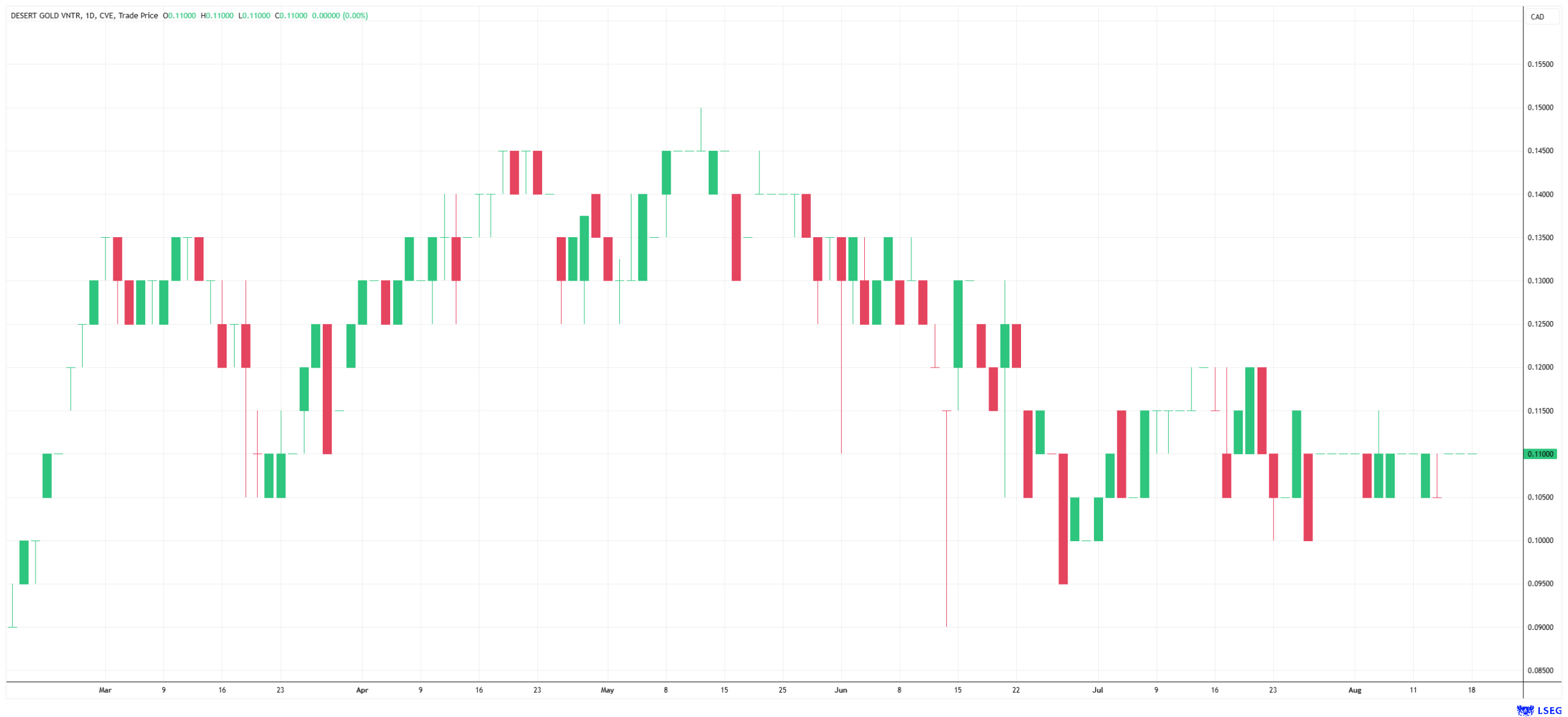
Desert Gold’s stock has been trading sideways with high volatility for months. Most recently, delays surrounding the company’s plans for its own production are likely to have weighed on the share. However, given the disruptions in international supply chains, investors should not overinterpret the lack of completion announcements. Furthermore, the practical application of Mali’s 2023 Mining Code shows that while the government is pushing for greater domestic value creation, agreements with companies such as Barrick Mining, B2Gold, or Robex are certainly possible. With a market capitalization of approximately CAD 40 million, Desert Gold’s stock is an attractive small-cap option for hedging against crises such as rising inflation or further disruptions in the financial system.

Conflict of interest
Pursuant to §85 of the German Securities Trading Act (WpHG), we point out that Apaton Finance GmbH as well as partners, authors or employees of Apaton Finance GmbH (hereinafter referred to as “Relevant Persons”) currently hold or hold shares or other financial instruments of the aforementioned companies and speculate on their price developments. In this respect, they intend to sell or acquire shares or other financial instruments of the companies (hereinafter each referred to as a “Transaction”). Transactions may thereby influence the respective price of the shares or other financial instruments of the Company.
In this respect, there is a concrete conflict of interest in the reporting on the companies.
In addition, Apaton Finance GmbH is active in the context of the preparation and publication of the reporting in paid contractual relationships.
For this reason, there is also a concrete conflict of interest.
The above information on existing conflicts of interest applies to all types and forms of publication used by Apaton Finance GmbH for publications on companies.
Risk notice
Apaton Finance GmbH offers editors, agencies and companies the opportunity to publish commentaries, interviews, summaries, news and the like on news.financial. These contents are exclusively for the information of the readers and do not represent any call to action or recommendations, neither explicitly nor implicitly they are to be understood as an assurance of possible price developments. The contents do not replace individual expert investment advice and do not constitute an offer to sell the discussed share(s) or other financial instruments, nor an invitation to buy or sell such.
The content is expressly not a financial analysis, but a journalistic or advertising text. Readers or users who make investment decisions or carry out transactions on the basis of the information provided here do so entirely at their own risk. No contractual relationship is established between Apaton Finance GmbH and its readers or the users of its offers, as our information only refers to the company and not to the investment decision of the reader or user.
The acquisition of financial instruments involves high risks, which can lead to the total loss of the invested capital. The information published by Apaton Finance GmbH and its authors is based on careful research. Nevertheless, no liability is assumed for financial losses or a content-related guarantee for the topicality, correctness, appropriateness and completeness of the content provided here. Please also note our Terms of use.
Stockhouse does not provide investment advice or recommendations. All investment decisions should be made based on your own research and consultation with a registered investment professional. The issuer is solely responsible for the accuracy of the information contained herein. For full disclaimer information, please click here.