

Barrick Mining: Between the Government and the Workforce
At the Loulo-Gounkoto complex in Mali, Barrick Mining is currently navigating a challenging environment. In 2024, the complex produced 723,000 ounces of gold. Operations were suspended in January 2025, followed by an agreement with the government in November 2025. Since then, production has resumed. In the first half of 2026, approximately 190,000 ounces (on a 100% basis) were produced—faster than planned, according to Barrick. The road to this point was costly. During the dispute, Mali had at times demanded up to USD 5.5 billion and seized gold worth approximately USD 245 million. The conflict ultimately ended with a payment of about USD 430 million. Most recently, the unions have spoken out. According to Reuters, the workforces of the operating companies Somilo and Gounkoto announced strikes for late September 2026. Employees of the catering and services provider Food & Events Africa also filed a strike notice. At the heart of a list of 15 demands were overtime pay, reimbursement of business travel expenses, and the implementation of existing collective bargaining agreements. According to the union, the parties reached an agreement on a new collective bargaining agreement on September 21, and the planned strikes were called off. Cost pressures remain high, however: Barrick’s company-wide All-In Sustaining Costs stood at USD 1,866 per ounce in the second quarter.
B2Gold: Cooperative Approaches for Greater Predictability
B2Gold is taking a pragmatic approach to collaboration. As early as September 2024, the company reached an agreement with the government on a framework for the Fekola complex, which includes, among other things, a mechanism for refunding outstanding value-added tax credits. On August 7, 2026, the official mining permit for Menankoto was granted. Together with the Dandoko license, Menankoto forms the Fekola Regional project, which falls under the 2023 Mining Code. The Malian government receives a 35% stake in this project, while the main Fekola mine, operating under the 2012 Code, retains the previous 80/20 split. With this concession, B2Gold secures planning certainty. Fekola Regional is scheduled to ramp up by the end of 2027 and contribute more than 150,000 ounces annually to the Fekola complex’s production starting in 2028. At the same time, the company is directing capital toward projects such as Otjikoto in Namibia and Goose in Canada to broaden its portfolio.
Desert Gold: Agility as the Driving Force on the Senegal-Mali Shear Zone
Far from the negotiating tables of major corporations, Desert Gold is advancing its lean business model. The company controls a 440 km² area along a 43 km stretch of the geologically promising Senegal-Mali Shear Zone. The mines operated by B2Gold, Barrick and Allied Gold are also located on the same geological structure. Instead of investing directly in a capital-intensive cyanide leaching plant, the management team led by CEO Jared Scharf is starting with a smaller initial development phase. On September 16, the company reported that a gravity separation plant capable of processing 200 metric tons of ore per day, as well as a 650-kVA generator, had arrived at the Barani site. The plant uses purely physical separation based on specific gravity to extract the gold from the heavily weathered oxide ore and is scheduled to begin operations by the end of October 2026. In the run-up to this, the team had to overcome delays in ocean freight via Dakar and regional fuel shortages. Added to this were heavy rains during the rainy season, which hampered civil engineering work.

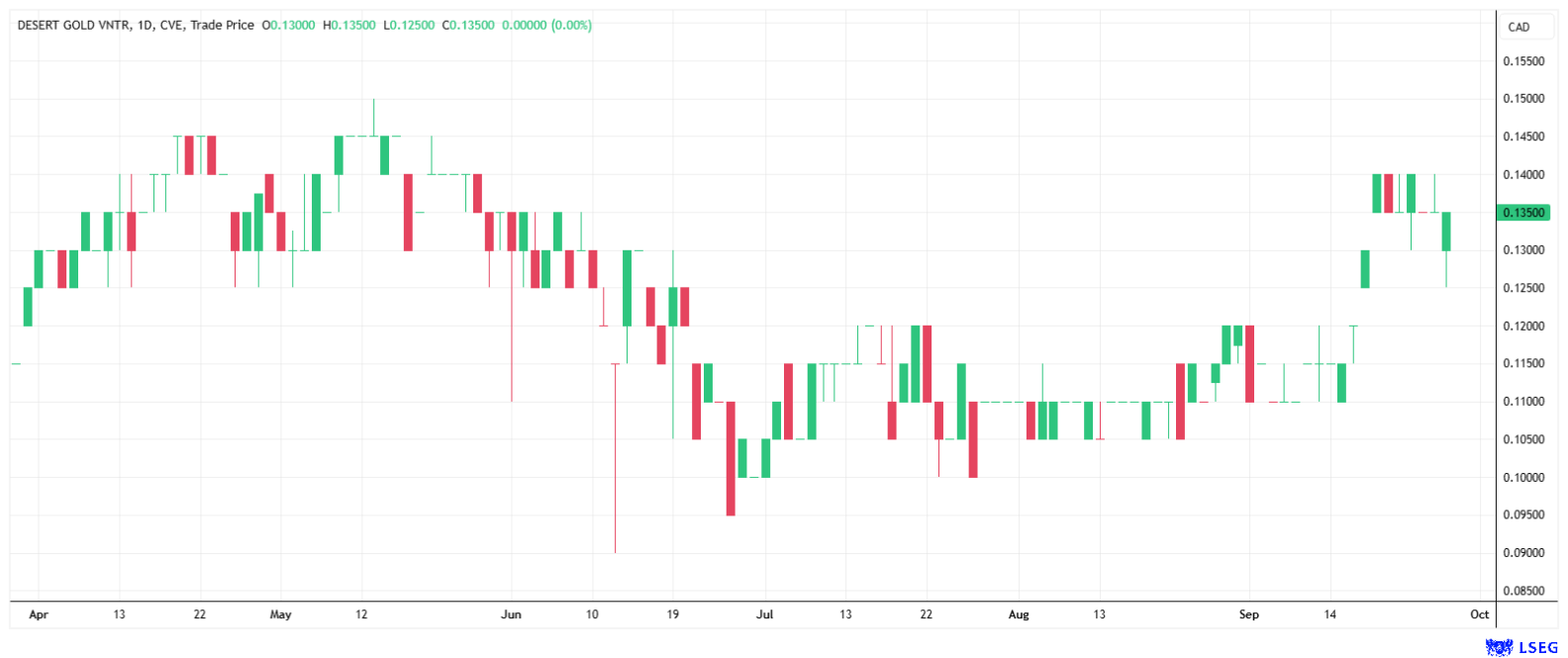
The start date, originally targeted for July, was therefore adjusted. According to the current schedule, ramp-up and initial processing will follow in November. The first gold is expected to be produced in the fourth quarter of 2026, subject to successful construction, commissioning, and ramp-up. The updated preliminary economic assessment (PEA) from November 2025 describes the eventual full-scale expansion: a modular gravity and CIL plant with a monthly throughput of 36,000 metric tons and an initial investment of USD 20.4 million. In the base case at USD 2,850 per ounce, the net present value (NPV, 10%, after taxes) is USD 61 million, the internal rate of return (IRR) is 57%, and the payback period is 2.5 years. At USD 4,070 per ounce, the PEA indicates an NPV of USD 124 million, an IRR of 101%, and a payback period of 2.1 years. Since the spot price is currently above USD 4,000, these figures should prompt even Mali skeptics to take a closer look at Desert Gold.


Desert Gold: Diversification and Interest from Asia
The investment in Barani marks only the beginning of a broader development. On the SMSZ project, Desert Gold’s geologists have now identified more than 25 gold zones. The 2022 resource estimate reports proven and indicated mineral resources of 310,300 ounces at a grade of 1.14 g/t, as well as inferred mineral resources of 769,200 ounces at 1.16 g/t. A financing round completed in February totaling approximately CAD 7.2 million provided the capital for the first phase of development. Desert Gold’s market capitalization most recently stood at approximately CAD 47 million. The company continues to diversify its portfolio: approximately USD 535,000 has been budgeted for the Phase 1 exploration program at the Tiegba Gold project in Côte d’Ivoire. Meanwhile, the West African region remains attractive to well-capitalized Asian players. Although Zijin Gold’s planned acquisition of Allied Gold fell through, in August, the Zijin Mining subsidiary Zijin Gold subscribed to new shares for approximately USD 295 million as part of a private placement and has since held a stake of approximately 9.2% in Allied Gold.
Desert Gold’s PEA projects all-in sustaining costs of USD 1,137 per ounce at full-scale production. At the current gold price, this would result in a margin of approximately USD 3,000 per ounce. If the transition from the first gravity stage to the planned full-scale operation is successful, these revenues could help finance further exploration of the large property and limit dilution from new capital raises. Desert Gold is currently in an exciting phase.

Conflict of interest
Pursuant to §85 of the German Securities Trading Act (WpHG), we point out that Apaton Finance GmbH as well as partners, authors or employees of Apaton Finance GmbH (hereinafter referred to as “Relevant Persons”) currently hold or hold shares or other financial instruments of the aforementioned companies and speculate on their price developments. In this respect, they intend to sell or acquire shares or other financial instruments of the companies (hereinafter each referred to as a “Transaction”). Transactions may thereby influence the respective price of the shares or other financial instruments of the Company.
In this respect, there is a concrete conflict of interest in the reporting on the companies.
In addition, Apaton Finance GmbH is active in the context of the preparation and publication of the reporting in paid contractual relationships.
For this reason, there is also a concrete conflict of interest.
The above information on existing conflicts of interest applies to all types and forms of publication used by Apaton Finance GmbH for publications on companies.
Risk notice
Apaton Finance GmbH offers editors, agencies and companies the opportunity to publish commentaries, interviews, summaries, news and the like on news.financial. These contents are exclusively for the information of the readers and do not represent any call to action or recommendations, neither explicitly nor implicitly they are to be understood as an assurance of possible price developments. The contents do not replace individual expert investment advice and do not constitute an offer to sell the discussed share(s) or other financial instruments, nor an invitation to buy or sell such.
The content is expressly not a financial analysis, but a journalistic or advertising text. Readers or users who make investment decisions or carry out transactions on the basis of the information provided here do so entirely at their own risk. No contractual relationship is established between Apaton Finance GmbH and its readers or the users of its offers, as our information only refers to the company and not to the investment decision of the reader or user.
The acquisition of financial instruments involves high risks, which can lead to the total loss of the invested capital. The information published by Apaton Finance GmbH and its authors is based on careful research. Nevertheless, no liability is assumed for financial losses or a content-related guarantee for the topicality, correctness, appropriateness and completeness of the content provided here. Please also note our Terms of use.
Stockhouse does not provide investment advice or recommendations. All investment decisions should be made based on your own research and consultation with a registered investment professional. The issuer is solely responsible for the accuracy of the information contained herein. For full disclaimer information, please click here.