

Salzgitter: Without high-purity pellets, the new furnace will be costly
In Lower Saxony, the conversion is in full swing. As part of the SALCOS programme, Salzgitter is building a direct reduction plant with an electric arc furnace, which is due to start up in late summer 2027. To produce the planned 2.1 million tonnes of sponge iron a year, the group theoretically needs around 2.9 to 3.0 million tonnes of high-purity DR-grade pellets. Because lower-grade ore produces more slag in the electric arc furnace and more iron is lost, it increases the cost of hot-rolled coil production by around EUR 41/t at an iron content of 65% rather than 67.5%, according to Fastmarkets. This remains a major strain on the balance sheet. Salzgitter did increase revenue to EUR 7.33 billion and EBITDA VX to EUR 659.1 million in the first nine months of 2026. However, EUR 252 million of this alone came from its stake in copper smelter Aurubis. At the same time, capital expenditure will rise to EUR 800 million to EUR 1.0 billion in 2027 – despite government funding commitments of EUR 1.322 billion.
thyssenkrupp: Two years later, but more flexible on ore
In Duisburg, thyssenkrupp is taking a different technical approach. In the major tkH2Steel project, which the federal and state governments are supporting with up to EUR 2.0 billion, the group is installing two electric smelters upstream of its existing converters. This has an advantage: the plant can, in principle, also handle cheaper blast furnace pellets. However, according to metallurgical studies, high-purity DR pellets reduce oxygen consumption by almost 20% even there, and there is as yet no commercial reference plant anywhere in the world for smelters of this size. November 2026 showed how heavily the dual burden of conversion and crisis weighs: thyssenkrupp postponed the start of tkH2Steel by two years to 2029 and intends to operate the plant initially with natural gas. After sale talks with Jindal Steel International were put on ice in May 2026, management is now restructuring the steel division on its own. By 2030, around 11,000 jobs will be cut or outsourced, and the group as a whole continues to expect a loss of up to EUR 800 million for the 2025/26 financial year.
Strategic Resources: Pellet plant directly at the deep-water port
While German steelmakers struggle with costs running into billions and a lack of hydrogen, a shortfall in suitable ore is emerging. Less than 5% of the global iron ore supply is pure enough for direct reduction plants. BloombergNEF analysts expect a deficit of 15 million tonnes a year by 2030, which could climb to 133 million tonnes by 2040. S&P Global expects a shortfall of 70 to 85 million tonnes in 2035. This is where Strategic Resources comes in with a planned pellet plant at the deep-water port of Port Saguenay in Québec. In the first development phase, the company will not operate its own mine, but instead intends to produce 4.0 million tonnes of DR-grade pellets annually from purchased ore concentrate – initially avoiding the high costs and risks of building a mine. The cost estimate for the pelletising plant comes from Finnish plant manufacturer Metso.
The strongest argument for the location is the existing port infrastructure, which is navigable year-round and kept open by the Canadian Coast Guard with icebreakers in winter. The federal and provincial governments are investing over CAD 235 million in the port site, including CAD 111.2 million for a roughly 2 km long, hydropower-driven pipe conveyor supplied by Germany’s BEUMER Group. It will connect the deep-water quay directly to the plant site. Added to this is the European carbon border adjustment mechanism CBAM, which has also applied to iron ore pellets, including indirect electricity emissions, since January 2026. With cheap hydroelectricity from Québec and a direct natural gas connection, the location should have an advantage here over plants fired by coal or oil.
Prominent financial backers and long-term contracts
Management secured procurement and sales arrangements early on. Strategic Resources concluded 10-year exclusive agency agreements with Javelin Global Commodities covering both the procurement of 4 million tonnes of concentrate and the sale of the finished pellets. The package is complemented by a non-binding term sheet for a credit facility of up to USD 150 million and a testing and cooperation agreement with Tacora Resources.
Only much later are its own BlackRock mine for vanadium, titanium and high-purity pig iron, which already has environmental approval and a 39-year mine life, and a direct reduction plant for sponge iron, which is also approved, due to follow. The portfolio also includes the mothballed Mustavaara mine in Finland. The ownership structure provides backing: state-owned Investissement Québec and Orion Mine Finance each hold 40.66% of the shares and together control 81.3% of the company. Investors should, however, look closely: Strategic Resources had to formally withdraw the financial forecasts from an early preliminary study dated March 2024 in July 2024 under pressure from Québec’s financial regulator. A bankable feasibility study is still being prepared.

Conclusion: Good Location, but Cash Reserves Remain Limited
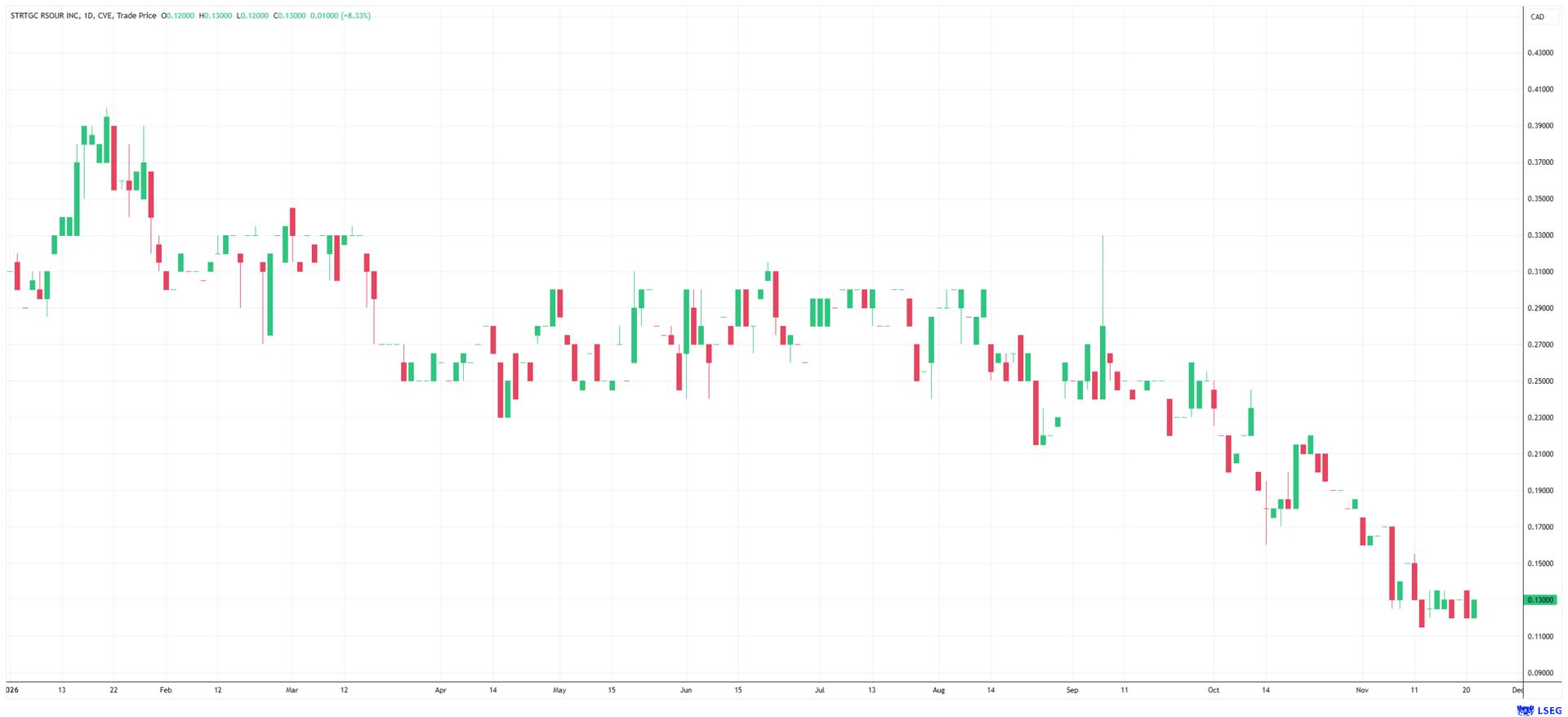
The logic behind the model is compelling. While Salzgitter and thyssenkrupp, as capital-intensive heavyweights, shoulder the costly transformation, Strategic Resources has secured a prime location for a scarce intermediate product. On the stock market, however, this has so far played hardly any role. With a market capitalisation of just CAD 7.1 to 7.7 million, the stock is a nano-cap. Before construction can begin at Port Saguenay, management needs the outstanding environmental approval to expand capacity from 1.5 to 4.0 million tonnes annually. In addition, based on the early cost estimate of USD 470 million, it would have to raise around USD 170 million through equity or partners – even if Société Générale, which has been mandated, secures the targeted USD 300 million in debt financing. In addition, market premiums for DR pellets fell to USD 42/t in the first quarter of 2026 due to economic conditions. Strategic Resources shares are therefore speculative at this time.

Conflict of interest
Pursuant to §85 of the German Securities Trading Act (WpHG), we point out that Apaton Finance GmbH as well as partners, authors or employees of Apaton Finance GmbH (hereinafter referred to as “Relevant Persons”) may hold shares or other financial instruments of the aforementioned companies in the future or may bet on rising or falling prices and thus a conflict of interest may arise in the future. The Relevant Persons reserve the right to buy or sell shares or other financial instruments of the Company at any time (hereinafter each a “Transaction”). Transactions may, under certain circumstances, influence the respective price of the shares or other financial instruments of the Company.
In addition, Apaton Finance GmbH is active in the context of the preparation and publication of the reporting in paid contractual relationships.
For this reason, there is a concrete conflict of interest.
The above information on existing conflicts of interest applies to all types and forms of publication used by Apaton Finance GmbH for publications on companies.
Risk notice
Apaton Finance GmbH offers editors, agencies and companies the opportunity to publish commentaries, interviews, summaries, news and the like on news.financial. These contents are exclusively for the information of the readers and do not represent any call to action or recommendations, neither explicitly nor implicitly they are to be understood as an assurance of possible price developments. The contents do not replace individual expert investment advice and do not constitute an offer to sell the discussed share(s) or other financial instruments, nor an invitation to buy or sell such.
The content is expressly not a financial analysis, but a journalistic or advertising text. Readers or users who make investment decisions or carry out transactions on the basis of the information provided here do so entirely at their own risk. No contractual relationship is established between Apaton Finance GmbH and its readers or the users of its offers, as our information only refers to the company and not to the investment decision of the reader or user.
The acquisition of financial instruments involves high risks, which can lead to the total loss of the invested capital. The information published by Apaton Finance GmbH and its authors is based on careful research. Nevertheless, no liability is assumed for financial losses or a content-related guarantee for the topicality, correctness, appropriateness and completeness of the content provided here. Please also note our Terms of use.
Stockhouse does not provide investment advice or recommendations. All investment decisions should be made based on your own research and consultation with a registered investment professional. The issuer is solely responsible for the accuracy of the information contained herein. For full disclaimer information, please click here.