


Deutsche Bank: “Old sins” meet solid profits
On the Frankfurt trading floor, a palpable tug-of-war between nervousness and cool calculation surrounds Deutsche Bank. The latest unease was triggered by reports based on 15 million leaked documents, which brought past failings and questions about controls back to the table. Investors initially reacted by selling reflexively, as uncertainty rarely goes down well on the stock market. At the same time, trading around the EUR 29 to EUR 30 level and the closely watched 200-day SMA showed how sensitively the share price reacts to headlines, even though some analysts, such as DZ Bank, maintained their positive rating.
Operationally, however, the bank stands on a much more stable footing than the heated headlines sometimes suggest. In the third quarter of 2026, Deutsche Bank generated revenue of approximately EUR 8.3 billion and earnings per share of EUR 0.94, compared with EUR 0.91 in the same period last year. In the second quarter, quarterly profit stood at EUR 1.9 billion. Regarding the leaked documents and the “old sins”, Group CEO Christian Sewing points to massive investments of EUR 7 billion in compliance and money laundering prevention, as well as an expansion of the department to 3,000 employees. The bank also emphasises that, according to findings to date, customer accounts, account balances or login details were not compromised and that past matters had already been investigated.
Nevertheless, the situation remains tense regarding valuation and the outlook. For the full year 2026, market observers anticipate earnings per share of around EUR 3.31 and an expected dividend of EUR 1.16, up from EUR 1.00 the previous year, while the analyst consensus puts the average price target at around EUR 37. On the one hand, operational progress and the prospect of rising distributions are enticing; on the other, legal, regulatory and reputational risks remain a constant companion. Investors buying in here need strong nerves if old files are perhaps reopened at some point.
After a look at Frankfurt’s banking world and Germany’s leading bank, the focus shifts to Leverkusen. There, it is less about bank balance sheets and data leaks and more about medicines, farming and how much advance praise may already be priced in.
Bayer: The strong rally is followed by a reality check
Over the past twelve-plus months, Bayer has staged a remarkable recovery, with its share price climbing at times to around EUR 57. However, after several weeks of strong gains, investors are increasingly taking a breather as the stock comes under closer scrutiny following its steep rise. The question is whether the share price has already run too far and whether much of the positive news may already be priced in. Recent tailwinds have included US approval of Sunharbo (Asundexian) for stroke prevention, as well as progress in the glyphosate litigation, including a favourable US Supreme Court ruling in June and a unanimous jury verdict in October.
The figures for the third quarter of 2026 show how unevenly the Group is currently performing. Group revenue climbed 4.1% to EUR 10.05 billion, while adjusted EBITDA rose 6.9% to around EUR 1.62 billion, and the full-year forecast was raised to EUR 9.8 to 10.3 billion. The pharmaceuticals business was particularly strong, with revenue growth of 8.0% and a 23.6% jump in adjusted EBITDA, while Crop Science showed marked weakness with a 41.3% decline in EBITDA. On the bottom line, impairments on Xofigo and Claritin weighed on earnings, while net legal payments of EUR 1.12 billion weighed on free cash flow, which came in at minus EUR 293 million for the quarter.
In terms of valuation and dividends, the current picture calls for a sober assessment. For the current year, a forward P/E ratio in a broad range of around 10 to approximately 25 is being discussed, depending on the source and calculation basis. The latest dividend offers only a rather weak yield, and net financial debt stood at EUR 31.1 billion at the end of September. Analysts such as Kepler Cheuvreux, with a price target of EUR 69, or Berenberg, with EUR 62, see further potential, but others, such as Jefferies, remain considerably more cautious, with a target of EUR 48.50. The prospect of final court approval for the settlement of up to USD 7.25 billion and further growth in pharmaceuticals is thus set against the risk of further delays and high debt.
It is a challenging situation for Bayer shares at present. One must also expect possible share price setbacks, but then also recognise these as an opportunity to buy in.
From Bayer, we now head across the Atlantic to the Nevada desert. There, Lahontan Gold awaits as a considerably smaller stock, where recent news and a recent sharp share price decline are creating a very particular special situation.
Lahontan Gold: A Pullback Could Set the Stage for a Rebound
A look at Lahontan Gold’s chart reveals a rollercoaster ride for investors. Just one to two months ago, the shares were trading around CAD 0.40 before falling by around 50% to approximately CAD 0.19 amid a weaker market environment for commodities and gold. Yet the project’s fundamental prospects have barely changed in recent weeks, offering little justification for such a steep decline. This suggests that the sell-off may largely reflect temporary market sentiment and headwinds from the gold price slump. On the downside, however, a broad support zone between CAD 0.17 and CAD 0.20 should provide support, while on the upside, the CAD 0.25 to CAD 0.26 level would first need to be reclaimed to give the rebound real momentum.
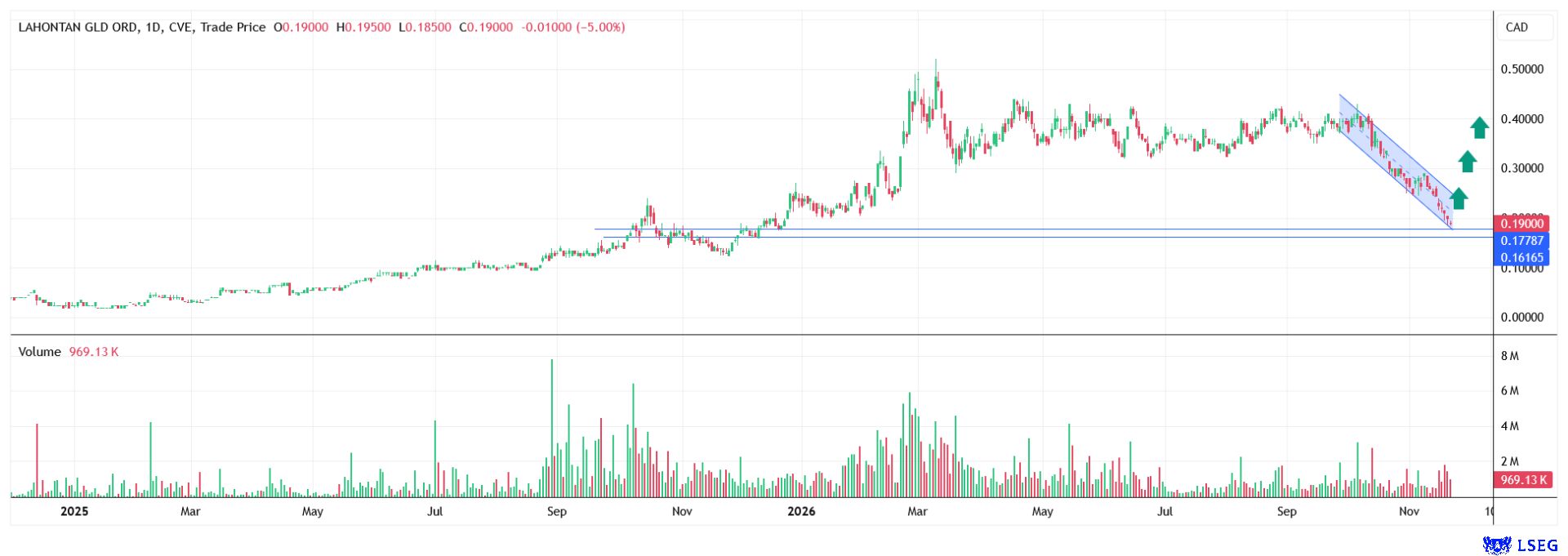
In terms of developments, Lahontan Gold has announced several important pieces of news in recent weeks. The three latest announcements focused on the updated preliminary economic assessment (PEA) for its flagship Santa Fe project in Nevada, extensive drill programmes totalling more than 13,000 m in 2026 at Santa Fe and West Santa Fe, and planned drilling on the historic Santa Fe East WRSF waste dump containing around 9.0 million tonnes of rock.
The aim is to recover additional, low-cost ounces of gold and silver from material previously considered waste rock and from historic stockpiles, and to advance toward construction and production starting in 2027. The October 2026 PEA outlines average annual production of around 91,900 ounces of gold equivalent (and 112,500 ounces in years 4 to 11) over 11 years of active mining plus 1 year of residual leaching, at estimated cash costs of USD 1,909 per ounce and all-in sustaining costs (AISC) of USD 2,250 per ounce.
The range of PEA metrics and valuations is also striking, which is why investors should take a closer look. Based on the PEA base-case prices of USD 3,600 per ounce of gold and USD 49.00 per ounce of silver, the study calculates an after-tax net present value (NPV5) of around USD 820.0 million, an internal rate of return (IRR) of 40.1%, initial capital expenditure of USD 172.0 million including contingency, and a payback period of around 3.7 years. Naturally, no dividend is paid at this stage of development.
As mentioned above, a successful breakout above CAD 0.25 to CAD 0.26 would be important, as the share price could then initially move towards CAD 0.30 and, if the recovery continues, even head back towards CAD 0.40, offering considerable catch-up potential from the current position.
Conclusion
Although Deutsche Bank is reporting solid profits and expanding its controls, it remains vulnerable to share price setbacks due to past events and the latest data leak. Following a strong recovery and progress in pharmaceuticals, Bayer’s share price may already reflect high expectations, but it still needs to deliver on cash flow, Crop Science and the glyphosate settlement. Following the sharp share price slide into the support zone between CAD 0.17 and CAD 0.20, and with a solid PEA outlook, Lahontan Gold offers fairly good prospects of a rebound above CAD 0.25 to CAD 0.26 and thus remains a promising resources stock.
Conflict of interest
Pursuant to §85 of the German Securities Trading Act (WpHG), we point out that Apaton Finance GmbH as well as partners, authors or employees of Apaton Finance GmbH (hereinafter referred to as “Relevant Persons”) may hold shares or other financial instruments of the aforementioned companies in the future or may bet on rising or falling prices and thus a conflict of interest may arise in the future. The Relevant Persons reserve the right to buy or sell shares or other financial instruments of the Company at any time (hereinafter each a “Transaction”). Transactions may, under certain circumstances, influence the respective price of the shares or other financial instruments of the Company.
In addition, Apaton Finance GmbH is active in the context of the preparation and publication of the reporting in paid contractual relationships.
For this reason, there is a concrete conflict of interest.
The above information on existing conflicts of interest applies to all types and forms of publication used by Apaton Finance GmbH for publications on companies.
Risk notice
Apaton Finance GmbH offers editors, agencies and companies the opportunity to publish commentaries, interviews, summaries, news and the like on news.financial. These contents are exclusively for the information of the readers and do not represent any call to action or recommendations, neither explicitly nor implicitly they are to be understood as an assurance of possible price developments. The contents do not replace individual expert investment advice and do not constitute an offer to sell the discussed share(s) or other financial instruments, nor an invitation to buy or sell such.
The content is expressly not a financial analysis, but a journalistic or advertising text. Readers or users who make investment decisions or carry out transactions on the basis of the information provided here do so entirely at their own risk. No contractual relationship is established between Apaton Finance GmbH and its readers or the users of its offers, as our information only refers to the company and not to the investment decision of the reader or user.
The acquisition of financial instruments involves high risks, which can lead to the total loss of the invested capital. The information published by Apaton Finance GmbH and its authors is based on careful research. Nevertheless, no liability is assumed for financial losses or a content-related guarantee for the topicality, correctness, appropriateness and completeness of the content provided here. Please also note our Terms of use.
Stockhouse does not provide investment advice or recommendations. All investment decisions should be made based on your own research and consultation with a registered investment professional. The issuer is solely responsible for the accuracy of the information contained herein. For full disclaimer information, please click here.