


A.H.T. Syngas: Are analyst estimates too conservative?
A.H.T. Syngas Technology has catch-up potential among the beneficiaries of skyrocketing energy prices. The company has developed a technology to produce a synthetic natural gas substitute from waste for the generation of electricity and heat. This provides structural tailwinds. Rising energy prices and geopolitical uncertainties are massively driving demand for self-sufficient, decentralized energy solutions.
In a recent interview with analysts from GBC Research, CEO Gero Ferges reported a “real rush” for A.H.T.’s technology since the war in Iran and the resulting sharp rise in oil and natural gas prices.
A key growth driver is international expansion, led by the partnership with INNOTEC in Poland. There, A.H.T. is currently developing 17 projects, several of which are already nearing the implementation phase. Poland boasts a robust agricultural infrastructure as well as extensive forest areas, making it an ideal location for synthesis gas projects. The revenue potential is substantial. Orders totaling up to EUR 10 million could be placed before the end of this year, and over EUR 25 million is possible by 2029. At the same time, activities in Germany, Austria, and the Benelux countries are also progressing. In addition, the company offers a scalable container solution for hydrogen. This has been demonstrated through the BiDroGen project.
With a project volume of over EUR 30 million, optimized processes, and a clear growth strategy, the company sees itself as excellently positioned to begin commercialization. Given current developments, are the forecasts by A.H.T. analysts perhaps even too conservative? So far, analysts expect A.H.T. to generate revenue of EUR 9.24 million in 2026. Next year, this figure is projected to reach nearly EUR 19 million, and over EUR 23 million in 2028. Following a balanced operating result in the current year, EBITDA is projected to reach EUR 1.62 million in 2027 and rise to EUR 2.13 million in 2028. Consequently, analysts recommend buying A.H.T. shares with a price target of EUR 8.50 Link to the GBC study. The stock is currently trading at around EUR 3.
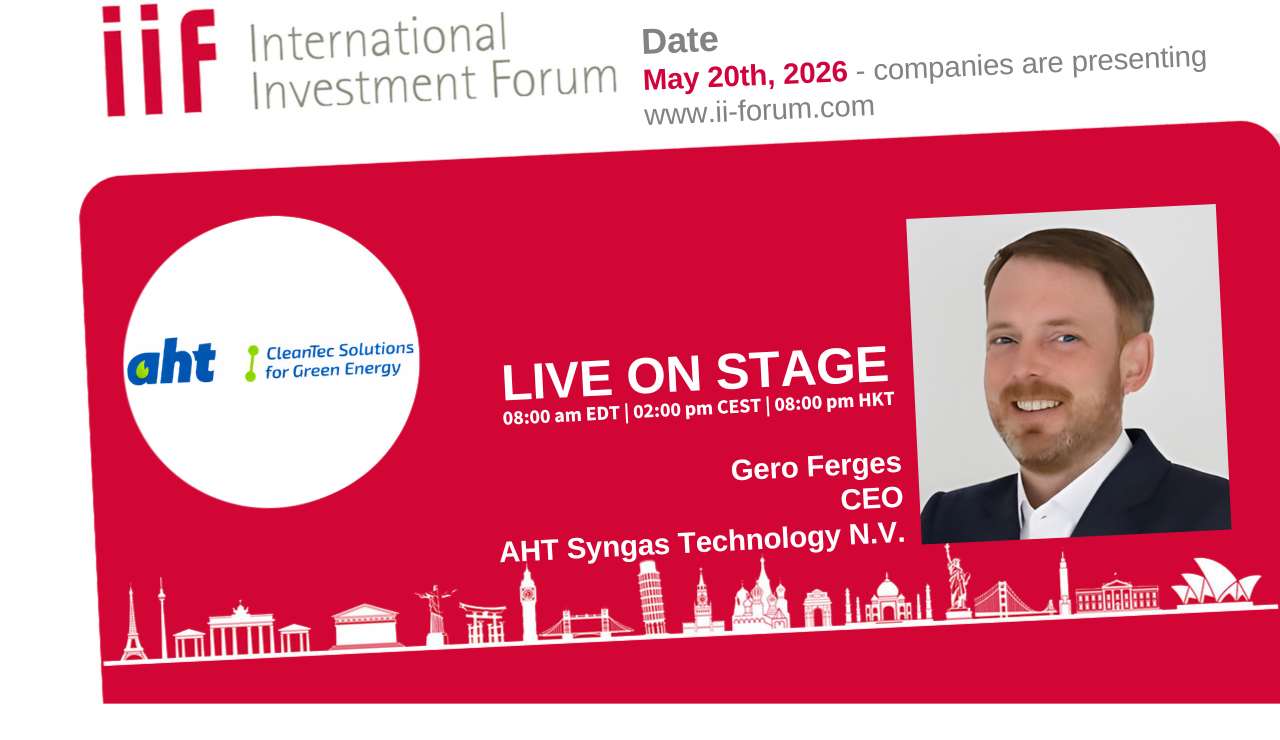
Save the date: A.H.T. Syngas CEO, Gero Ferges, will present at the International Investment Forum on May 20, 2026. Attendance is free for investors.

Rheinmetall: Partnerships in Drones and Missiles
Rheinmetall has not been a favorite among investors for quite some time. This may be because drones and missiles dominate coverage of the wars in Iran and Ukraine. The Düsseldorf-based company is better known for its heavy military equipment. Yet reports are mounting that Germany’s largest defense contractor is changing this. Most recently, the establishment of the joint venture “Rheinmetall Destinus Strike Systems” with the Dutch defense firm Destinus was announced. The goal is to develop, produce, and market modern missile systems such as cruise missiles and ballistic missile artillery to meet the growing demand for scalable and cost-effective defense solutions.
Destinus already develops and manufactures cruise missile systems and turbojet engines. Rheinmetall brings its long-standing experience in the development and production of complex defense systems, an industrial presence in Germany, and extensive ongoing investments in independent, scalable defense production. Together, the partners aim to establish industrial capacities for series production and qualification in Germany, thereby meeting European sovereignty goals as well as NATO requirements.
Rheinmetall had previously announced a partnership with Boeing. Together with Boeing Defence Australia, Germany’s largest defense contractor aims to position the MQ-28 “Ghost Bat” autonomous drone as a solution for the Bundeswehr’s planned procurement of a Collaborative Combat Aircraft (CCA) by 2029. The platform, which has already been tested in over 150 flights, functions as a so-called “force multiplier” and can be deployed alongside manned combat aircraft. Thanks to its modular architecture and autonomous capabilities, it covers a broad spectrum of missions—from reconnaissance and electronic warfare to the integration of weapon systems.
As part of the cooperation, Rheinmetall will assume the role of system integrator in Germany and be responsible for integration into existing Bundeswehr systems as well as operations, maintenance, and logistics. At the same time, an industrial hub is to be established in Germany that will strengthen national value creation and open up revenue potential in the hundreds of millions. The partnership also provides for close German-Australian cooperation in the further development of the platform, including a joint digital development environment.
TUI: Analysts Are Confident, But Caution Is Advised!
TUI is considered a loser in the wake of international conflicts and high energy prices. While it still looked in early February as though the stock could break the EUR 10 mark and thus hit a new multi-year high, it plummeted to below EUR 7 in the following weeks.
Barclays considers the price drop to be excessive. Although analysts have reduced their estimates for the entire sector due to higher kerosene costs and potential capacity cuts, the “Buy” recommendation for the tourism group’s stock was confirmed. The price target for TUI stock was slightly reduced from EUR 11 to EUR 10.50.
Analysts at mwb research see the fair value of TUI shares at EUR 16. Although estimates for the current year have been reduced, the impact of the war on the 2026 fiscal year is likely to remain limited. Furthermore, TUI’s financial resilience and adaptability could lead to gains in market share. The conflict in the Middle East is leading to temporary hesitation in summer travel bookings, particularly for destinations such as Turkey and Egypt. However, some of this could be offset by higher demand for Western Europe. Analysts also point to ongoing disruptions in the cruise division. Mein Schiff 4 and 5 are reportedly stranded in the Arabian Gulf, and key Mediterranean cruises will not resume until mid-May.
A.H.T. is a beneficiary of surging energy prices. The CEO’s comments sound extremely promising. Could the analysts’ forecasts even be exceeded? Rheinmetall and the entire German defense industry are not currently in the spotlight among investors, and buying the stock is not a pressing priority. The same applies to TUI. Its business model is currently heavily dependent on external factors.
Conflict of interest
Pursuant to §85 of the German Securities Trading Act (WpHG), we point out that Apaton Finance GmbH as well as partners, authors or employees of Apaton Finance GmbH (hereinafter referred to as “Relevant Persons”) may hold shares or other financial instruments of the aforementioned companies in the future or may bet on rising or falling prices and thus a conflict of interest may arise in the future. The Relevant Persons reserve the right to buy or sell shares or other financial instruments of the Company at any time (hereinafter each a “Transaction”). Transactions may, under certain circumstances, influence the respective price of the shares or other financial instruments of the Company.
In addition, Apaton Finance GmbH is active in the context of the preparation and publication of the reporting in paid contractual relationships.
For this reason, there is a concrete conflict of interest.
The above information on existing conflicts of interest applies to all types and forms of publication used by Apaton Finance GmbH for publications on companies.
Risk notice
Apaton Finance GmbH offers editors, agencies and companies the opportunity to publish commentaries, interviews, summaries, news and the like on news.financial. These contents are exclusively for the information of the readers and do not represent any call to action or recommendations, neither explicitly nor implicitly they are to be understood as an assurance of possible price developments. The contents do not replace individual expert investment advice and do not constitute an offer to sell the discussed share(s) or other financial instruments, nor an invitation to buy or sell such.
The content is expressly not a financial analysis, but a journalistic or advertising text. Readers or users who make investment decisions or carry out transactions on the basis of the information provided here do so entirely at their own risk. No contractual relationship is established between Apaton Finance GmbH and its readers or the users of its offers, as our information only refers to the company and not to the investment decision of the reader or user.
The acquisition of financial instruments involves high risks, which can lead to the total loss of the invested capital. The information published by Apaton Finance GmbH and its authors is based on careful research. Nevertheless, no liability is assumed for financial losses or a content-related guarantee for the topicality, correctness, appropriateness and completeness of the content provided here. Please also note our Terms of use.
Stockhouse does not provide investment advice or recommendations. All investment decisions should be made based on your own research and consultation with a registered investment professional. The issuer is solely responsible for the accuracy of the information contained herein. For full disclaimer information, please click here.