
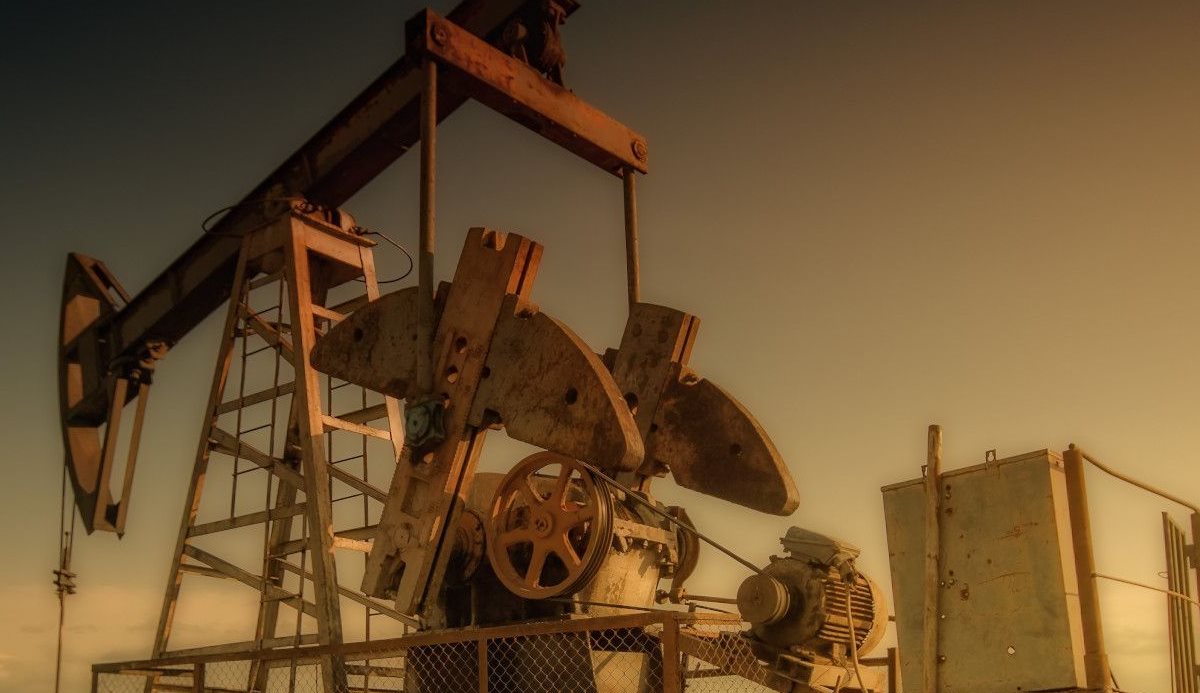

A bill running into billions
According to the company, US states have documented more than 129,000 orphaned wells, with an estimated 210,000 to 746,000 more not yet recorded. The company puts the cost of addressing the entire inventory of inactive wells at USD 500 billion, based on an estimated USD 100,000 to 150,000 per well. The federal government has allocated USD 4.7 billion through the Infrastructure Investment and Jobs Act (IIJA)—a drop in the ocean.
Of the USD 1.93 billion in grants distributed so far, according to the number of wells, USD 778 million is going to Zefiro’s five core states, namely Pennsylvania, Ohio, West Virginia, Kentucky and New York. According to the company, a further USD 4 billion or so can also be drawn down by 2031. This plays into the hands of a provider that already has equipment on the ground there.
An order book extending through 2029
On October 19, Zefiro reported an order backlog of around USD 40 million from state-funded projects, extending through June 2029. The largest item is a USD 19.6 million contract with the Ohio Department of Natural Resources (ODNR) for around 200 wells by May 2029. Added to this is USD 11.5 million from the Great Lakes region, running from November 2026 through June 2029.
Of the total, around USD 4.9 million is to be worked through in the quarter ending December 31, with the remaining USD 34.6 million mainly in 2027 and 2028. There is also an exploration contract from the ODNR in south-eastern Ohio. Orders from corporate customers are not included in the figure.
According to its own figures, Zefiro has so far won around 25% of the plugging contracts initiated by the Infrastructure Act in its core areas. It says it is the sole bidder in many tenders, and the only fully integrated provider in New York State. A sole bidder has no competitor breathing down its neck.
More rigs, more customers
In May, Zefiro acquired equipment from Viking Well Service for USD 4.3 million. This added five rigs and operating capabilities in five further states, from which the company expects around USD 10 million in additional annual revenue. On October 27, it reported that the equipment had already generated around USD 1.54 million in revenue in August and September, equivalent to over USD 9 million on an annualised basis. That is a solid start.
According to its October presentation, Zefiro has 147 field employees, 25 rigs and operating capabilities in 15 states. On October 27, three new framework agreements were added, two with listed resource companies. This brings the total to seven new framework agreements since the acquisition, five of which have already generated revenue.
There is also demand even without funding. According to the company, developers of power plants and data centres cannot build on sites with abandoned wells until these have been plugged. Who pays for that? The owner, who does not follow the budget cycle. According to CEO Catherine Flax, Zefiro plugged wells at a liquefied natural gas export facility in Louisiana so that a billion-dollar project could be built. This provides an additional tailwind.
A potential second pillar
On September 22, Zefiro launched operations in Indiana and Michigan. In Indiana, Zefiro is working on a CO₂ storage well for the first time, an eight-week project generating around USD 750,000 in revenue. In Michigan, an emergency operation at a single well that was leaking hydrogen sulphide is bringing in around USD 500,000. According to the company, this is well above the usual revenue per well.
The business also includes measuring methane before and after plugging. According to the company, this work generates roughly twice the margin of plugging. According to CEO Catherine Flax, West Virginia has commissioned Zefiro to measure methane leaks at all orphaned wells in the state.
On November 2, Zefiro reported that it had provided financial and technical support for the draft of Isometric’s protocol for orphaned wells. Isometric presented the draft on October 15, and the public consultation runs through November 14. The first-ever sale under the American Carbon Registry methodology has already been completed by Zefiro, according to the company. Mercuria Energy America and EDF Trading were named as the buyers. If the protocol is finalised, it could open the door to further credits.
Data centre operators with ambitious climate targets and liquefied natural gas exporters were seeking methane credits, CEO Catherine Flax said in an interview at the International Investment Forum (IIF). In her view, credits could in the future account for 10 to 15% of the business. If the protocol is introduced, this could develop into another pillar alongside plugging and methane measurements.
A turnaround year
On September 28, Zefiro presented its figures for the financial year ending June 30. Revenue rose to USD 42.5 million, from USD 32.4 million in the previous year. Gross profit climbed from USD 7.5 million to USD 12.4 million, and the gross margin rose from 23.0% to 29.2%. Adjusted EBITDA swung from minus USD 4.0 million to plus USD 3.8 million. The breakthrough has come in adjusted EBITDA.
For the current financial year, CEO Catherine Flax pointed to around USD 10 million in additional revenue from the new equipment. With equipment and personnel at full capacity, she said close to USD 70 million would likely be possible. By 2028, the CEO is targeting around USD 100 million in revenue through organic growth and acquisitions.
What the analysts say
On October 28, GBC AG confirmed its Buy rating for Zefiro and set a price target of USD 1.42 by June 30, 2027. The analysts point to the order backlog of around USD 40 million, which covers state-funded projects through to June 2029. The analysts see this as providing significantly better revenue visibility over several financial years.
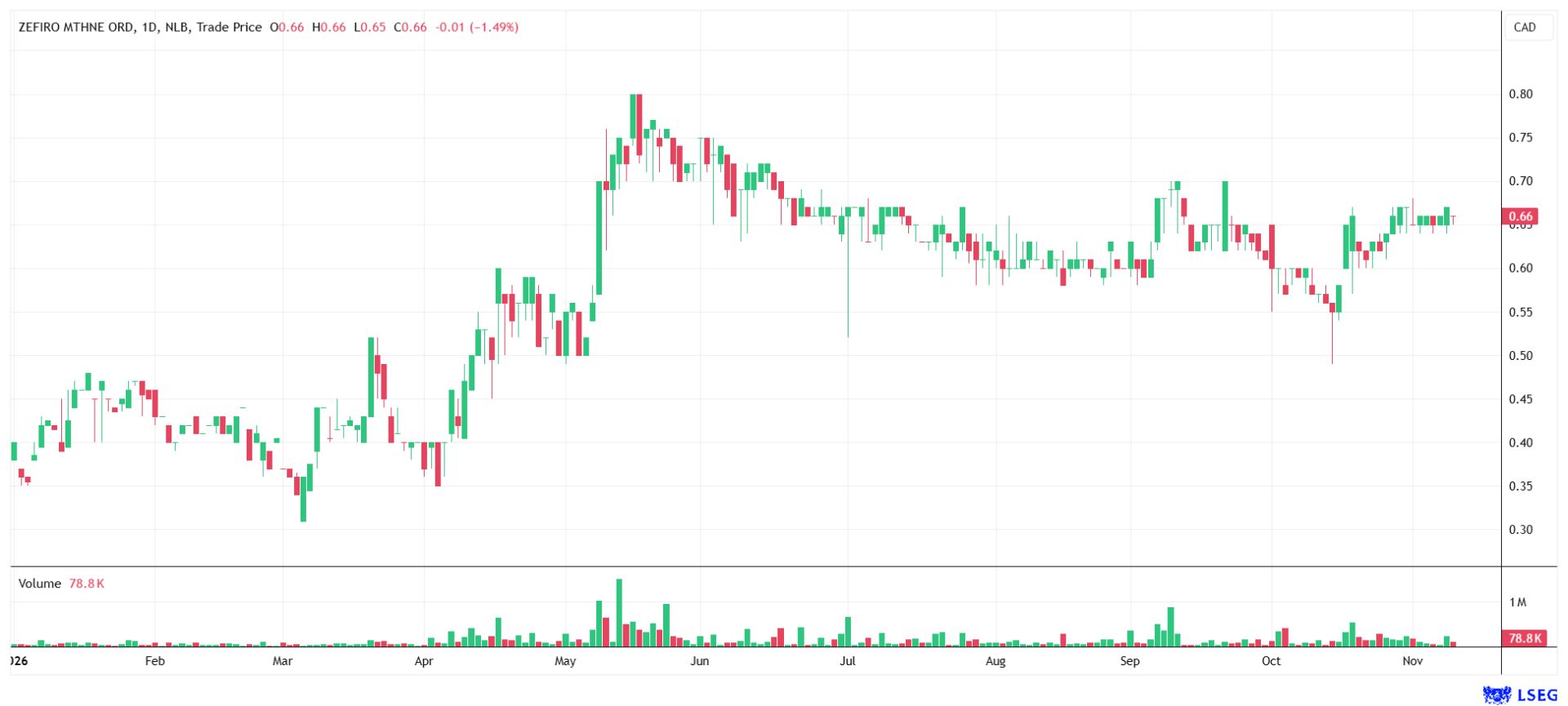
The next steps are concluding the consultation on Isometric’s protocol and working through around USD 4.9 million in the quarter ending December 31. If the new drilling rigs can be fully utilised, revenue in the 2027 financial year could be significantly above the previous year’s USD 42.5 million. The share is currently trading at CAD 0.66.
Conclusion
Zefiro Methane has seen adjusted EBITDA turn around. It stands at a positive USD 3.8 million, the order backlog through to 2029 amounts to around USD 40 million, and with 25 drilling rigs and operational capability in 15 states, the capacity is there. Methane credits and CO₂ storage could become a second mainstay. Investors betting on cleaning up America’s legacy liabilities will find a specialist here with decades of experience. The direction is right.
Conflict of interest
Pursuant to §85 of the German Securities Trading Act (WpHG), we point out that Apaton Finance GmbH as well as partners, authors or employees of Apaton Finance GmbH (hereinafter referred to as “Relevant Persons”) currently hold or hold shares or other financial instruments of the aforementioned companies and speculate on their price developments. In this respect, they intend to sell or acquire shares or other financial instruments of the companies (hereinafter each referred to as a “Transaction”). Transactions may thereby influence the respective price of the shares or other financial instruments of the Company.
In this respect, there is a concrete conflict of interest in the reporting on the companies.
In addition, Apaton Finance GmbH is active in the context of the preparation and publication of the reporting in paid contractual relationships.
For this reason, there is also a concrete conflict of interest.
The above information on existing conflicts of interest applies to all types and forms of publication used by Apaton Finance GmbH for publications on companies.
Risk notice
Apaton Finance GmbH offers editors, agencies and companies the opportunity to publish commentaries, interviews, summaries, news and the like on news.financial. These contents are exclusively for the information of the readers and do not represent any call to action or recommendations, neither explicitly nor implicitly they are to be understood as an assurance of possible price developments. The contents do not replace individual expert investment advice and do not constitute an offer to sell the discussed share(s) or other financial instruments, nor an invitation to buy or sell such.
The content is expressly not a financial analysis, but a journalistic or advertising text. Readers or users who make investment decisions or carry out transactions on the basis of the information provided here do so entirely at their own risk. No contractual relationship is established between Apaton Finance GmbH and its readers or the users of its offers, as our information only refers to the company and not to the investment decision of the reader or user.
The acquisition of financial instruments involves high risks, which can lead to the total loss of the invested capital. The information published by Apaton Finance GmbH and its authors is based on careful research. Nevertheless, no liability is assumed for financial losses or a content-related guarantee for the topicality, correctness, appropriateness and completeness of the content provided here. Please also note our Terms of use.
Stockhouse does not provide investment advice or recommendations. All investment decisions should be made based on your own research and consultation with a registered investment professional. The issuer is solely responsible for the accuracy of the information contained herein. For full disclaimer information, please click here.