
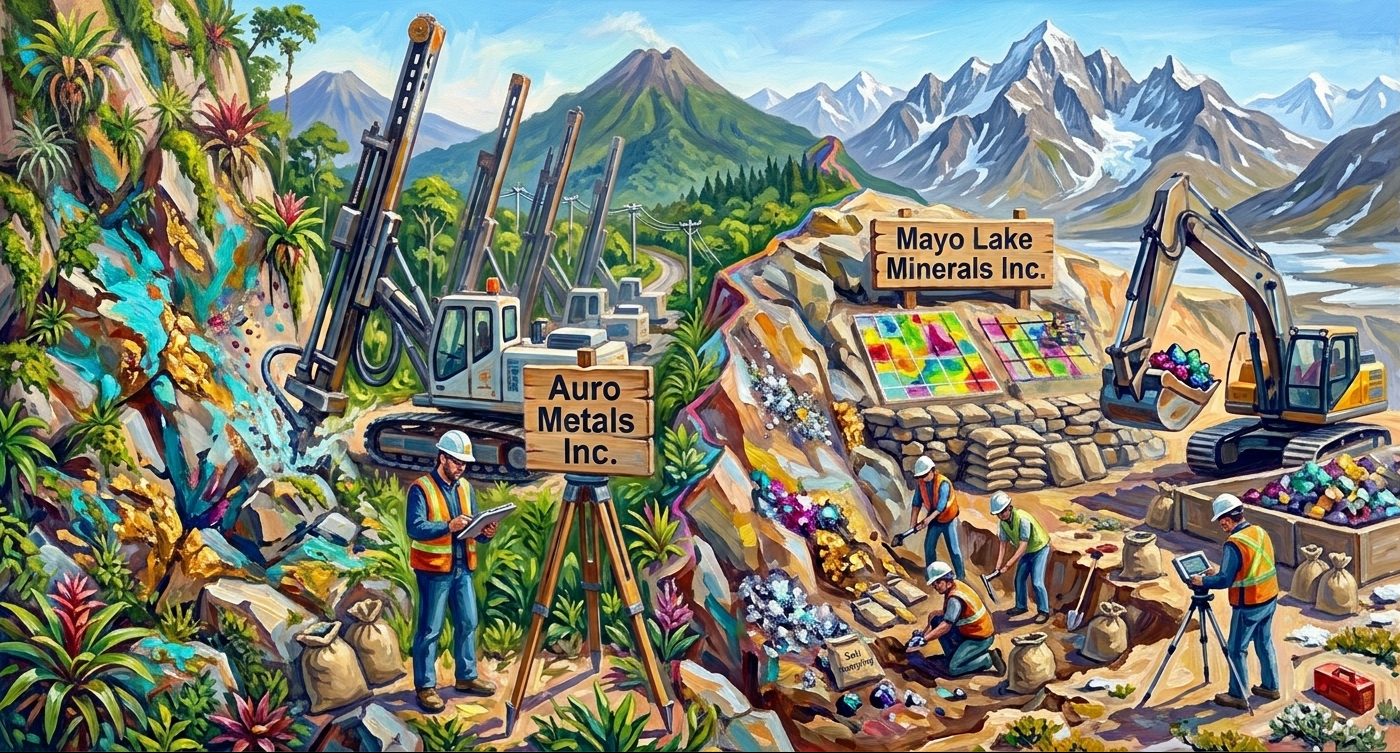

The thrill of investing in junior mining stocks is that the asset class if so small, including about 2,500 companies, about half of which sport a market cap of less than US$10 million, according to Resource Capital Funds, that investors will often fail to notice attractive opportunities, even if they’re staring them right in the face.
This article is disseminated in partnership with junior mining stocks Auro Metals Inc. and Mayo Lake Minerals Inc. It is intended to inform investors and should not be taken as a recommendation or financial advice.
The reasons why are not surprising. A junior mining company often has no revenue to speak of, forcing it to tap the capital markets and dilute shareholders whenever it needs to replenish its coffers. Decumulating value is obviously antithetical to anyone looking to fill an empty spot in their portfolio.
Then there’s the exploration work this capital will fund: rock and soil sampling, geochemical analysis, magnetic surveys, and the interpretation of the overall data set in the hopes of uncovering a glimpse of what could become an economical mineral system. To call it complex to execute is an understatement and it’s even harder for a non-expert, i.e. you and me, to determine a given land package’s potential without a geology degree.
The probability of a junior mining investment working out well then heavily relies on management, which must apply industry experience, ideally including successful discoveries, towards uncovering a new one with the potential to create shareholder value that ultimately ends up in your pocket. I don’t know how good of a judge of character you consider yourself to be, but PR quotes and a 100-word bio on a company website isn’t much for even the shrewdest investor to work with.
Even so, the tall proposition of all these factors aligning, potentially yielding one of the less than 100 mineral deposits discovered every year, is what keeps investors in the game, because they know that only one or two of these outcomes can carry a whole portfolio’s returns.
This brings us to junior mining stocks Auro Metals and Mayo Lake Minerals, the subjects of the latest edition of Stockhouse’s Weekly Market Movers, whose underlying companies make strong cases for sturdy ships on their journeys across the mining lifecycle.
Auro Metals
Auro Metals, market cap C$189.27 million, is advancing its 100%-owned, 55.3-square-kilometre Santa Barbara gold and copper project in southeastern Ecuador, which it purchased from Silvercorp Metals in May 2026. The porphyry system, located on the Zamora copper and gold belt, is estimated to host 697,000 ounces of gold and 68 million pounds of copper in indicated resources, plus 3,418,000 ounces of gold and 426 million pounds of copper inferred.
The company recently published the final five drillholes from its phase-1 2026 drilling program, focused on what leaderships believes to be the core of the mineralized system, yielding highlights of:
- 322.46 metres (m) grading 0.56 grams per ton (g/t) gold and 0.10% copper from 10.54 m to 333 m.
- 572.47 m grading 0.60 g/t gold and 0.10% copper from 72.53 m to 645 m.
A 20,000-m phase-2 program is now underway with four drill rigs designed to increase step-out exploration while filling in the gaps within known mineralized zones. The first four drillholes totaling 3,104 m are now complete with assays pending.
Auro intends to demonstrate that Santa Barbara’s location among well-mineralized neighbors, including Silvercorp’s Condor Project 10 km away and Lundin Gold’s Fruta del Norte Mine 36 km away, isn’t mere coincidence, but an indication of deposit scale and development potential.
To this end, the company is backed by a C$17.5 million capital raise closed in March, readily accessible roads, power, labour and infrastructure, and a leadership team that has founded, explored for and allocated capital on behalf of successful companies across the mining lifecycle, including New Pacific Metals, Silvercorp Metals and Omai Gold Mines.
Auro Metals stock (TSXV:AURO) last traded at C$1.38, adding only 25.45% since the company changed its name and commodity focus from tin to copper and gold in June 2026, leaving plenty of room between its market cap and almost US$20 billion in estimated resources in the ground.
Mayo Lake Minerals
Our second junior mining stock cultivating substantial upside potential is Mayo Lake Minerals, market cap C$4.71 million, whose three projects, spanning a collective 145.6 sq. km, reside within the Mayo-Keno Area of Yukon’s Keno Hill Silver District and Tombstone Gold Belt (see slide 4 of the November 2026 investor deck), two of the province’s most prolific sites for mineral exploration and development.
The 86-sq.-km Anderson-Davidson Property hosts the 48-sq.-km Anderson Gold Trend, whose more than 10,000 m of related gold-in-soil anomalies suggest the presence of underground gold mineralization.
The 44-sq.-km Carlin-Roop Property bears geological and geochemical traits of Keno Hill-style high-grade silver mineralization. This is most notable in the Carlin West Zone, whose geology leadership considers comparable to the historic Elsa Mine, a former flagship asset of United Keno Hill Mines, which ranked among the largest silver producers in the world.
The 15-sq.-km Edmonton Property, for its part, features a broad magnetic low suggesting an alteration halo above a buried intrusion. The main exploration target on the land package includes anomalous gold, silver and base metals, plus positive spatiotemporal geochemical hydrocarbon responses, offering the company numerous avenues for sampling and drilling.
Mayo Lake plans to delineate drill targets within six highly prospective zones at Anderson-Davidson throughout the remainder of 2026. To this end, the company will reprocess geochemical soil results and generate a 3D magnetic inversion model to highlight buried igneous intrusions, with eyes on a spring-summer 2027 drilling program to pursue mineral continuity and scale. The company will also conduct trenching at Carlin-Roop, as well as modelling work at Carlin-Roop and Edmonton, as dictated by property geology.
Mayo Lake intends to fund its exploration work with a C$700,000 capital raise, the first tranche of which recently closed for C$231,574, with the second slated to close on November 27th.
The leadership team in charge of deploying these funds brings extensive global exploration, management and institutional investing experience to the table, including Vern Rampton, President and Chief Executive Officer since Mayo Lake’s inception in 2011, who led Kinbauri Gold since inception in 1984 to a 10x takeover in 2009.
Rampton sat down with Ricki Lee to discuss how the company is going about refining targets in anticipation of 2027 drilling. Watch the interview here.
Mayo Lake Minerals stock (CSE:MLKM) last traded at C$0.035 and has given back 12.50% year-over-year.
Thanks for reading! I’ll see you next Monday for a new edition of Weekly Market Movers, where I delve into companies that joined Stockhouse for an interview over the past week. Here’s the most recent article, 2 cash-flowing mining stocks shielded from going to zero, in case you missed it.
Join the discussion: Find out what investors are saying about these junior mining stocks on the Auro Metals Inc. and Mayo Lake Minerals Inc. Bullboards and explore the rest of Stockhouse’s stock forums and message boards.


