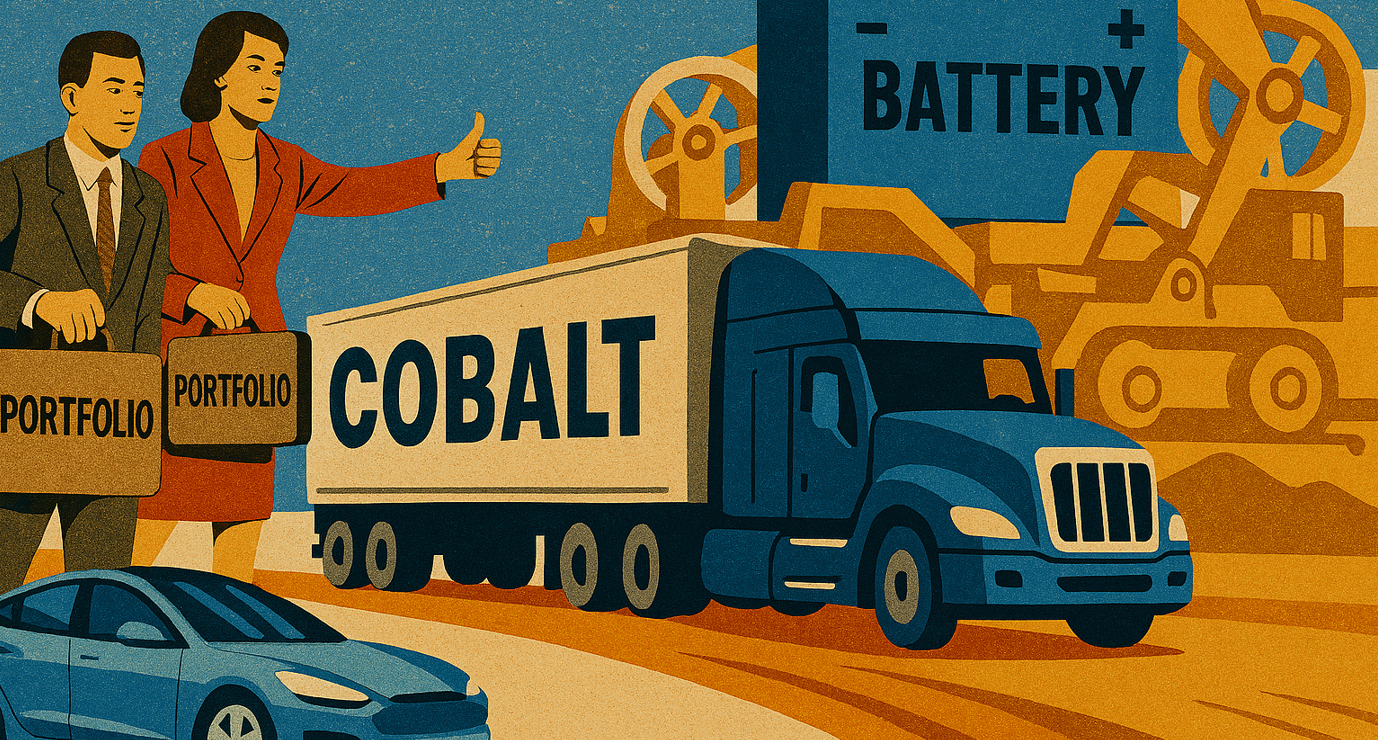

While record gold and silver prices are garnering most of the headlines as of late, a number of commodities have posted their own standout run-ups, succeeding in the shadows of these precious metals.
Cobalt, chief among them, has managed a more than 160 per cent year-over-year return, coming in at more than US$56,000 per ton – just ahead of silver and more than double gold’s effort over the period – meriting a closer look at the critical metal’s prospects for Canadian investors.
What is cobalt?
Cobalt is a grayish metal, predominantly mined as a copper and nickel by-product, that excels as a cathode, which, alongside anodes, facilitate the flow of electricity in and out of batteries and the devices they power.
Electric vehicles currently account for the majority of cobalt use, according to data from Natural Resources Canada, but laptops and cellphones are gaining ground, leveraging the metal’s high energy density. These use-cases are followed by magnets, cutting tools and advanced alloys in the aerospace, energy and defense industries, which are more interested in cobalt’s extreme hardness and heat resistance.
Going back to ancient times, however, cobalt fulfilled a far more ornamental purpose, serving as a key ingredient in blue pigments for paint destined for glass, pottery and anything else apt to be enlivened by a little color.
How should investors frame cobalt’s long-term value proposition?
All things considered, cobalt commanded a US$17 billion market in 2024 that is expected to surpass US$25 billion by 2030, leveraging the rapidly accelerating energy transition. The International Energy Agency forecasts clean technology demand for the critical metal to grow more than sevenfold from 2021 to 2040, resulting in a deficit throughout the 2030s.
Cobalt’s short supply is further at risk given its concentrated availability in only a few countries, including:
- The Democratic Republic of Congo, the world’s largest producer of mined cobalt at a more than 75-per-cent share, where export quotas will be in effect until at least 2027. The Congo also hosts the majority of cobalt reserves, coming in at an estimated 11.4 million tons, representing more than 50 per cent of what the planet has to offer, placing the industry’s human right abuses into stark relief.
- Indonesia, the world’s second-largest producer at a nearly 10 per cent share, driven by the growth of the company’s nickel industry, despite a long history of systemic corruption and discriminatory violence keeping the country from reaching its full potential.
- Russia, at about a 3 per cent share, essentially removing this output from consideration for Western allies.
On the refining side, China is the clear leader at more than 70 per cent of capacity – fed by a significant percentage of raw Congolese metal – which it puts towards its world-leading battery manufacturing industry, granting the communist country outsized control over the cobalt supply chain.
Under these tense circumstances, it’s no surprise that cobalt is one of the most expensive battery metals, incentivizing companies across the mining lifecycle to advance high-quality assets in safe, free-market jurisdictions, convert tonnage into cash flow and assuage soaring demand.
Canada’s small but mighty cobalt opportunity
Though Canada only represented 1.9 per cent of cobalt reserves in 2024, placing it seventh in the world at an estimated 220,000 tons, again according to Natural Resources Canada, this is equivalent to more than US$12.3 billion in the ground at the US$56,000 price, with both numbers likely to swell should an expected deficit rear its head.
That said, to capitalize on this addressable market, Canadian producers will need to step up their game, vying to improve upon:
- Only 3,351 tons mined in 2024 – good for 7th in the world but only 15 per cent of Congolose output – amounting to a mere US$187 million in revenue at the current price per ton.
- Another 5,920 tons of refined cobalt generated in 2024 from only three refineries, good for 3rd in the world but more than 25 times less than Chinese output, demonstrating how dislocated from Western interests the cobalt market has become.
Luckily for investors, a handful of mining companies are advancing projects with the potential to push Canadian cobalt further onto center stage, leveraging the country’s numerous green flags for long-term partnerships, including its strong currency, mining-friendly government, transparent rule of law and strategic location near the US and major Asian markets.
Battery Mineral Resources
First up, we have Battery Mineral Resources, market capitalization C$58.49 million, a mineral explorer and developer that owns one of the largest land packages in Ontario’s historic Cobalt district, which hosted more than 70 mines that produced 525 million ounces of silver and 50 million pounds of cobalt from 1904-1985.
The vast land package, recently monetized through the sale of the company’s Gowganda claims, is highlighted by the McAra project, where resources are estimated at 1.1 million pounds of cobalt equivalent indicated and 216,000 pounds inferred.
The company complement its cobalt exposure with the past-producing Punitaqui Mining Complex in Chile, which is prospective for copper, gold and silver, as well as ESI Energy Services, a profitable equipment rental business for the energy and renewables sectors.
Battery Mineral Resources stock (TSXV:BMR) last traded at C$0.17 and has added 70 per cent year-over-year.
Fortune Minerals
Another micro-cap stock notable for its cobalt exposure is Fortune Minerals, market capitalization C$68.23 million, whose feasibility-stage NICO deposit in the Northwest Territories is expected to deliver robust polymetallic production over its first 14 years in operation. Here’s a breakdown:
- ~1,800 tons per year (t/y) of cobalt in 8,780 t/yr of cobalt sulphate from a more than 82 million pound deposit.
- ~1,700 t/yr of bismuth from a deposit estimated at 12 per cent of global reserves.
- ~47,000 troy ounces of gold per year, exploiting a 1.1 million ounce deposit.
- ~300 t/yr of copper from a more than 27 million pound deposit.
NICO will benefit from a planned cobalt sulphate processing facility in Alberta, where recent testing validated the ability to produce battery-grade materials, improving the chances of a positive final investment decision when it’s announced later this year.
Should the green light be given, Fortune would be on track for initial production at the vertically integrated project in 2028.
Fortune Minerals stock (TSX:FT) last traded at C$0.12 and has added 130 per cent year-over-year.
Electra Battery Materials
Our third name making a compelling case to cobalt investors is Electra Battery Materials, market capitalization C$115.22 million, a lithium battery technology company building North America’s first battery-grade cobalt sulfate refinery in Ontario. The key input for EV batteries traded around the US$12,000 per ton mark in China in October 2025, according to a report from Mining.com.
The pioneering refinery, on track for commissioning in 2027, will have the capacity to produce 6,500 tons of cobalt sulphate per year, enough for more than 1 millions EVs, or an estimated 27 per cent of ex-China demand, according to Electra’s investor deck, while reducing greenhouse gas emissions by 51 per cent compared to Chinese peers thanks to access to hydroelectric power. At maximum capacity, the pre-revenue company expects to earn tens of millions of dollars in potential EBITDA, which would go a long way to nudging the stock into a re-valuation.
Secured by a US$700 million offtake agreement with LG Energy Solution, as well as feedstock agreements with Glencore and ERG, the upcoming refinery makes Electra a pillar in the quest for North American critical mineral independence, having received a combined US$48 million from the US Department of War, Government of Canada and
Invest Ontario to date.
Electra sweetens its value proposition with a more than 70,000-hectare land package in Idaho’s Cobalt Belt boasting more than 20 million pounds of cobalt resources and more than 100 million pounds of copper. This is in addition to:
- A black mass recycling joint venture repurposing used lithium-ion batteries.
- A North American nickel sulphate refinery, another cathode material with no domestic production.
- A second cobalt sulphate refinery in Quebec in one of Canada’s largest industrial parks featuring upcoming battery facilities from the likes of GM, POSCO and Ford.
Despite efficient technology, institutional support and a target commodity with a robust long-term tailwind, investors have turned away from the company’s promise, cutting Electra Battery stock (TSXV:ELBM) in half year-over-year, offering readers a chance to run operations through due diligence to validate what appears to be a deep-value play.
Takeaway
While a portfolio of index funds frees investors from market timing and will likely benefit the most from such a passive approach, taking advantage of the stock market’s proven history of inflation-beating returns, mining investors don’t have the option of kicking their feet up.
This is because, unlike the global economy, which won’t go to zero unless some science-fiction movie catastrophe comes to pass, a mining company is mortally vulnerable at all times.
All it takes is for cobalt demand to dry up for longer than a company is able to stay solvent for projects to transition to care and maintenance, business plans to change and for your shares to take a nosedive.
To keep your portfolio as far away as possible from this tragic sequence of events, your best bet, in the absence of a time machine, is to stick to investing fundamentals – due diligence, diversification, respecting your risk tolerance – and to seek your thrills in the analog world.
Join the discussion: Find out what investors are saying about cobalt stocks on the Battery Mineral Resources Corp., Fortune Minerals Ltd. and Electra Battery Materials Corp. Bullboards, and make sure to explore the rest of Stockhouse’s stock forums and message boards.
Stockhouse does not provide investment advice or recommendations. All investment decisions should be made based on your own research and consultation with a registered investment professional. The issuer is solely responsible for the accuracy of the information contained herein.
For full disclaimer information, please click here.