

- Prime Minister Mark Carney says Canada must reduce its reliance on the U.S., arguing that once‑beneficial ties have become economic vulnerabilities as U.S. tariffs hit autos, steel, and lumber
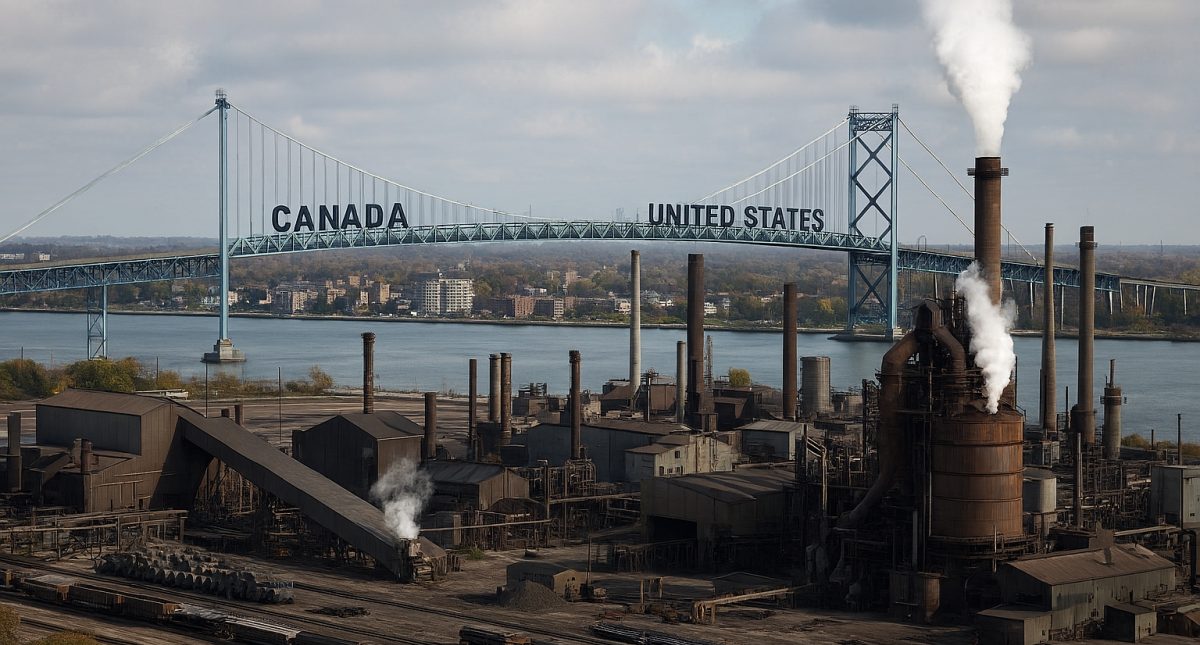
- The Windsor‑Detroit auto corridor highlights the challenge of that pivot—production is deeply integrated, with just‑in‑time parts crossing the border multiple times, making rapid decoupling impractical
- Algoma Steel (producer), Russel Metals (distributor), and Tree Island Steel (fabricator) illustrate how exposure to U.S. demand varies by position in the value chain, affecting volatility and resilience
- Trade diversification is likely to be gradual; investors are focused on which companies can balance today’s cross‑border interdependence with longer‑term efforts to adapt to a more diversified trade strategy
Canada reconsiders its U.S. trade bet as Windsor‑Detroit interdependence tests the pivot
For investors, Canada’s recalibration of trade policy is colliding with the reality of North America’s most integrated manufacturing corridor.
In a 10‑minute video address released Sunday, Prime Minister Mark Carney said Canada must rethink its reliance on the United States, describing close economic ties as “weaknesses that we must correct,” as tariffs imposed by U.S. President Donald Trump continue to weigh on sectors such as autos, steel, and lumber. Carney said Washington has “fundamentally changed its approach to trade,” lifting tariffs to levels “last seen during the Great Depression,” and pledged regular updates on efforts to diversify Canada’s trade relationships.
This article is a journalistic opinion piece that has been written based on independent research. It is intended to inform investors and should not be taken as a recommendation or financial advice.
A policy shift meets a tightly coupled system
Nowhere is the complexity of that pivot clearer than the Windsor‑Essex/Detroit corridor, which functions as a synchronized production system built over a century. Auto parts routinely cross the border multiple times before final assembly, moving on a just‑in‑time basis through the Ambassador Bridge and tunnel network that together handle an outsized share of bilateral trade by value. Supply‑chain specialists and regional economists emphasize that even modest friction—delays, paperwork, or tariff uncertainty—can ripple quickly through assembly lines on both sides of the river.
Local labour leaders and academics in Windsor‑Essex say those realities make any rapid decoupling impractical. While diversification may be a long‑run objective, transition timelines matter in regions where production, logistics, and workforces are interwoven with U.S. facilities. Analysts note that the corridor’s efficiency is itself a competitive advantage—one that is difficult to replicate elsewhere without years of capital investment and supplier relocation.
What stocks are investors watching?
For equity investors, the near‑term question is how Canada’s rhetoric and policy signaling translate into operating conditions for domestically listed industrial names that are still deeply exposed to U.S. demand.
Algoma Steel Inc. (TSX:ASTL) is the country’s largest remaining public pure‑play steelmaker, supplying plate and flat products to automotive, construction, defense and energy customers in Canada and the United States. Algoma is in the midst of a multiyear transformation toward electric‑arc‑furnace steelmaking, a shift intended to lower costs and emissions over the cycle. Yet near‑term earnings have been pressured by tariff costs and volatile steel spreads, underscoring how sensitive integrated producers remain to cross‑border policy outcomes.
Algoma Steel stock (TSX:ASTL) was 2 per cent higher on Wednesday, closing trading at C$6.43 and is up nearly 14 per cent since the year began.
Russel Metals Inc. (TSX:RUS) offers a different exposure profile. As a distributor and processor, Russel sits between mills and end‑users, with a broad network of service centers across Canada and the U.S. The business typically exhibits lower operating leverage than producers and can partially offset price swings through mix, inventory management, and value‑added services. That steadier cash‑flow profile has historically appealed to income‑oriented investors during periods of trade uncertainty.
Russel Metals stock (TSX:RUS) was 1 per cent higher on Wednesday, closing trading at $50.90 and is up over 16 per cent since the year began.
Tree Island Steel Ltd. (TSX:TSL) represents the downstream end of the value chain, manufacturing fabricated wire products for construction, industrial, and agricultural markets. While smaller and more cyclical than distributors, Tree Island illustrates how U.S. exposure persists even for niche manufacturers, given that a significant portion of demand is tied to North American building activity and cross‑border supply chains.
Tree Island Steel stock (TSX:TSL) last traded 0.04 per cent higher at C$2.54 and is down 1 per cent since the year began, but has risen 1 per cent since this past week.
Diversification versus disruption
Carney’s address emphasized that diversification is a process, not an overnight shift. Trade policy experts say Canada’s options include accelerating agreements with Europe and the Indo‑Pacific, reducing internal trade barriers, and supporting investment in logistics that broaden export routes. At the same time, they caution that re‑routing trade away from the U.S. does not eliminate U.S. exposure so much as rebalance it over time, particularly in autos and steel where North American integration remains economically efficient.
For the Windsor‑Detroit region, even incremental policy frictions are closely watched. The corridor’s just‑in‑time model leaves little buffer for delays, which is why market participants often respond quickly to tariff headlines, border staffing changes, or infrastructure bottlenecks. Investors, in turn, tend to differentiate among producers, distributors, and fabricators based on balance‑sheet strength and flexibility under uncertain trade regimes.
The investor takeaway
Canada’s call to rethink reliance on the U.S. sets a strategic direction, but execution will be gradual and uneven across regions. For equities tied to steel and autos, exposure is less about geography alone than about position in the value chain and resilience to policy‑driven volatility. As Ottawa signals diversification while the Windsor‑Detroit system continues to operate as an integrated whole, investors are likely to favour companies that can navigate both realities—maintaining cross‑border efficiency today while adapting to a more diversified trade map over time.
Join the discussion: Find out what the Bullboards are saying about metal fabrication stocks and check out Stockhouse’s stock forums and message boards.
Stockhouse does not provide investment advice or recommendations. All investment decisions should be made based on your own research and consultation with a registered investment professional. The issuer is solely responsible for the accuracy of the information contained herein. For full disclaimer information, please click here.