
- Kobrea Exploration has secured a first-mover position in Argentina’s newly opened Mendoza mining district
- The company controls over 730 km² of prospective ground across a district-scale copper belt
- Early drilling at El Perdido has confirmed a copper-bearing porphyry system, with assays expected in the near term
Newly opened district creates first-mover opportunity
Kobrea Exploration (CSE:KBX) (OTC:KBXFF) is advancing a district-scale copper exploration strategy in Argentina’s Mendoza province — a region that, until recently, was effectively closed to large-scale mining activity.
This article is disseminated in partnership with Kobrea Exploration. It is intended to inform investors and should not be taken as a recommendation or financial advice.
With a shift in government policy and local sentiment, the Western Malargüe mining district is now emerging as a new frontier for exploration. Kobrea has moved quickly to secure a dominant land position, becoming the first and currently only publicly listed company licensed to explore in the area.
The company’s land package spans more than 730 square kilometres along a highly prospective copper belt, hosting over 20 identified porphyry targets. Importantly, much of the groundwork had already been completed historically — but without the ability to drill — positioning Kobrea to rapidly advance targets now that permitting has been unlocked.
Recent developments have further strengthened the story. Drilling has begun at the El Perdido project, confirming the presence of a copper-bearing system, while the discovery of a large hydrothermal breccia body along the Cuprum Trend suggests potential for a broader mineralized system.
With initial assays expected in the near term, the focus is now on validating scale and identifying higher-grade zones within the system — key milestones that could define the next phase of growth for the company.
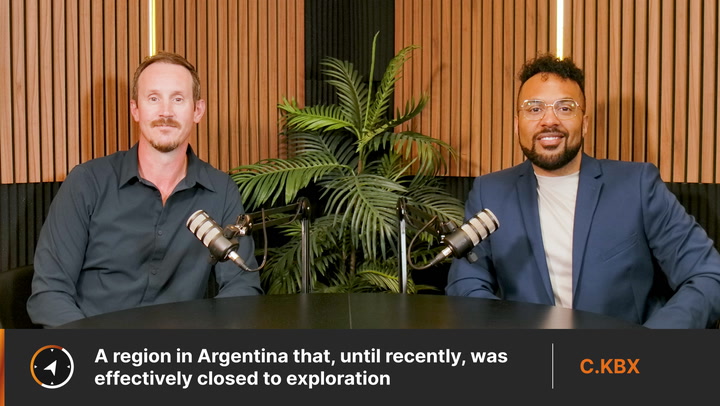
Joining Ricki Lee in this episode of The Capital Compass to walk through the opportunity, the drill program, and what investors should be watching next is Rory Ritchie, VP Exploration and Director of Kobrea Exploration.
Watch the full video above or on YouTube, and get involved in the conversation by leaving your comments and engaging in the forums.
Kobrea Exploration targets first-mover advantage in Argentina
Ricki: It’s a pleasure to have you. So, Rory, let’s start with the broader picture. Mendoza was historically closed to modern exploration and it’s now reopening. How significant is the shift for the region and how important was it for Kobrea to establish itself early as the first and only publicly licensed company to explore there?
Rory: So that’s a two part question. So, first off, Mendoza, the opening or really the development of this mining district in Southwest Mendoza Province is a huge shift, a full 180 degree, not just through governmental policy and environmental policy, but also just the people, the social scene there.
Historically there was some pushback with exploration and development. Now that oil’s drying up and they need new sources of revenue they’re very pro mining. So it is literally gone from an anti-mining jurisdiction to pro mining.
So, in that regard for an opportunity like that, for a world class, in this case, copper belt to open up you really have to be a first mover. If that was our prerogative, we wanted to be the first ones. We did our due diligence quick, and we secured what we feel are the best projects in this new district.
Ricki: And in this district, you’ve assembled an enormous land position in the Western Malargüe district. Can you give us a sense of the scale of your claims and why controlling that much ground in a newly open district matters for both a geological and strategic perspective?
Rory: So, it’s over 730 square kilometers. So it is a big land position. It straddles the Chilean Argentinian border. Well, it doesn’t straddle, it’s strictly in the Argentinian side, but it occupies about a hundred kilometers north, south, approximately.
The projects, some are, most are contiguous, some are separated. So, it is a big land package, but there’s good access and good infrastructure. It makes it easy enough for a small company like ourselves to explore efficiently and to visit and do the systematic exploration we need to do at all the targets.
So that’s what we’re doing. As well, as you mentioned, we’re drilling El Perdido, we’re doing both concurrently, the target development and the drill program.
Ricki: The last time we spoke with Kobrea, we were talking about El Perdido, but now obviously the drilling has begun there, like you just mentioned, and you’ve also announced the discovery of a large hydrothermal breccia body within the Cuprum Trend.
What’s been the most meaningful development in this story over the past few months, and how has it refined your understanding of the district?
Rory: So, the significance of that discovery with that large hydrothermal breccia at what we call KBX 17 1,250 meter by 500 meter hydrothermal breccia that we feel is emanating off the top of a porphyry system. That’s big in what we call the target development landscape searching across the projects, trying to rank targets and do our systematic exploration.
But really, I think what’s most meaningful, particularly to shareholders, is the fact that we’re drilling. There were people who thought you could never get a drill permit in this jurisdiction, in this part of the world. So, we’re drilling it El Perdido, we are seeing copper. It is a copper bearing porphyry system, which was not a certainty.
So, both of those things are highly significant but generally speaking now we know we can drill across the projects, not just operationally, but get the permission as well. So, certainly drilling it El Perdido is the most significant.
Ricki: And we’ve spoken about how vast this district is, but your current drill program is focused on quite a small portion of the overall land package. What exactly are you testing in this phase and how does that tie into the broader district scale exploration thesis?
Rory: So, generally speaking, across the district or across the district scale land package, we have over 20 porphyry targets. These are large bulk tonnage type deposits that really you can see on Google Earth, for example, these big hydrothermal alteration footprints.
So, a big part of the story is that there was other work done by good operators in the past. They just couldn’t get drilling permits. So in large part, a lot of these things were identified by other groups. We just happen to be the first ones who will have the opportunity to drill them.
So, what we’re seeing at El Perdido, I don’t want to get too esoteric with the technical stuff, but generally speaking, we have these leached caps on top of these porphyry systems and really you don’t see a lot of copper at surface.
So, it’s important for us at El Perdido that we see as we drill through the leach cap, we do get into hypergene copper, and really that’s something we can take across to the rest of the targets. Knowing how to kind of objectively quantify or qualify the geochemistry at surface.
For example, if you have 500 ppm copper at surface in a leach cap, well maybe that equates to half a percent copper once you get through that leach cap. Something like that. So, that was big that we saw that at El Perdido. And again, now we can take that information, and it’ll help with targeting across all the other targets we have in the land package.
Ricki: I guess from an investor perspective, what they really want to know is about the timing, right? So, when should we expect the first drill results to come back from this campaign, and what would success look like at this early stage?
Rory: So, to the first part of your question we have assays pending. They’re all at the lab still. We have sent all of the core samples from the first four holes to the lab. We were a bit behind in getting those samples to the lab, and then there’s a little bit of a lag at the laboratory itself.
So, I expect early May, we should be able to put out some results on the initial drilling and what success looks like at this stage in the game. We just a wanted to see that it’s a copper bearing system. We know that now.
Another thing I haven’t touched on is that we are seeing now that there is the presence of some supergene enrichment, which again, I won’t get too technical with, but that’s just something you want to see in these NDN porphyry systems. In terms of a hard number, you know, XX percent over X meters.
It’s hard to say that in terms of what success looks like, but for us what we want to do is find the core of the system, which is where the best mineralization is. And then if that mineralization is half a percent copper or more over hundreds of meters, that would certainly be a big success.
Ricki: Wow. Well, thank you so much for sharing your time with us today and taking us through the latest developments at Kobrea.
Rory: Yeah, my pleasure. Thanks. Thanks, Ricki. Once again, that is Rory Ritchie, VP of Exploration at Kobrea Exploration. For more information, visit Kobreaexploration.com. I’m Ricki Lee, and this has been the Capital Compass. Thanks for watching, and I’ll see you again next time.
Join the discussion: Find out what the Bullboards are saying about Southern Energy and check out Stockhouse’s stock forums and message boards.