

- Microsoft (NASDAQ:MSFT) announced Project Helix, a next‑gen Xbox designed to play both Xbox and PC games, signalling a major hybrid shift for the brand
- Series X|S sales slumped to just over two million units in 2025, underscoring Microsoft’s need for a strong hardware comeback
- Questions loom over PC storefront support and competition, especially with a Steam console on the way and Sony (NYSE:SONY) pulling back from PC—factors that could shape Helix’s relevance by its expected 2027 window
- Microsoft stock (NASDAQ:MSFT) opened trading at US$409.35
Microsoft (NASDAQ:MSFT) has officially begun lifting the curtain on Project Helix, the codename for its next-generation Xbox console, and early signals suggest the company is betting heavily on a radical hybrid strategy to regain momentum in the gaming hardware space. The announcement arrived via a post on X from new Microsoft Gaming CEO Asha Sharma, who wrote:
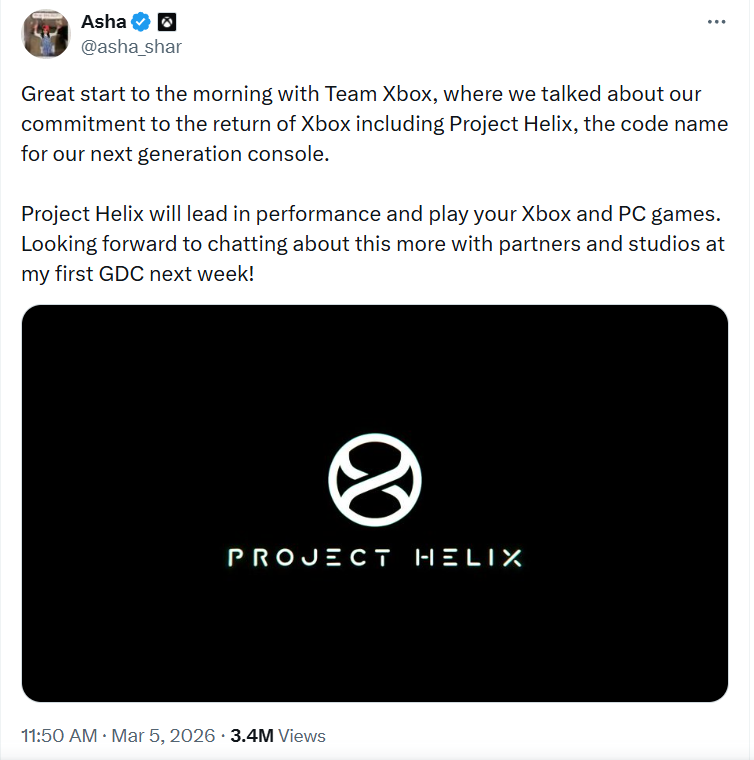
The message confirms not only the existence of the device, but also Microsoft’s most ambitious cross-platform pivot yet: native PC game support on a home console.
A strategy reboot after a difficult hardware generation
The timing of Project Helix is no accident. The Xbox Series X|S generation has faced significant sales struggles, with estimates showing just over two million units sold in 2025—a sharp drop from previous years and a signal that Microsoft continues to lose ground to competitors.
These weak numbers reflect a broader decline in Xbox’s hardware footprint, as analysts have repeatedly noted Microsoft’s pivot toward subscription services and cloud distribution at the expense of traditional console momentum. Such conditions make the arrival of Helix critical to re-establishing Xbox as a relevant hardware brand.
A console that plays PC games — but which storefronts?
With Sharma confirming that the system will “play your Xbox and PC games,” Microsoft is effectively positioning Helix as a hybrid PC-console, one that blurs the line between Windows gaming and living-room hardware.
However, this raises new and potentially disruptive questions:
- Will Helix support PC storefronts beyond Microsoft’s own ecosystem?
Reports and analysis note that true PC support could mean compatibility with platforms such as Steam, Epic Games Store, Ubisoft Connect, or GOG, but Microsoft has not clarified this. If Helix is limited to the Microsoft Store, the value proposition for consumers becomes murkier—especially when third‑party games on Steam or other storefronts are often cheaper or come with richer features. - If Helix does support Steam and others, Microsoft may face tension between hardware sales and software revenue. Selling hardware that encourages players to buy games elsewhere could weaken Microsoft’s already thin console-software margins.
A new competitor: Steam’s own living-room console
Microsoft’s timing may also pit Project Helix directly against Valve. According to industry reporting, Steam has its own console slated to release in the first half of 2026, further blurring lines between PC and console ecosystems. Project Helix’s direct support for PC games would place it in the same competitive lane, making Microsoft’s engineering, pricing, and storefront decisions even more consequential.
Sony moves away from PC Ports — A return to exclusivity?
Adding more complexity, Sony (NYSE:SONY) appears to be reversing course on its previously aggressive PC expansion strategy. Multiple reports indicate that the company is pulling back its first‑party PlayStation releases from PC, signalling that Sony may re-embrace exclusivity heading into the next console cycle.
If Sony hardens exclusivity while Microsoft embraces full PC interoperability, the competitive landscape may split dramatically: Sony doubling down on console-first identity, and Microsoft leaning further into a unified PC-plus-console ecosystem.
Is 2027 a realistic release date for Helix?
Officially, Microsoft hasn’t confirmed a release year. But AMD—Microsoft’s silicon partner—has stated that development for Project Helix is progressing toward a 2027 launch window, aligning with typical generational cycles.
Yet industry circumstances complicate this forecast:
- Rising memory prices and a global RAM shortage driven by AI datacentre expansion have already begun pushing hardware timelines.
- Analysts warn these shortages could delay next-generation consoles for both Microsoft and Sony.
This creates a strategic dilemma for Microsoft:
Release too early, and supply constraints could make the console overpriced or understocked.
Release too late, and Helix risks becoming irrelevant in a landscape where PCs, handhelds, cloud platforms, and rival consoles evolve rapidly.
Can Project Helix bring Xbox back?
Project Helix represents Microsoft’s boldest console experiment yet—a full embrace of PC architecture, a unification of game libraries, and an attempt to regain relevance after a faltering generation. But this new direction brings equal parts opportunity and risk.
If 2027 is indeed the target year, Microsoft will need to thread a difficult economic and technological needle. Memory shortages, fierce competition, and unclear storefront integration leave Helix’s success far from guaranteed.
Yet waiting too long may sacrifice the momentum this announcement is starting to build. In a market shifting faster than ever, 2027 may be both the perfect time—and possibly too late—for Xbox’s comeback attempt.

Don’t call it a comeback
Microsoft Corp. develops and supports software, services, devices, and solutions. The company’s segments include productivity and business processes, intelligent cloud, and more personal computing.
Microsoft stock (NASDAQ:MSFT) opened trading slightly higher on Friday at US$409.35, closing out the week nearly 5 per cent higher and has gained more than 4.5 per cent since this time last year.
Join the discussion: Find out what the Bullboards are saying about Microsoft and check out Stockhouse’s stock forums and message boards.
Stockhouse does not provide investment advice or recommendations. All investment decisions should be made based on your own research and consultation with a registered investment professional. The issuer is solely responsible for the accuracy of the information contained herein. For full disclaimer information, please click here.