
- Markets ignore mounting risks (war, inflation, debt) because decades of intervention have conditioned investors to believe sharp sell‑offs will always trigger a rescue
- The “Greenspan Put” mindset—reinforced in 2008, 2013, and during COVID—has turned policy support from an emergency tool into a baseline assumption
- That backstop is now constrained: inflation limits rate cuts, debt limits fiscal stimulus, and the Fed’s ability to step in is narrower than in past crises
- Markets appear to be pricing an “AI put” instead, assuming artificial intelligence will offset economic, geopolitical, and supply‑chain risks—even if that confidence proves misplaced
Why investors keep looking past war, inflation, and debt—and what they think will catch them if they fall
The question investors keep asking quietly—but rarely pricing loudly—is deceptively simple: why is the stock market so insistent on ignoring risk right now?
Escalation in Iran threatens global energy flows. Inflation remains stubborn enough to limit central bank flexibility. Government debt is high, political consensus is fractured, and supply chains remain geopolitically fragile. And yet equity markets, after brief stumbles, continue to behave as if gravity itself has been suspended.
As Kyla Scanlon recently argued in a widely read New York Times opinion essay, the answer may not lie in data, earnings models, or even confidence in current economic fundamentals. It lies in something more reflexive and more dangerous: the market’s deep‑seated belief that it will always be saved. Scanlon speaks more to this in the video below:
This article is a journalistic opinion piece that has been written based on independent research. It is intended to inform investors and should not be taken as a recommendation or financial advice.
A market trained by rescue
Modern financial markets were not always this confident. But over the past four decades, they have been carefully—and repeatedly—trained.
The training began in earnest in 1987. After Black Monday, when the Dow Jones collapsed more than 22 per cent in a single day, then‑Federal Reserve Chair Alan Greenspan made it clear the Fed would supply liquidity to stabilize markets. That moment planted the seed of what would later be known as the “Greenspan Put”—the implicit promise that severe asset declines would trigger policy intervention.
The behavior intensified after 2008. Ben Bernanke took interest rates to zero and expanded the Fed’s balance sheet by trillions of dollars through quantitative easing, not merely to stabilize banks but to support asset prices and confidence more broadly. Markets internalized a new rule: systemic drawdowns would be met with extraordinary support.
That expectation hardened during COVID. Congress and the Federal Reserve deployed fiscal stimulus and monetary support at a pace and scale previously unthinkable. Equity markets not only recovered from the sharpest economic shock since the Great Depression—they reached new all‑time highs within months.
The lesson learned by investors was clear and dangerously reinforcing: If prices fall far enough, someone will step in.
Demanding the backstop
By 2013, markets had moved beyond passively expecting rescue to actively reacting against any hint it might be withdrawn. When Bernanke merely suggested that the Fed could slow its bond purchases, Treasury yields spiked and global markets convulsed in what became known as the “taper tantrum”.
That episode revealed a crucial shift. The market was no longer just aided by policy. It required it.
Over time, this dynamic has turned intervention from an emergency tool into a baseline assumption. Risk premiums compressed. Volatility declined structurally. Valuations expanded—not because risk disappeared, but because investors increasingly believed risk no longer mattered.
The infrastructure is now under stress
What makes the present moment different—and more fragile—is that many of the historical rescue mechanisms are now constrained.
Federal Reserve Governor Christopher Waller has spoken candidly about what he calls “one transitory shock after another”—a sequence of disruptions that, when compounded, stop behaving like temporary noise and begin reshaping inflation dynamics and expectations.
War‑related energy shocks, tariff pressures, supply chain fragmentation, and labor force constraints are not isolated blips. They stack. And stacking shocks limit the Fed’s ability to respond.
Cutting rates to support markets risks reigniting inflation. Expanding the balance sheet risks undermining credibility. Fiscal stimulus faces real political and debt‑capacity limits. The old playbook is no longer unlimited.
Which raises the question investors appear reluctant to ask outright: If markets fall sharply, who—or what—steps in this time?
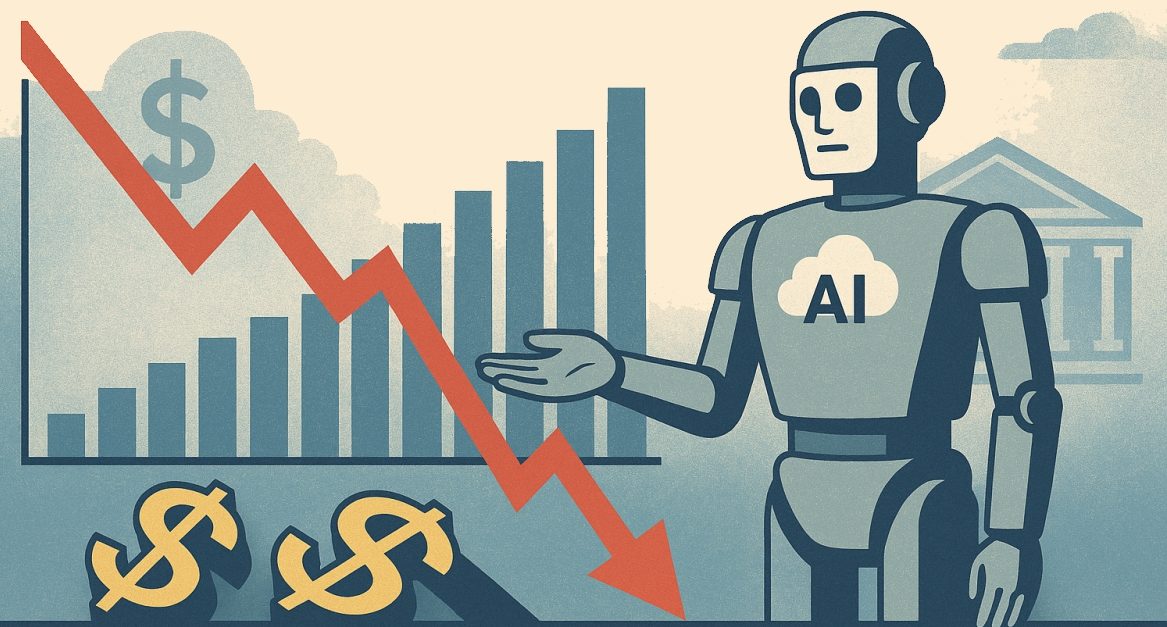
Enter the “AI put”
Scanlon’s answer, echoed increasingly across market commentary and earnings calls, is that markets may have quietly substituted a new backstop: artificial intelligence.
Call it the “AI put.”
The assumption embedded in today’s valuations is not merely that AI will boost productivity. It is that AI will do everything. Offset job displacement. Lower energy intensity. Optimize supply chains. Absorb geopolitical shock. Generate earnings growth resilient enough to paper over risks that policy can no longer address.
In this narrative, AI becomes the market’s universal insurance policy—even as it remains deeply exposed to the same supply chain, energy, and geopolitical constraints investors are discounting.
Semiconductors come from Taiwan. Energy still moves through chokepoints like the Strait of Hormuz. Data centres consume enormous power. AI is not external to the real economy—it is embedded in it.
Risk isn’t gone—It’s just priced as solved
Supporters argue that earnings expectations already reflect this reality. That markets are discounting risk precisely because innovation historically has overcome disruption.
But there is a thinner, more unsettling interpretation: markets may no longer be pricing risk at all—they may be pricing rescue instead.
Decades of intervention have trained investors to believe that outcomes will be managed, volatility capped, and losses socialized if they become large enough. That belief doesn’t disappear simply because the constraints tighten. It becomes reflexive.
Even escalating war. Even stubborn inflation. Even if AI underdelivers.
The expectation persists.
The real question for investors
This does not mean markets must collapse. Stabilization is entirely possible. Innovation may indeed surprise to the upside. Shocks may dissipate.
But for investors, the more important exercise is not predicting the next rescue—it is asking what happens if it doesn’t materialize the way markets expect.
Because the most dangerous assumption in finance is not optimism.
It is inevitability.
Stockhouse does not provide investment advice or recommendations. All investment decisions should be made based on your own research and consultation with a registered investment professional. The issuer is solely responsible for the accuracy of the information contained herein. For full disclaimer information, please click here.