

Antimony as the Backbone of Defence and Technology
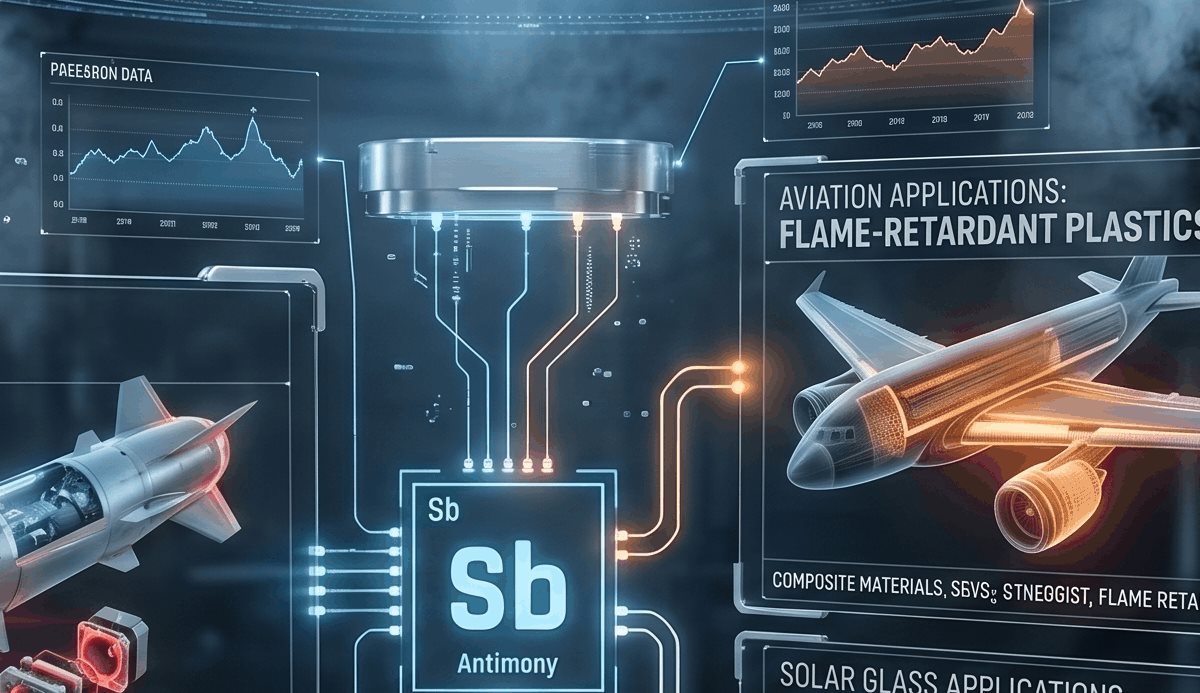
Antimony is a silver-gray metal that is virtually irreplaceable in key industries due to its unique chemical properties. The fact that China recently controlled about 61% of global production and introduced restrictive export licenses makes the current shortage a fundamental risk for industry in Germany and the entire West. Antimony hardens lead alloys and acts as a flame retardant by inhibiting combustion in the form of antimony trioxide. The situation is particularly critical in the defence sector, where the Pentagon classifies antimony as a critical mineral for infrared sensors, night-vision devices, and the hardening of ammunition. Civilian safety is also affected, as the metal is a standard additive in plastics to meet strict fire safety standards, for example, in aviation. Even the energy transition depends on antimony, as it stabilizes lead-acid batteries and is used in the photovoltaic industry for specialty glass and in specialized semiconductors such as indium antimonide.
BASF and Lufthansa: What to do about the polycrisis?
BASF and Lufthansa are directly affected by the blockades in the Strait of Hormuz, through which roughly one-third of global methanol trade and significant quantities of helium are normally transported. Leveraging its proven procurement structures, BASF reported EBITDA before special items of EUR 2.4 billion in the first quarter of 2026 despite challenging conditions. For BASF, the antimony shortage is particularly critical, as the Industrial Solutions segment produces additives and flame retardants that depend directly on the availability of this scarce raw material and have already led to significant price increases in the Nutrition & Care division. Lufthansa, on the other hand, is primarily grappling with sharply rising kerosene prices resulting from the Gulf blockade, which impacted its operating loss in the first quarter. To safeguard its business, the group was forced to cancel thousands of short-haul flights for the coming summer. At the same time, Lufthansa Technik’s reliance on specialty raw materials for maintenance remains a critical risk for the group that many observers have yet to recognize.
Antimony Resources: Canada’s Answer to China’s Monopoly
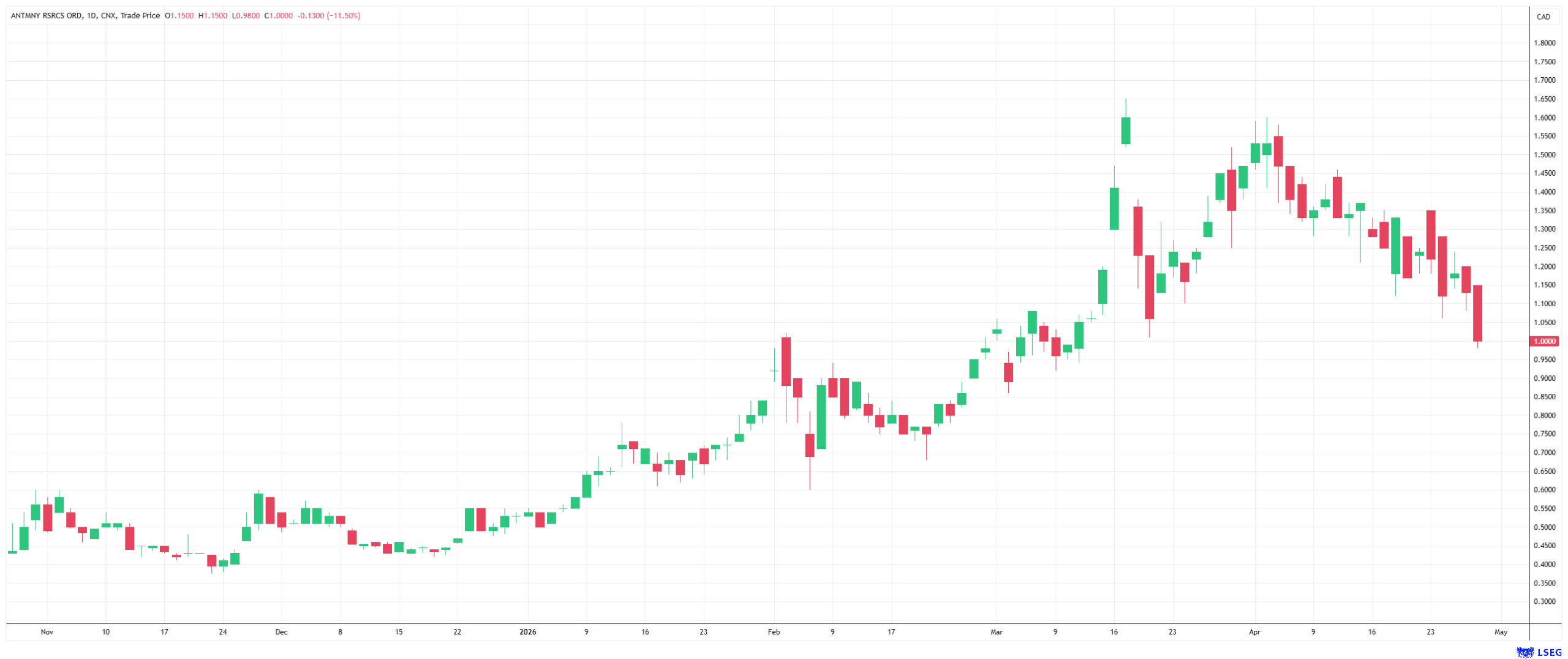
Amid supply concerns among many established companies, Antimony Resources is coming into focus with its Bald Hill project in New Brunswick, Canada. The project is considered one of the few realistic opportunities to establish a stable Western source of high-grade antimony. This year is crucial for the company: a 10,000-meter drilling program is intended to prepare the first official resource estimate. Outstanding results such as 4.4% antimony over 7.05 m, including a high-grade core of 9.8% Sb over 3.15 m, confirm the enormous potential of the mineralization. New discoveries such as the Marcus Zone show significant stibnite mineralization and demonstrate that the system is far larger than originally assumed. Coupled with its location just 55 km from a deep-water port, these are strong arguments in favour of the company and its stock. Antimony Resources has already commissioned GEMTEC Consulting to initiate permitting studies to shorten the timeline to production through early engagement with regulatory authorities. Here, the company benefits from the fact that policymakers and authorities have recognized the signs of the times and want to expedite procedures.
Conclusion: No future without resource sovereignty – Antimony Resources as a problem-solver
The current crisis makes it clear that the era of cheap energy and unlimited availability of raw materials from autocratically ruled states is over. While corporations like BASF and Lufthansa are trying to cushion the impact of the Hormuz blockade through cost-cutting measures, the long-term solution lies in sourcing raw materials from stable regions. Companies like Antimony Resources occupy a crucial niche here with the promising Bald Hill project. For investors, Antimony Resources offers an opportunity to get in early on the trend toward securing Western antimony supply chains. Those who want to protect Europe’s industry in the long term must secure direct access to critical resources. Even critics of mining in Germany have now recognized this. Projects in Canada are considered particularly well-suited to guaranteeing this security of supply due to their excellent infrastructure and legal certainty.
Conflict of interest
Pursuant to §85 of the German Securities Trading Act (WpHG), we point out that Apaton Finance GmbH as well as partners, authors or employees of Apaton Finance GmbH (hereinafter referred to as “Relevant Persons”) may hold shares or other financial instruments of the aforementioned companies in the future or may bet on rising or falling prices and thus a conflict of interest may arise in the future. The Relevant Persons reserve the right to buy or sell shares or other financial instruments of the Company at any time (hereinafter each a “Transaction”). Transactions may, under certain circumstances, influence the respective price of the shares or other financial instruments of the Company.
In addition, Apaton Finance GmbH is active in the context of the preparation and publication of the reporting in paid contractual relationships.
For this reason, there is a concrete conflict of interest.
The above information on existing conflicts of interest applies to all types and forms of publication used by Apaton Finance GmbH for publications on companies.
Risk notice
Apaton Finance GmbH offers editors, agencies and companies the opportunity to publish commentaries, interviews, summaries, news and the like on news.financial. These contents are exclusively for the information of the readers and do not represent any call to action or recommendations, neither explicitly nor implicitly they are to be understood as an assurance of possible price developments. The contents do not replace individual expert investment advice and do not constitute an offer to sell the discussed share(s) or other financial instruments, nor an invitation to buy or sell such.
The content is expressly not a financial analysis, but a journalistic or advertising text. Readers or users who make investment decisions or carry out transactions on the basis of the information provided here do so entirely at their own risk. No contractual relationship is established between Apaton Finance GmbH and its readers or the users of its offers, as our information only refers to the company and not to the investment decision of the reader or user.
The acquisition of financial instruments involves high risks, which can lead to the total loss of the invested capital. The information published by Apaton Finance GmbH and its authors is based on careful research. Nevertheless, no liability is assumed for financial losses or a content-related guarantee for the topicality, correctness, appropriateness and completeness of the content provided here. Please also note our Terms of use.
Stockhouse does not provide investment advice or recommendations. All investment decisions should be made based on your own research and consultation with a registered investment professional. The issuer is solely responsible for the accuracy of the information contained herein. For full disclaimer information, please click here.