
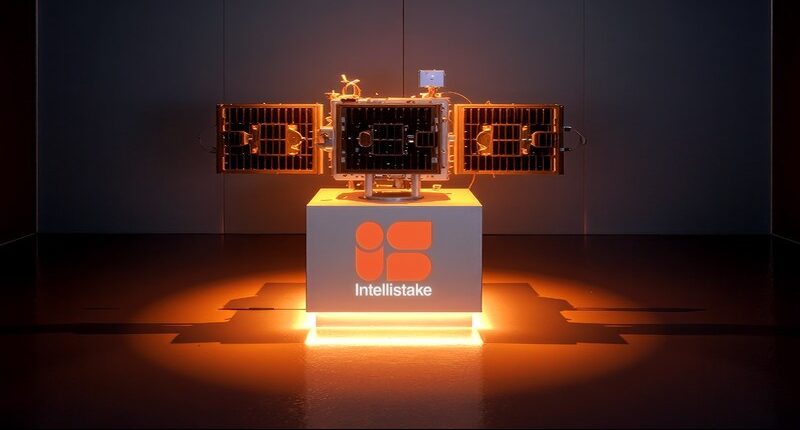

- A potential SpaceX IPO highlights the growing importance of space-based AI and infrastructure beyond Earth
- Intellistake (CSE:ISTK) is positioning itself as the decentralized “trust layer” verifying data and AI activity within emerging orbital networks
- With partnerships like Orbit AI and rising investor interest, the company is gaining attention as an early-stage player in this new infrastructure stack
- Intellistake stock (CSE:ISTK) last traded at $0.40
Beneath a potential SpaceX IPO, a new layer of infrastructure emerges
“If you’re excited about a trillion‑dollar SpaceX IPO, wait until you understand the infrastructure behind it.”
That framing, offered recently by Intellistake Technologies (CSE:ISTK), captures a growing narrative forming around one of the most anticipated listings in modern capital markets.
Reports suggesting SpaceX could pursue a 2026 public offering at a valuation approaching US$2 trillion—potentially raising over US$30 billion—have already begun to recalibrate investor expectations.
Yet Intellistake’s argument is less about the headline valuation than what underpins it. In its view, a public listing by Elon Musk’s space company would represent not the beginning of a story, but a milestone perched atop years of quietly evolving infrastructure spanning artificial intelligence, energy systems, and orbital computing.
The comparison is instructive. SpaceX’s early years—marked by repeated launch failures and existential funding risk—played out beyond the reach of public investors. If and when the company lists, it will do so at a stage of maturity far removed from those formative risks. For Intellistake, that gap highlights a recurring pattern in transformative technology cycles: foundational infrastructure tends to develop out of view long before it becomes investable through public markets.
The expanding scope of SpaceX’s ecosystem
Today, SpaceX sits at the centre of a broader technological convergence. Beyond launch services and satellite connectivity, it is increasingly part of a wider conversation about how the world will sustain the next generation of AI systems.
The challenge is physical as much as digital. Data centres are rapidly consuming more electricity and straining land, cooling, and grid resources. As AI workloads intensify, the constraints of terrestrial infrastructure are becoming more visible.
Orbital computing presents a radically different environment. In space, solar energy is near-continuous and cooling can occur through radiation into the vacuum, reducing some of the burdens that dominate Earth-bound data centres. These characteristics have drawn interest from major technology players exploring space-based processing and networking.
Within this context, SpaceX’s launch capabilities and Starlink network become enabling layers in a much larger stack—one that could include distributed computing, satellite-based data processing, and autonomous infrastructure operating beyond Earth.
It is within this emerging stack that Intellistake is positioning itself.
Intellistake’s role: The “trust layer”
Intellistake, a smaller publicly listed company, is not competing with rocket builders or chip manufacturers. Instead, it is targeting what it describes as the “trust layer” of decentralized AI infrastructure.
Its core business involves operating validator and node systems that help decentralized networks verify transactions, coordinate activity, and maintain consensus without centralized control. This function becomes increasingly relevant as computing environments expand across jurisdictions—and potentially into orbit—where traditional oversight mechanisms may be limited or absent.
The company has extended this approach through a partnership with Singapore-based aerospace firm Orbit AI, aimed at supporting what is called the “Orbital Cloud”—a satellite network designed to integrate AI computation, communication, and blockchain verification in space.
Under this collaboration, Intellistake intends to provide the blockchain backbone of the system, enabling satellites to authenticate data and coordinate workloads independently of terrestrial infrastructure. The architecture combines three elements: AI processing (DeStarAI), connectivity (DeStarlink), and blockchain verification (Intellistake).
For Intellistake, the partnership represents a move beyond purely digital systems into physical infrastructure linked to space-based computing.
The company has also aligned itself financially with this direction, announcing an initial US$500,000 investment in Orbit AI for a 1 per cent equity stake, with options to increase that investment in future funding rounds. The agreement was formalized through a collaboration framework signed in late 2025.
Market tailwinds and emerging demand
The timing reflects broader industry forecasts pointing to rapid expansion in orbital infrastructure. Projections suggest the space-based infrastructure market could grow from roughly US$13.5 billion in 2024 to more than US$21 billion by 2029. The in-orbit data centre segment, still nascent, is expected to scale significantly in the following decade, alongside rapid growth in satellite data services.
These projections underscore a key shift: as AI demand accelerates, computing capacity may increasingly extend beyond terrestrial limits. If that transition materializes, systems that ensure data integrity, coordination, and trust—particularly in decentralized environments—could become critical.
Intellistake’s thesis rests on that assumption.
Academic validation and institutional engagement
Recent developments in the Orbit AI ecosystem provide additional context for that strategy. In March 2026, Nanyang Technological University (NTU) announced a formal research collaboration with BC Space (Orbit AI) to develop operational control algorithms for computational satellites.
The initiative builds on prior academic work examining the feasibility of orbiting data centres, moving now toward the practical challenges of managing such systems. Areas of focus include power optimization, thermal management, and distributed workload scheduling across satellite constellations.
Importantly, the research will be tested using real hardware, including satellites launched in late 2025 and planned deployments in 2026. This progression from theoretical study to operational validation suggests increasing institutional interest in orbital computing infrastructure.
For Intellistake, which holds its minority equity position in Orbit AI, the collaboration reinforces its early alignment with a category that remains in development but is gaining technical and academic traction.

Other side of the moon
By comparison, Intellistake occupies a markedly different position than Intuitive Machines, Inc. (NASDAQ:LUNR), a NASA-focused aerospace company best known for its lunar landers and direct participation in government space missions. While Intuitive Machines generates revenue through contracts tied to physical payload delivery and lunar exploration, Intellistake is positioning itself higher up the emerging digital stack—focused not on moving hardware to space, but on verifying, coordinating, and securing the data and AI workloads that may eventually operate there. In effect, Intuitive Machines represents the “logistics and exploration” side of the new space economy, whereas Intellistake is attempting to build the decentralized infrastructure layer that could underpin how data and computation are trusted once that economy scales beyond Earth.
Linking back to SpaceX
While Intellistake does not have a formal relationship with SpaceX, the connection between the two companies lies in the broader ecosystem they occupy.
SpaceX provides the launch and connectivity infrastructure that makes orbital systems feasible. Companies like Orbit AI aim to build computational layers on top of that foundation. Intellistake, in turn, is positioning itself to verify and secure the activity occurring within those systems.
In this sense, a potential SpaceX IPO could serve as a visible milestone for a much larger—and less visible—stack of technologies developing alongside it.
A stock to watch in an emerging category
Intellistake remains an early-stage company operating in a complex and evolving market. Its plans depend on successful satellite deployments, partnerships, regulatory developments, and the broader adoption of decentralized AI infrastructure.
However, its positioning at the intersection of blockchain, AI, and aerospace places it within a niche that is still relatively uncrowded in public markets.
That positioning has not gone unnoticed by investors. The company’s shares have risen more than 150 per cent over the past year, reflecting increasing interest in its strategy and the thematic tailwinds behind it.
As attention turns toward a potential SpaceX listing, Intellistake’s bet is that the most enduring value may not lie solely in rockets or satellites, but in the systems that enable those assets to operate with transparency, coordination, and trust.
For investors looking beyond headline valuations, the question may be less about when SpaceX rings the opening bell—and more about the infrastructure quietly taking shape beneath it.
About Intellistake Technologies Corp.
Intellistake develops decentralized AI software spanning validator operations, token participation and enterprise AI agents.
Intellistake Technologies stock (CSE:ISTK) closed trading 1.27 per cent higher at $0.40 and has risen nearly 150 per cent since this time last year.
Join the discussion: Find out what investors are saying about this blockchain technology stock on the Intellistake Technologies Corp. Bullboard and make sure to explore the rest of Stockhouse’s stock forums and message boards.