

The nature of finance and investing is such that, while there are only a handful of fundamental rules everyone should follow, they all go against human nature, requiring them to be repeated again and again, regardless of the forum, in the hopes of maximizing and optimizing the dollars in as many people’s pockets as possible.
One of these rules, of particular relevance to Stockhouse readers, which I’ve shared before and will share again, is that the only valid reason to invest in small-cap and micro-cap stocks if is their underlying companies are, in one way or another, superior to their competitors.
This article is disseminated in partnership with micro-cap stocks Starfighters Space and Rank One Computing. It is intended to inform investors and should not be taken as a recommendation or financial advice.
The idiosyncratic risk of single-stock ownership, which cannot be diversified away, is much too great – we’re talking total loss of capital – to settle for filling your portfolio with companies that are merely good enough, especially when index funds will give you broad market returns at pennies on the dollar.
The key here is not to necessarily shoot for the moon, which may result in you biting off more than you can chew, but to ensure that innovation is actually taking place, in line with market demand, setting you up to reasonably expect a satisfactory long-term return.
Starfighters Space
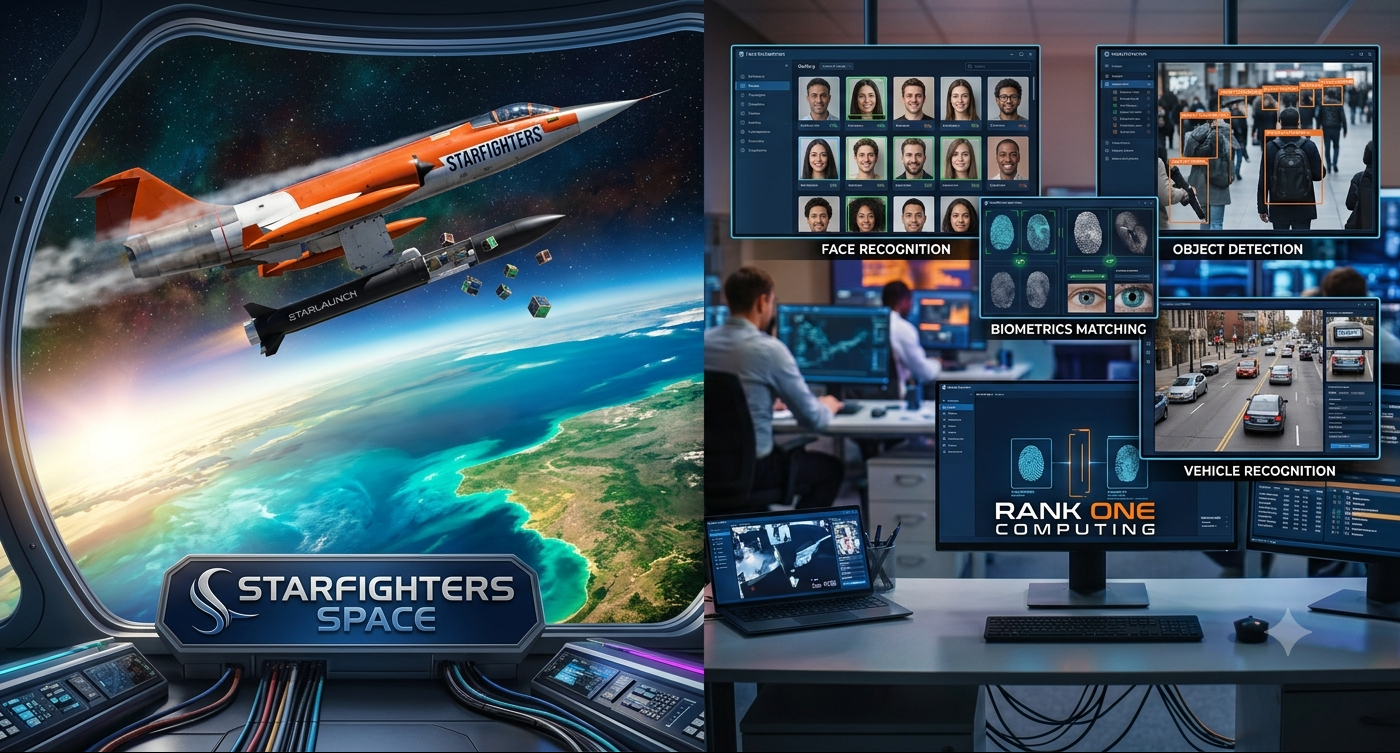
A micro-cap stock that fits this mold rather well is Starfighters Space, market cap US$238.54 million, the only company in the world capable of delivering payloads at MACH 2 or higher into space, leveraging:
- Its proprietary Starlaunch rockets, equipped for small payloads equivalent to multiple nano or micro-satellites.
- The only commercial fleet of F-104 fighter jets, which are able to reach an unmatched altitude of up to 45,000 feet.
Based in NASA’s Kennedy Space Center in Florida, alongside heavy hitters SpaceX (NASDAQ:SPCX), Blue Origin and United Launch Alliance, the company is keen to meet commercial space demand, supported by an expected 14x jump in satellite launches this decade to more than 38,000 units, differentiating itself by accommodating small-scale operators more quickly and cost-effectively (at about US$15,000 per kilogram) than either rideshare or dedicated space vehicles, including research and training services that keep costs low by keeping development completely in house.
Starfighters’ value-added services have attracted a who’s who client base, including Lockheed Martin, GE, Innoveering, Space Florida and the US Air Force Research Laboratory, the latter actively developing hypersonic rockets with the company to bolster US national security, going a long way towards validating operations in the eyes of the broader space industry and de-risking future deals.
That said, the micro-cap is in full growth mode, meaning that market share, as opposed to profitability, is currently its chief concern, with wind tunnel testing for the first Starlaunch iteration yielding positive results in Q1 2026, moving the company one step closer to initial revenue generation.
Before putting dry powder to work, investors should pay close attention to how Starfighters’ income statements develop over the coming quarters, evaluating how leadership parlays only 44.1 million shares outstanding into the capital required to put the company on a path to profitability.
A recently closed US$17.5 million capital raise, to be allocated under the guidance of Chief Executive Officer, Tim Franta, a previous Deputy Director and Director of Special Projects for Energy Florida, as well as a Chief of Staff for the Florida Space Authority, keeps the company on track for a demonstration flight within the next 18 to 24 months.
Franta spoke with Stockhouse’s Ricki Lee about Starfighters Space’s inclusion in the Russell 3000 Index. Watch the interview here.
Starfighters Space stock (NYSEAM:FJET) last traded at US$5.28 and has given back 37.94 per cent since going public in December 2025.
Rank One Computing
Denver-based Rank One Computing, market cap US$113.91 million, is another micro-cap stock aiming to usher its industry into newfound efficiency through its flagship Vision AI, a unified data intelligence platform, unlike anything else on the market, with functionality spanning face recognition, age estimation, fingerprint recognition, iris recognition, tattoo matching, object and weapons detection, as well as vehicle and license plate recognition.
The company’s wholistic offering promises clients a faster, more accurate and more cost-efficient alternative compared to doing business with separate operators and accolades to date have certainly backed up these ambitions, as highlighted by the National Institute of Standards and Technology, part of the US Department of Commerce, ranking Vision AI #1 in the areas of facial, fingerprint and iris recognition.
This high-level tip of the hat does a lot of the explaining as to why 10 Department of Defense agencies, more than 20 law enforcement agencies and more than 80 integrator and fintech partners have trusted Vision AI in their corner, granting the company a growing client base to build its path to profitability through recurring subscription and licensing revenue.
Revenue has been on an upward trend from US$15.4 million in 2023 to US$13.7 million in 2024 to US$16.9 million in 2025, followed by a solid US$2.5 million in Q1 2026, down from US$3.2 million year-over-year, largely attributable to the late 2025 government shutdown. Gross margins, for their pair, averaged approximately 80 per cent over the period, presaging the strong benefits of scale Rank One would likely enjoy, should it succeed at stepping up revenue generation.
That said, operating losses remain a constant, coming to US$3 million in Q1 2026, cautioning investors to risk-adjust their positions, or wait patiently on the sidelines, as the company works its way through numerous rollouts, expansions and pilot programs (see slide 13 of Rank One’s latest investor deck) in a bid to show more tangible progress on its income statements, sweetening its prospects of garnering a greater share of an estimated US$106 billion total addressable market (see slide 16).
Rank One’s leadership team, composed of scientists and engineers previously serving the military, FBI, as well as top AI labs, appears well-equipped to the task, guided by CEO, Scott Swann, whose more than 20 years in the FBI and 10 years growing major biometric companies makes him as bespoke a leader as any reasonable investor could hope for as the company continues to prove itself as a go-to partner in mission-critical decision-making for governments, law enforcement, defense operators and commercial clients.
Swann joined Coreena Robertson to speak about the company taking home the Facial Recognition System of the Year Award at the 9th Annual AI Breakthrough Awards. Watch the interview here.
Rank One Computing stock (NASDAQ:ROC) last traded at US$5.82, giving back 5.60 per cent since inception in February 2026, sporting only 19.1 million shares outstanding to strategically meet its liquidity needs.
Thanks for reading! I’ll see you next Monday for a new edition of Weekly Market Movers, where I delve into companies that joined Stockhouse for an interview over the past week. Here’s the most recent article, in case you missed it.
Join the discussion: Find out what investors are saying about these high-quality micro-cap stocks on the Starfighters Space Inc. and Rank One Computing Corp. Bullboards and make sure to explore the rest of Stockhouse’s stock forums and message boards.