


Alphabet and Amazon: Hyperscalers Invest Hundreds of Billions
Where traditional utilities once set the tone, sustainability is now the driving force behind highly capitalized platform companies. Alphabet’s strategy is primarily based on the strategic goal of fully meeting the massive electricity demands of its artificial intelligence systems and Google data centers around the clock with carbon-free energy (24/7 Carbon-Free Energy). To secure this continuous baseload, the company is no longer investing solely in traditional wind and solar power plants; instead, it is acquiring specialized energy companies at scale and making targeted investments in advanced geothermal and nuclear energy partnerships. The new financial scale is enormous. For 2025 and 2026 alone, Alphabet plans to invest between USD 175 billion and USD 185 billion in its technical infrastructure. Among other things, the spectacular acquisition of the green energy developer Intersect Power, valued at approximately USD 4.75 billion, stands out. Fifty-five analysts on the LSEG platform have, on average, raised their target price further to around USD 422. In that light, USD 344 does not seem so expensive after all. Alphabet is the third-largest company on the global stock market, with a market capitalization of approximately USD 4.2 trillion.
Amazon, on the other hand, as the world’s largest private purchaser of green electricity, is taking a direct approach, injecting new capacity into global power grids through a massive portfolio of power purchase agreements (PPAs). The focus here is on unprecedented scaling across more than 700 major projects worldwide to offset the energy footprint of the entire Amazon Web Services (AWS) retail and cloud empire. A recent market study by BloombergNEF (BNEF) has now confirmed Amazon as the global leader in corporate green power procurement for the fifth consecutive year. According to the study, the company has now signed contracts for a total installed capacity of more than 40 gigawatts of zero-emission energy. Here, too, 54 analysts are bullish, assigning a “Buy” rating and setting a 12-month price target of around USD 320. At Friday’s closing price of USD 265, this represents upside potential of about 22%. Together, these two stocks form a solid foundation for investors looking to capitalize on the unstoppable megatrend of the digital energy transition.
RE Royalties: Elegant and Focused with Innovative Ideas
From the industry giants to a small specialized financier that is just gearing up for its next stage of growth. With the expansion of its partnership with Solaris Energy announced in early August, royalty financing totaling up to USD 67.5 million could materialize soon. USD 4.8 million has already been invested in 16 solar projects totaling approximately 15.24 MW, and an additional USD 13.7 million would flow into 13 projects with 48 MWDC that are already contractually secured. Things get really exciting when it comes to the next stage of development: Solaris has another 83 projects totaling approximately 142 MW, which could potentially provide an additional USD 49 million in royalty financing. This would allow RE Royalties not only to finance individual solar parks but also to gain an early foothold in a significantly larger project pipeline.
This aligns perfectly with the company’s business model, which provides capital and, in return, participates in electricity revenues through long-term, revenue-based payments, without having to bear the traditional operator and construction risks itself. The Solaris royalties are initially structured to deliver an agreed-upon minimum return over 25 years and then continue for the remaining useful life of the plants—a remarkably long-term commitment for a market capitalization of only about CAD 16 million. At the same time, RE Royalties has freed up additional liquidity by fully repaying a CAD 2.4 million revolving loan, while the existing royalties from the financed projects remain intact.
Against this backdrop, the strategic review process takes on significantly greater importance, because when a small company suddenly gains access to financing opportunities totaling more than USD 60 million, the question of the optimal capital structure inevitably arises. For this reason, RE Royalties, in collaboration with PwC Corporate Finance, continues to explore a potential sale, strategic partnerships, co-investments, and new equity or debt financing. For investors, it is crucial to note that discussions have already been held with various interested parties, even though neither a transaction nor its timing can be disclosed at this time.
A recent study by the International Energy Agency (IEA) underscores the structural tailwind. Global investment in clean energy now stands at well over USD 2 trillion annually, clearly surpassing spending on fossil fuels—and the capital requirements along the entire value chain remain correspondingly enormous. RE Royalties occupies an attractive niche because smaller and medium-sized projects in particular often require financing solutions that fall between traditional bank loans and large-scale institutional capital. The Solaris agreement also demonstrates that a repeatable business model can emerge from an initial transaction. First USD 3 million, then USD 800,000, and now another USD 1 million—small steps are building a potentially large financing channel. Forgoing a high short-term payout in favour of additional investments could therefore prove a smart move, as each newly acquired royalty agreement can generate additional recurring cash flows. There could actually be more to the story than the current market valuation suggests.
COO Peter Leighton outlined the company’s strategy for the current year at the 19th International Investment Forum.
Alibaba: Time Ticks Differently in the Far East
Finally, we turn our attention to Asia. The Chinese tech giant Alibaba is impressively demonstrating that it is establishing its own, far-reaching rules in the global tech race and firmly anchoring sustainability in its growth DNA. In the realm of alternative financing, the company is setting new standards and strategically aligning its capital market activities with strict ESG criteria to advance green projects at record speed. The corporate structure embeds this philosophy at the heart of its flagship cloud division, which, as a certified hyperscaler, is investing massive sums in AI infrastructure. Over the next three years alone, Alibaba has mobilized approximately EUR 45 billion to more than double the deployment of modular, highly efficient AI data centers worldwide. To mitigate the enormous energy demands of the new “Qwen” generation of language models, the group is simultaneously pushing for a radical energy transition at its locations. With a smart combination of in-house liquid cooling and a rapidly increasing share of green electricity, management aims to achieve a fully climate-neutral cloud infrastructure by 2030. Through this holistic approach, the Far Eastern champion is proving that data-driven peak performance and environmental responsibility can go hand in hand in operations. Investors will find a historically low 2027 P/E ratio of 7 on LSEG Refinitiv. Earnings figures are expected on August 20. It remains exciting!
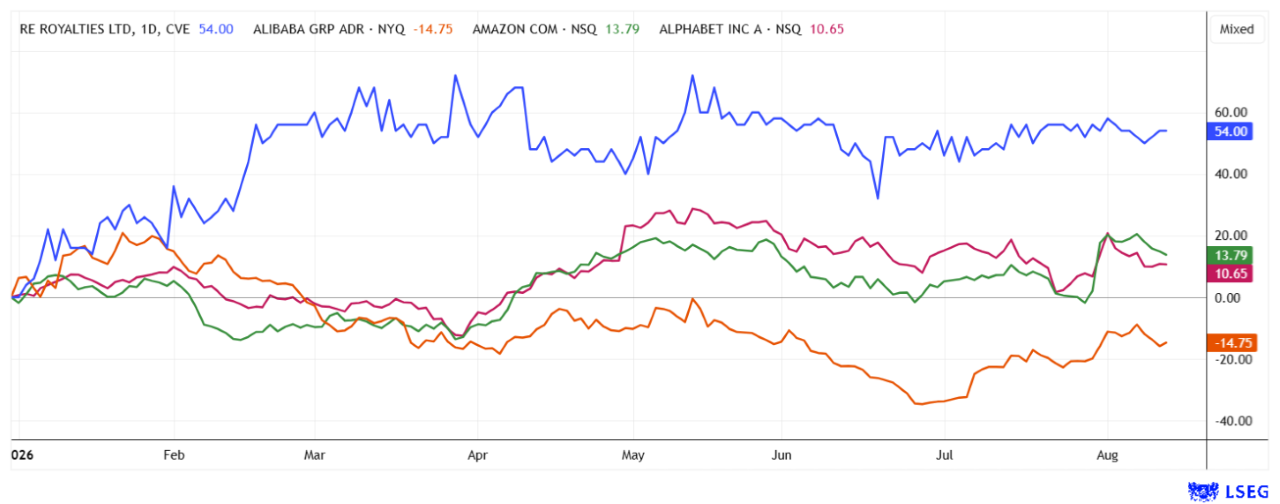
The world is investing billions to really get “AI” off the ground. Leading the charge are the tech giants, which are channelling their abundant cash flows almost exclusively into this sector. But Asia is also investing heavily in IT and power infrastructure. The Alibaba Group started as a B2B procurement platform; today, the group operates payment portals and is investing vast sums in its modern tech ecosystem. RE Royalties could be poised for its next big leap; investors should keep the stock high on their watchlist.
Conflict of interest
Pursuant to §85 of the German Securities Trading Act (WpHG), we point out that Apaton Finance GmbH as well as partners, authors or employees of Apaton Finance GmbH (hereinafter referred to as “Relevant Persons”) currently hold or hold shares or other financial instruments of the aforementioned companies and speculate on their price developments. In this respect, they intend to sell or acquire shares or other financial instruments of the companies (hereinafter each referred to as a “Transaction”). Transactions may thereby influence the respective price of the shares or other financial instruments of the Company.
In this respect, there is a concrete conflict of interest in the reporting on the companies.
In addition, Apaton Finance GmbH is active in the context of the preparation and publication of the reporting in paid contractual relationships.
For this reason, there is also a concrete conflict of interest.
The above information on existing conflicts of interest applies to all types and forms of publication used by Apaton Finance GmbH for publications on companies.
Risk notice
Apaton Finance GmbH offers editors, agencies and companies the opportunity to publish commentaries, interviews, summaries, news and the like on news.financial. These contents are exclusively for the information of the readers and do not represent any call to action or recommendations, neither explicitly nor implicitly they are to be understood as an assurance of possible price developments. The contents do not replace individual expert investment advice and do not constitute an offer to sell the discussed share(s) or other financial instruments, nor an invitation to buy or sell such.
The content is expressly not a financial analysis, but a journalistic or advertising text. Readers or users who make investment decisions or carry out transactions on the basis of the information provided here do so entirely at their own risk. No contractual relationship is established between Apaton Finance GmbH and its readers or the users of its offers, as our information only refers to the company and not to the investment decision of the reader or user.
The acquisition of financial instruments involves high risks, which can lead to the total loss of the invested capital. The information published by Apaton Finance GmbH and its authors is based on careful research. Nevertheless, no liability is assumed for financial losses or a content-related guarantee for the topicality, correctness, appropriateness and completeness of the content provided here. Please also note our Terms of use.
Stockhouse does not provide investment advice or recommendations. All investment decisions should be made based on your own research and consultation with a registered investment professional. The issuer is solely responsible for the accuracy of the information contained herein. For full disclaimer information, please click here.