
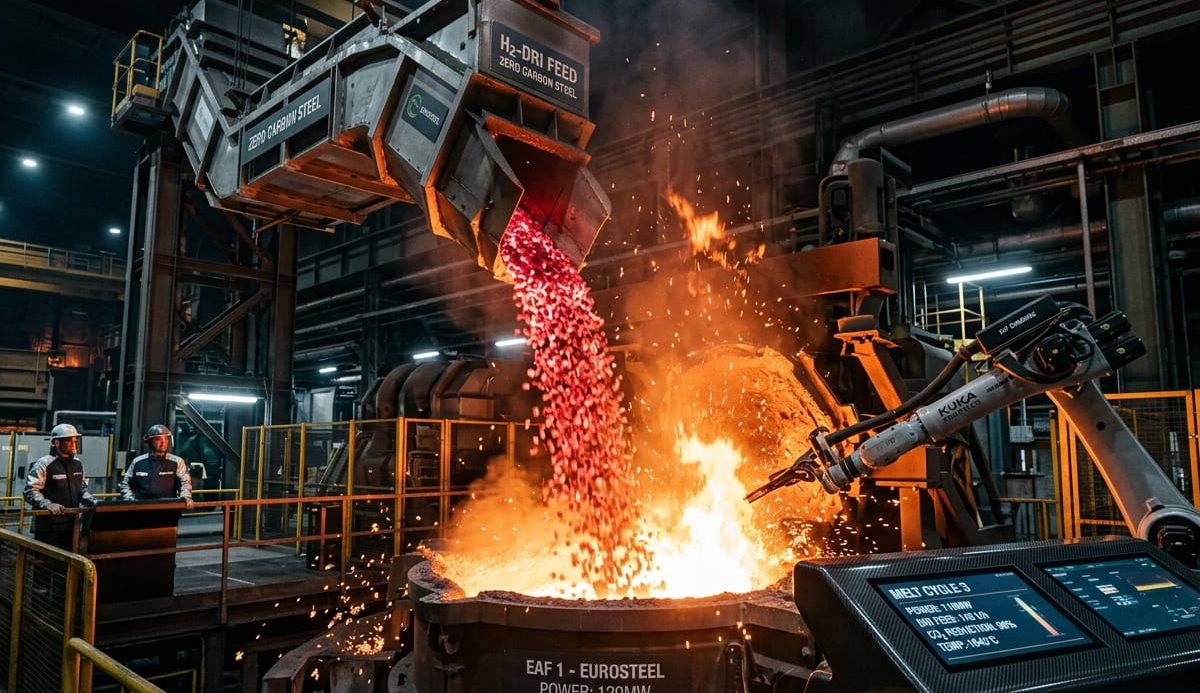

thyssenkrupp Undertakes Billion-Euro Restructuring in Duisburg
In the Ruhr region, Germany’s largest steel group, thyssenkrupp, is driving the biggest transformation in its corporate history to reduce future CO₂ emissions. Under the name tkH2Steel, a modern direct reduction plant with an annual capacity of 2.5 million metric tons of directly reduced iron is being built at the Duisburg site. The project, which costs EUR 3 billion, is receiving EUR 2 billion in government subsidies to reduce CO₂ emissions from the group’s steel division by about 30% by 2030. However, instead of melting the resulting intermediate product in new electric furnaces, management is relying on a different process: the hot material flows directly into two innovative electric remelting furnaces and is then transferred to the converters in liquid form. In this way, thyssenkrupp ensures that material certifications for automotive sheet metal and specialty steels are maintained. At the same time, the Group is completing its transformation into a decentralized financial holding company through its ACES 2030 strategy. To date, it has spun off 49% of its marine division, TKMS, via a direct stock market listing, and is preparing for the proportional spin-off of the tk accelis division.
Salzgitter Focuses on Direct Reduction with SALCOS
thyssenkrupp’s competitor in Lower Saxony is charting its own course and, through the SALCOS program, is aiming for the complete decarbonization of its steel production by 2033. The first construction phase includes a direct reduction plant with an annual output of 1.9 to 2.0 million metric tons of sponge iron, which will be directly coupled to a flexible electric arc furnace. Salzgitter is investing approximately EUR 2 billion in the first SALCOS expansion phase and has secured EUR 1.32 billion in subsidies for this purpose. To ensure regional production and gradually transition to low-emission processes, Salzgitter acquired the entire Hüttenwerke Krupp Mannesmann in July 2026 and commissioned the plant manufacturer Tenova to construct a new electric arc furnace.
Despite these investments, both thyssenkrupp and Salzgitter face challenges. Conventional blast furnaces can easily smelt low-grade ore, but shaft furnaces operate on solid ore and require DR pellets with a minimum iron content of 67%. Since Vale, Rio Tinto, and BHP control over 70% of the seaborne market, and their standard ores from Western Australia’s Pilbara region typically contain too many impurities, there is an acute shortage of premium feedstock for the “green” steel industry on the global market.
Strategic Resources Solves the Steel Industry’s Problems
This is precisely the supply gap that the mineral resource developer Strategic Resources aims to close. At the heart of the company is the 100%-owned BlackRock Project in the Canadian province of Québec, considered a massive vanadium-titanium-magnetite deposit. The BlackRock Project has proven and probable reserves of 127.8 million metric tonnes of ore with an iron oxide content of 40.2% and a calculated mine life of 39 years. However, to generate cash flow as quickly as possible, management is prioritizing the construction of an industrial pelletizing plant at the year-round ice-free deep-water port of Port Saguenay, from where freighters can sail directly to European steel mills via the St. Lawrence Seaway. The plant is designed for an annual output of 4.0 million metric tonnes of high-purity DR pellets with an iron content of at least 67% and will initially be supplied from other mines. The port location benefits from clean hydropower, has a natural gas connection, and features a government-subsidized CAD 111 million conveyor belt system that connects directly to the wharf facilities. A preliminary economic analysis by the engineering firm BBA estimates the investment costs for the pelletizing plant at USD 470 million and calculates an annual EBITDA of USD 173 million, as well as a net present value after taxes of USD 957 million at an internal rate of return of 25%. For the entire mining and metallurgical industrial complex, the company even estimates a total value in the billions.
Additional Projects and the Share’s Potential
To mitigate risks, Strategic Resources relies on strong partners and government support. A key factor is the binding 10-year agreement with the global commodities trader Javelin Global Commodities, which contractually guarantees both the supply of 4.0 million metric tonnes of raw concentrate and the purchase of the finished DR pellets. In addition, subject to due diligence, trading partner Javelin is providing the Canadian project with a secured working-capital credit line of USD 150 million. There is also unusual stability on the shareholder side. The government development agency Investissement Québec and the commodity fund Orion Mine Finance each hold approximately 41% of the shares and support the project both politically and financially.
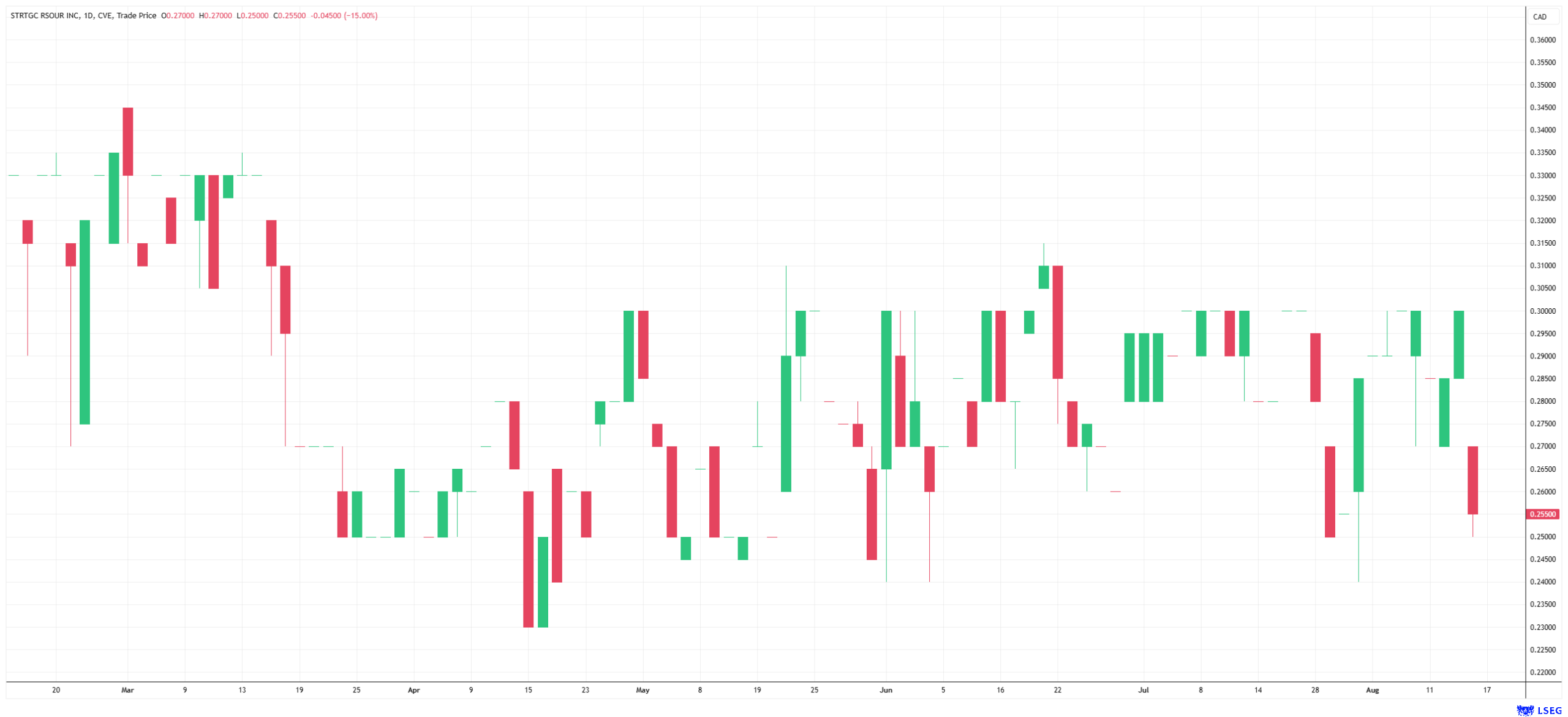
At the same time, the company is developing the Mustavaara project in northern Finland, a historic vanadium-titanium-magnetite property for which a preliminary study indicates an after-tax net present value of EUR 190 million. When Strategic Resources’ promising projects are weighed against its market capitalization of approximately CAD 20 million, questions arise. In fact, the market likely still prices in some development risks for Strategic Resources. However, given the partnership with Javelin Global Commodities, the company’s economic fundamentals and the transformation of the steel industry, it is questionable whether such a significant discount is justified. Strategic Resources occupies a promising niche, which also makes the stock an interesting prospect. Speculative investors should take a closer look.
Conflict of interest
Pursuant to §85 of the German Securities Trading Act (WpHG), we point out that Apaton Finance GmbH as well as partners, authors or employees of Apaton Finance GmbH (hereinafter referred to as “Relevant Persons”) may hold shares or other financial instruments of the aforementioned companies in the future or may bet on rising or falling prices and thus a conflict of interest may arise in the future. The Relevant Persons reserve the right to buy or sell shares or other financial instruments of the Company at any time (hereinafter each a “Transaction”). Transactions may, under certain circumstances, influence the respective price of the shares or other financial instruments of the Company.
In addition, Apaton Finance GmbH is active in the context of the preparation and publication of the reporting in paid contractual relationships.
For this reason, there is a concrete conflict of interest.
The above information on existing conflicts of interest applies to all types and forms of publication used by Apaton Finance GmbH for publications on companies.
Risk notice
Apaton Finance GmbH offers editors, agencies and companies the opportunity to publish commentaries, interviews, summaries, news and the like on news.financial. These contents are exclusively for the information of the readers and do not represent any call to action or recommendations, neither explicitly nor implicitly they are to be understood as an assurance of possible price developments. The contents do not replace individual expert investment advice and do not constitute an offer to sell the discussed share(s) or other financial instruments, nor an invitation to buy or sell such.
The content is expressly not a financial analysis, but a journalistic or advertising text. Readers or users who make investment decisions or carry out transactions on the basis of the information provided here do so entirely at their own risk. No contractual relationship is established between Apaton Finance GmbH and its readers or the users of its offers, as our information only refers to the company and not to the investment decision of the reader or user.
The acquisition of financial instruments involves high risks, which can lead to the total loss of the invested capital. The information published by Apaton Finance GmbH and its authors is based on careful research. Nevertheless, no liability is assumed for financial losses or a content-related guarantee for the topicality, correctness, appropriateness and completeness of the content provided here. Please also note our Terms of use.
Stockhouse does not provide investment advice or recommendations. All investment decisions should be made based on your own research and consultation with a registered investment professional. The issuer is solely responsible for the accuracy of the information contained herein. For full disclaimer information, please click here.