


Stage 1: The Origin – Organic Pest Control Instead of Chemical Pesticides
Consumer protection begins in the field. More than 568 synthetic chemical pesticide active ingredients have already been banned worldwide. Agriculture therefore urgently needs chemical-free alternatives. This is exactly where MustGrow Biologics comes in. The Canadian company extracts natural bioactives from mustard seeds to develop biological solutions for agriculture. Its technology has given rise to two product lines with distinct applications: the already approved biofertility product TerraSante™, which provides key nutrients to the soil and soil microbiome, and the pre-registered biopesticide TerraMG™, which is being developed to target nematodes, pests and soil-borne diseases without relying on traditional chemicals and fertilizers. The business model is deliberately designed to conserve capital. Instead of operating its own factories, MustGrow relies on contract manufacturers while retaining ownership of the patents—approximately 110 have been granted or are pending. This makes the business highly scalable. The current production capacity of approximately 650 metric tons of TerraSante™ could be expanded to up to 3,900 metric tons without requiring significant investment. At full capacity, revenue of USD 50 million to USD 100 million with gross margins of 40% to 60% would be achievable. This contrasts with a current market capitalization of just USD 20.2 million (CAD 28.2 million).
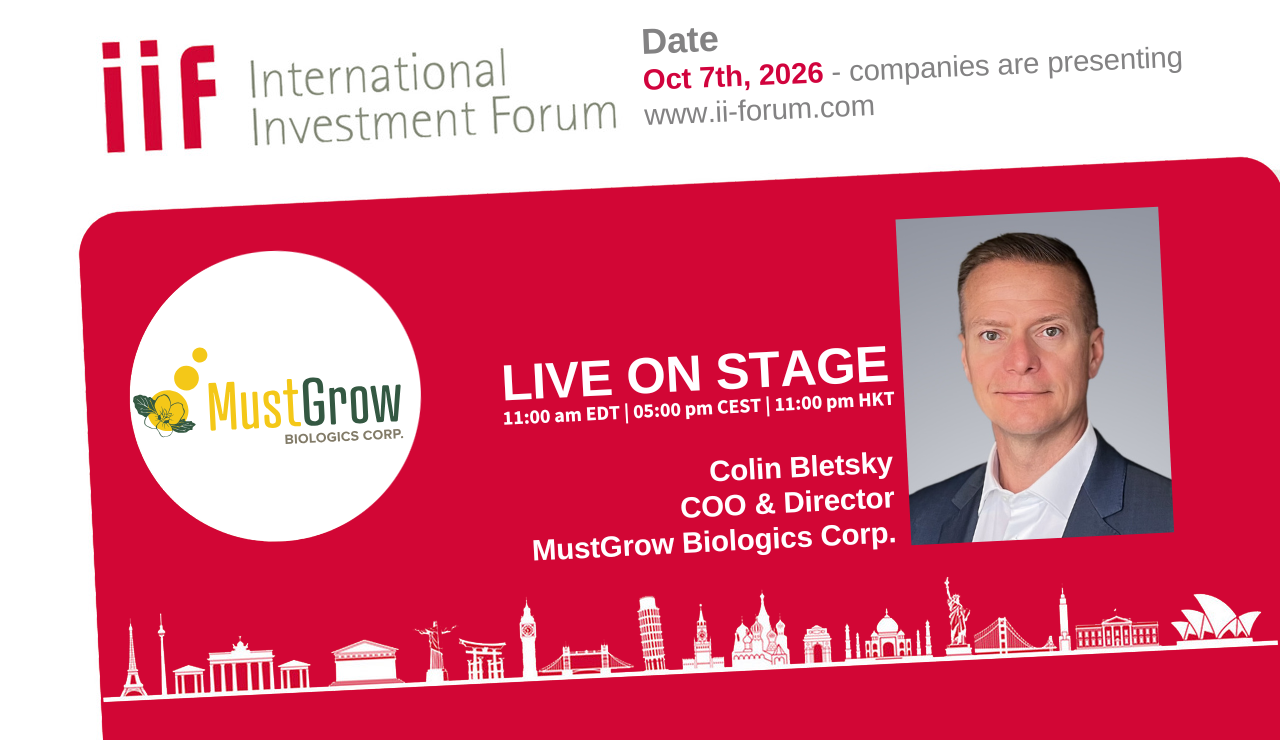
The real leverage lies in the partnership with the German agricultural and pharmaceutical group Bayer. The Leverkusen-based DAX-listed company secured the license for the TerraMG™ technology in Europe, the Middle East, and Africa (EMEA) in 2023 and will handle development, regulatory approval, and sales in those regions. MustGrow estimates that the value of the upfront and milestone payments, plus development work, could total about USD 35 million to USD 40 million over the next 5 to 7 years, with ongoing royalty payments to follow once approval is granted. MustGrow received the first of these milestone payments in August. This confirms that the joint development is making technical progress, even though the exact amount of the payment remains confidential. Anyone looking to learn more about the MustGrow investment story will have the opportunity to do so on October 7. On that day, Colin Bletsky, Chief Operating Officer and Director at MustGrow, will present the company’s strategy at 5:00 pm at the International Investment Forum (IIF). The IIF is one of the leading virtual small-cap investor conferences and is also open to retail investors.
https://us06web.zoom.us/webinar/register/WN_KxUBth5WSYagM_MwU_P4fw#/registration Click here to register:
License revenue of CAD 1.4 million helped MustGrow move into the black in the second quarter—resulting in a net profit of CAD 400,000. However, product revenue from TerraSante™ came in weak, as expected, at CAD 75,000, because contract manufacturers first had to switch over their production, and expensive air freight weighed on margins. Nevertheless, TerraSante™ revenue since the beginning of the year stands at CAD 900,000 (as of mid-August), up 46% from the total for the previous year. Following the planned switch from air to sea freight, management expects the gross margin to recover to 25–30%. With ongoing operating costs of approximately CAD 900,000 per quarter, MustGrow is well positioned to scale further, with CAD 4.4 million in cash and cash equivalents and CAD 5.2 million in working capital; its debt is marginal at approximately CAD 377,000. A significantly oversubscribed capital increase in June raised an additional CAD 3.74 million—the original target had been only CAD 2.0 million. In early September, Tyler Reinheimer was also appointed CFO, strengthening the finance team.
The Augsburg-based research firm GBC Research took a closer look at the stock in July. The experts estimate TerraSante’s revenue for the current year at CAD 4.5 million and expect it to rise to CAD 14.1 million (2027) and CAD 31.6 million (2028). Based on this, GBC issues a “Buy” rating and sets a price target of CAD 2.70, or EUR 1.66, by December 31, 2027. Based on the current share price of CAD 0.41 (EUR 0.25 on German exchanges), this represents upside potential of more than 500%. However, this scenario hinges on the products receiving full approval in key global markets. Until then, MustGrow remains dependent on further milestone payments, but the mass market for private-label products is still in its infancy and offers enormous potential. Initial sales successes in test regions such as California, Washington, and Florida show that the Canadian company is on the right track.
Stage 2: Processing – Brand Manufacturers Caught Between Cost-Cutting and Restructuring
At the second stage of the chain, expensive raw materials meet cost-conscious consumers. Figures from Hain Celestial illustrate just how painful this balancing act can be. The US consumer goods manufacturer focuses on producing and distributing healthy “better-for-you” foods and natural products such as tea, yoghurt, and baby and children’s food, marketed through traditional retail channels and e-commerce. Revenue fell by 13% to USD 1.35 billion in fiscal year 2025/26, which ended on June 30. Adjusted for divestitures and portfolio changes, the organic decline was 3%. The bottom line was a net loss of USD 305 million (previous year: USD 531 million), impacted by a goodwill impairment charge of USD 193 million. Adjusted earnings before interest, taxes, depreciation, and amortization (EBITDA) fell by 22% to USD 89 million, while the adjusted gross margin fell slightly to 20.5%.
The outlook for liquidity is more positive, which CEO Alison Lewis describes as “pivotal” – in other words, crucial: operating cash flow increased by 250% to USD 78 million, while free cash flow turned from a negative USD 3 million to a positive USD 58 million. As a result, total debt fell from USD 705 million to USD 558 million. Along with the financial results, Hain Celestial announced on Monday the next step toward recovery: the sale of its entire international business—including brands such as Ella’s Kitchen, Linda McCartney Foods, and New Covent Garden—to the German private equity firm Aurelius for approximately USD 323 million in cash. The proceeds from the sale are to be used almost entirely to reduce debt. Previously, the snack business, which included brands such as Terra Chips and Garden Veggie, had already been sold. What remains is a lean, North America-focused provider of organic products with strong brands such as Celestial Seasonings, Earth’s Best and The Greek Gods.
The brand-name company is under time pressure to sell its international business. Although the transaction is scheduled to be completed by the end of December, it is contingent on the lenders granting an extension. If this is not achieved within 30 days of signing the contract, Aurelius may withdraw from the purchase. On the balance sheet, USD 558 million of the debt is already classified as current. Analysts are accordingly cautious in their assessment of the stock: the consensus rating is “Hold”, and the average price target is USD 1.33. Given the current price of USD 0.63, that would represent a gain of more than 100%. However, estimates of fair value range from USD 0.50 to USD 3.00, depending on the analyst. This range illustrates how differently experts assess the prospects for the turnaround.
Stage 3: The Supermarket – Healthy Financials, but a Struggling Core Business
At the end of the chain is the retail sector. Sprouts Farmers Market has traditionally been regarded in the US as a particularly healthy cash cow. In the second quarter, net revenue rose 5% to USD 2.33 billion, the gross margin remained high at 38.7%, and earnings per share increased from USD 1.35 to USD 1.37, exceeding expectations. Analysts had expected, on average, a decline to USD 1.34. Operating cash flow reached USD 369 million in the first half of the year, of which USD 210 million alone went toward share buybacks. For the full year, management expects revenue growth of 5.5% to 6.5% and earnings per share of USD 5.32 to USD 5.40.
The catch lies in the details: comparable store sales (Comps) at existing stores that have been open for more than a year fell by 1.0% in the second quarter and by as much as 1.4% since the beginning of the year. Existing stores are losing momentum—Sprouts is currently able to grow primarily because it is adding new stores on an ongoing basis. There were 13 new store openings in the first half of the year, with a total of 42 planned for 2026—representing an investment of approximately USD 310 million. Added to this is a one-time calendar effect. The 2026 fiscal year has 53 weeks instead of the usual 52. The extra week in the final quarter artificially inflates revenue and profit—so the growth forecast by management should be taken with a grain of salt.
Despite the weakening same-store sales, most analysts remain optimistic. The consensus rating is “Buy”, and the average price target from 16 experts is USD 95. At the current price of USD 73.50, analysts see an average upside of about 30%. However, the range here also extends from USD 70 to USD 114, meaning the price potential ranges from no gain at all to a 55% chance of profit.
Who Has the Best Chance of Leaving the Drought Behind?
Ever since Amazon’s acquisition of Whole Foods in 2017, the organic sector has made its mark on the stock market. Yet, like producers and retailers of conventional pesticides and food, the industry cannot escape the effects of inflation or the economically driven slump in consumer sentiment. MustGrow Biologics, Hain Celestial, and Sprouts Farmers Market all traded at significantly higher levels years ago. The value chain also shows that organic is not a uniform theme on the stock market. Those seeking defensive quality will find it at Sprouts Farmers Market—but must keep an eye on its weak organic growth momentum. Those betting on a classic, but risky, turnaround should keep an eye on Hain Celestial until the loan extension is clarified in December. Analysts see the greatest upside potential at the very beginning of the chain: MustGrow Biologics’ current share price of CAD 0.41 contrasts with a target price of CAD 2.70. Whether this potential can be realized depends primarily on one question: Will the company succeed in making the leap from the initial milestone payments from Bayer to recurring licensing revenue? If so, the Canadian company has the best chance among the trio of quickly leaving the lean years behind.
Conflict of interest
Pursuant to §85 of the German Securities Trading Act (WpHG), we point out that Apaton Finance GmbH as well as partners, authors or employees of Apaton Finance GmbH (hereinafter referred to as “Relevant Persons”) may hold shares or other financial instruments of the aforementioned companies in the future or may bet on rising or falling prices and thus a conflict of interest may arise in the future. The Relevant Persons reserve the right to buy or sell shares or other financial instruments of the Company at any time (hereinafter each a “Transaction”). Transactions may, under certain circumstances, influence the respective price of the shares or other financial instruments of the Company.
In addition, Apaton Finance GmbH is active in the context of the preparation and publication of the reporting in paid contractual relationships.
For this reason, there is a concrete conflict of interest.
The above information on existing conflicts of interest applies to all types and forms of publication used by Apaton Finance GmbH for publications on companies.
Risk notice
Apaton Finance GmbH offers editors, agencies and companies the opportunity to publish commentaries, interviews, summaries, news and the like on news.financial. These contents are exclusively for the information of the readers and do not represent any call to action or recommendations, neither explicitly nor implicitly they are to be understood as an assurance of possible price developments. The contents do not replace individual expert investment advice and do not constitute an offer to sell the discussed share(s) or other financial instruments, nor an invitation to buy or sell such.
The content is expressly not a financial analysis, but a journalistic or advertising text. Readers or users who make investment decisions or carry out transactions on the basis of the information provided here do so entirely at their own risk. No contractual relationship is established between Apaton Finance GmbH and its readers or the users of its offers, as our information only refers to the company and not to the investment decision of the reader or user.
The acquisition of financial instruments involves high risks, which can lead to the total loss of the invested capital. The information published by Apaton Finance GmbH and its authors is based on careful research. Nevertheless, no liability is assumed for financial losses or a content-related guarantee for the topicality, correctness, appropriateness and completeness of the content provided here. Please also note our Terms of use.
Stockhouse does not provide investment advice or recommendations. All investment decisions should be made based on your own research and consultation with a registered investment professional. The issuer is solely responsible for the accuracy of the information contained herein. For full disclaimer information, please click here.