

SAP: A Historic AI Opportunity for the Software Giant
The Walldorf-based software company may be on the cusp of a transition to an entirely new era of enterprise software. For the South German firm, artificial intelligence is no longer just a marketing buzzword; it is being integrated, in a highly profitable way, into actual business management. CEO Christian Klein sees these innovative AI agents as a historic opportunity for massive, sustainable growth. In the future, these intelligent, self-learning assistants are set to become deeply embedded in customers’ day-to-day processes, delivering enormous productivity gains. The company is wisely not relying exclusively on external language models but is leveraging its own vast data treasure trove to create a genuine “moat” and competitive advantage.
On the operational side, the machinery is already running at full speed. Thanks to a strong cloud business, revenue climbed 8% in 2025 to EUR 36.8 billion. Bottom line, the DAX-listed company posted a net profit of EUR 7.5 billion. At the same time, management is demonstrating enormous financial strength and confidence in its own future strategy. In just a few trading days in mid-September, the company repurchased hundreds of thousands of its own shares on the stock exchange. On the one hand, this supports the share price; on the other hand, it also boosts earnings (in terms of earnings per share), as the total number of shares decreases when the shares are retired following the buyback. Excitement is building, as the next key quarterly results are expected as early as the end of October.
Analysts, too, are practically falling over themselves with their positive assessments of the stock. Experts at Jefferies, for example, have set a price target of EUR 220, while Bank of America considers EUR 226 a slightly more realistic figure. From a technical analysis perspective, a “Buy” signal has already emerged. The closely watched 50-day SMA has crossed above the longer-term 200-day SMA. Experts call this a “golden cross”. If the stock now manages to sustainably break above the strong resistance zone ranging between EUR 190 and EUR 200, the path upward would be almost completely clear from a purely technical perspective and could move toward the price targets set by the analysts mentioned above.
While SAP floats in the digital clouds, the Ruhr region is grappling with the industrial challenges posed by steel. It is precisely here that a political decision is now providing a tailwind.
thyssenkrupp: A Political Lifeline for Steelmakers
After long months of uncertainty, the European steel industry is finally breathing a noticeable sigh of relief. The European Union has enacted provisional safeguard measures in the form of fixed import quotas and strict minimum prices for electrical steel. This grain-oriented special steel is an enormously important, and above all high-margin, pillar of the Essen-based company’s day-to-day business. The new, strict regulations are intended to effectively shield domestic producers from extremely cheap imports from overseas. For the battered thyssenkrupp Steel Europe division, this is a much-needed and perhaps lifesaving lifeline in the face of “unfair” global competition.
The “guidelines” for this measure have been clearly defined by policymakers. Within the approved quotas, minimum prices ranging from EUR 2,800 to EUR 3,400 per metric ton apply immediately; if these limits are exceeded, prices rise to as high as EUR 3,500. These price floors now give management the financial planning certainty needed for the ongoing corporate restructuring. This political backing comes at just the right time, especially ahead of the steel division’s eagerly anticipated Capital Markets Day. Market participants now hope to gain insight into the traditional conglomerate’s future strategic direction.
Stock market investors are already applauding this development. The stock celebrated the news on Friday with a price jump of over 3% and closed strongly at over EUR 15. Since the beginning of the year, the gain has already exceeded 60%, a fact that alone proves many critics wrong—after all, so many had written the stock off just a few years ago. Just under two years ago, the share price stood at just over EUR 2. Today, there is little, if anything, left of that situation.
We now leave thyssenkrupp and SAP, and therefore Germany as well, and take a look across the Atlantic at NU E Power in North America.
NU E Power: Energy Infrastructure Projects and an Interesting Technical Setup
NU E Power follows the strategic “develop-to-divest” business model. The company enters energy infrastructure projects at a relatively early stage and aims to do so as cost-effectively as possible. The real value is then created through so-called “de-risking”, in which NUE handles the fundamentals such as land rights, regulatory approvals and grid connections. Once projects reach construction-ready status, they are ideally sold to financially strong institutional buyers or pension funds. The profit generated is then typically reinvested quickly into new projects. The focus is primarily on regions experiencing rapid growth in power demand for computationally intensive applications such as artificial intelligence, data centres and large industrial facilities.
The current developments surrounding the Hays project in southern Alberta demonstrate that this strategy is being implemented. NUE has signed a non-binding letter of intent (LOI) to acquire 100% of this solar and battery storage project, which has a planned solar capacity of 145 MWac and a 123 MWh battery energy storage system (BESS). The purchase price of approximately CAD 7.25 million is tied to achieving specific milestones. Completion of the non-binding LOI remains subject to seven conditions precedent. Hays has no executed interconnection agreement and no power purchase agreement or offtake arrangement in place. Following completion of the Hays acquisition, the portfolio would increase to approximately 1,258 MW gross and 760 MW net.
This operational growth is set to be supported by two key management appointments. John Windsor, who brings more than 20 years of industry experience, was appointed COO at the end of August to oversee permitting and construction. In addition, Peter Espig, an expert in cross-border transactions and project financing, was appointed to the Board of Directors.
The company has also emphasized transparent communication in its corporate updates, providing regular information on project developments and milestones.
From a technical analysis perspective, the stock has been consolidating for several weeks within a sideways channel, with the boundaries roughly between CAD 0.11 and CAD 0.17. A sustained move above the CAD 0.17 level would represent a technical breakout from this range. The chart therefore provides a clear reference point for monitoring future trading activity.
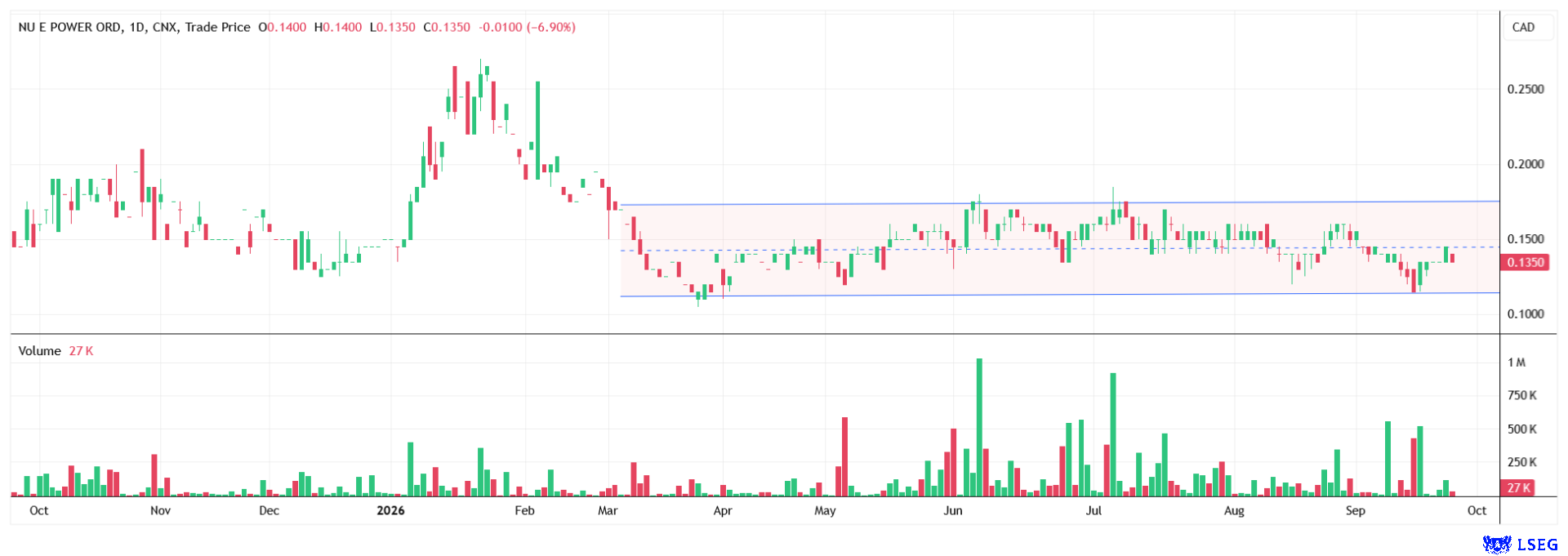
SAP currently combines strong cloud growth with significant AI developments, while its chart has formed a “Golden Cross”. At thyssenkrupp, new EU protective measures are providing greater planning certainty for the specialty steel business. NU E Power, meanwhile, remains within a sideways trading range, with CAD 0.17 currently marking the upper boundary of the range. A sustained move above this level would constitute a technical breakout.
Conflict of interest
Pursuant to §85 of the German Securities Trading Act (WpHG), we point out that Apaton Finance GmbH as well as partners, authors or employees of Apaton Finance GmbH (hereinafter referred to as “Relevant Persons”) may hold shares or other financial instruments of the aforementioned companies in the future or may bet on rising or falling prices and thus a conflict of interest may arise in the future. The Relevant Persons reserve the right to buy or sell shares or other financial instruments of the Company at any time (hereinafter each a “Transaction”). Transactions may, under certain circumstances, influence the respective price of the shares or other financial instruments of the Company.
In addition, Apaton Finance GmbH is active in the context of the preparation and publication of the reporting in paid contractual relationships.
For this reason, there is a concrete conflict of interest.
The above information on existing conflicts of interest applies to all types and forms of publication used by Apaton Finance GmbH for publications on companies.
Risk notice
Apaton Finance GmbH offers editors, agencies and companies the opportunity to publish commentaries, interviews, summaries, news and the like on news.financial. These contents are exclusively for the information of the readers and do not represent any call to action or recommendations, neither explicitly nor implicitly they are to be understood as an assurance of possible price developments. The contents do not replace individual expert investment advice and do not constitute an offer to sell the discussed share(s) or other financial instruments, nor an invitation to buy or sell such.
The content is expressly not a financial analysis, but a journalistic or advertising text. Readers or users who make investment decisions or carry out transactions on the basis of the information provided here do so entirely at their own risk. No contractual relationship is established between Apaton Finance GmbH and its readers or the users of its offers, as our information only refers to the company and not to the investment decision of the reader or user.
The acquisition of financial instruments involves high risks, which can lead to the total loss of the invested capital. The information published by Apaton Finance GmbH and its authors is based on careful research. Nevertheless, no liability is assumed for financial losses or a content-related guarantee for the topicality, correctness, appropriateness and completeness of the content provided here. Please also note our Terms of use.
Stockhouse does not provide investment advice or recommendations. All investment decisions should be made based on your own research and consultation with a registered investment professional. The issuer is solely responsible for the accuracy of the information contained herein. For full disclaimer information, please click here.