
AeroVironment: US Market Leader Flexes Its Muscles
The US company AeroVironment has demonstrated, through its performance over the past few quarters, the enormous scale that unmanned aviation is reaching. In fiscal year 2026 (ending in April), AeroVironment increased its revenue by 141% to just under USD 1.98 billion, thanks in part to the BlueHalo acquisition. The funded order backlog most recently reached USD 1.5 billion. Through targeted acquisitions such as BlueHalo, the company no longer operates merely as a hardware supplier but as a systems integrator for aerospace and cyber defence. Major contracts, such as a US Army laser contract worth approximately USD 465 million, underscore this position. However, this growth comes at a cost: the convertible bonds alone total USD 747.5 million. In the first quarter of the current fiscal year, the company reported a loss of USD 5.1 million, compared to a loss of USD 67.4 million in the prior year. With a market capitalization of just over USD 7 billion, AeroVironment nevertheless plays in a different league than its Canadian competitors.
Draganfly: Expansion Through Prominent US Investors
On the Canadian side, Draganfly is pursuing a completely different strategy and seeking connections with financially strong networks in the United States. The company secured liquidity through direct capital increases and received a USD 10 million capital injection at the end of September 2026. These funds came in equal parts from an unnamed US fund and Unusual Machines, a company backed by Donald Trump Jr. Operationally, Draganfly’s quarterly revenue climbed 26% to CAD 2.66 million in the second quarter of 2026. At the same time, the quarterly loss widened to CAD 11.8 million. This figure includes a one-time, non-cash stock-based compensation expense of CAD 3.7 million. Thanks to a large financing round in February, Draganfly nevertheless had CAD 131.9 million in cash on hand as of June 30. The company plans to use the fresh capital to hire new employees and expand manufacturing. Technologically, Draganfly relies on swarm software from its partner, Palladyne AI. In the US, it also supplies FPV drones and training to US Air Force special operations forces.
Volatus Aerospace: Series Production and Innovation in Canada
Volatus Aerospace, by contrast, is firmly focused on its home market and is currently scaling up its own series production. At the end of September, Volatus Aerospace officially opened its 53,000-square-foot (approximately 4,900 m²) facility in Mirabel near Montréal, with Business Development Bank of Canada (BDC) CEO Isabelle Hudon present. The plant has been operational since June. The facility produces automated docking stations that can land and recharge drones completely autonomously while also downloading their data. CEO Glen Lynch makes it clear: technology alone is not enough. It is essential to be able to build the systems domestically.
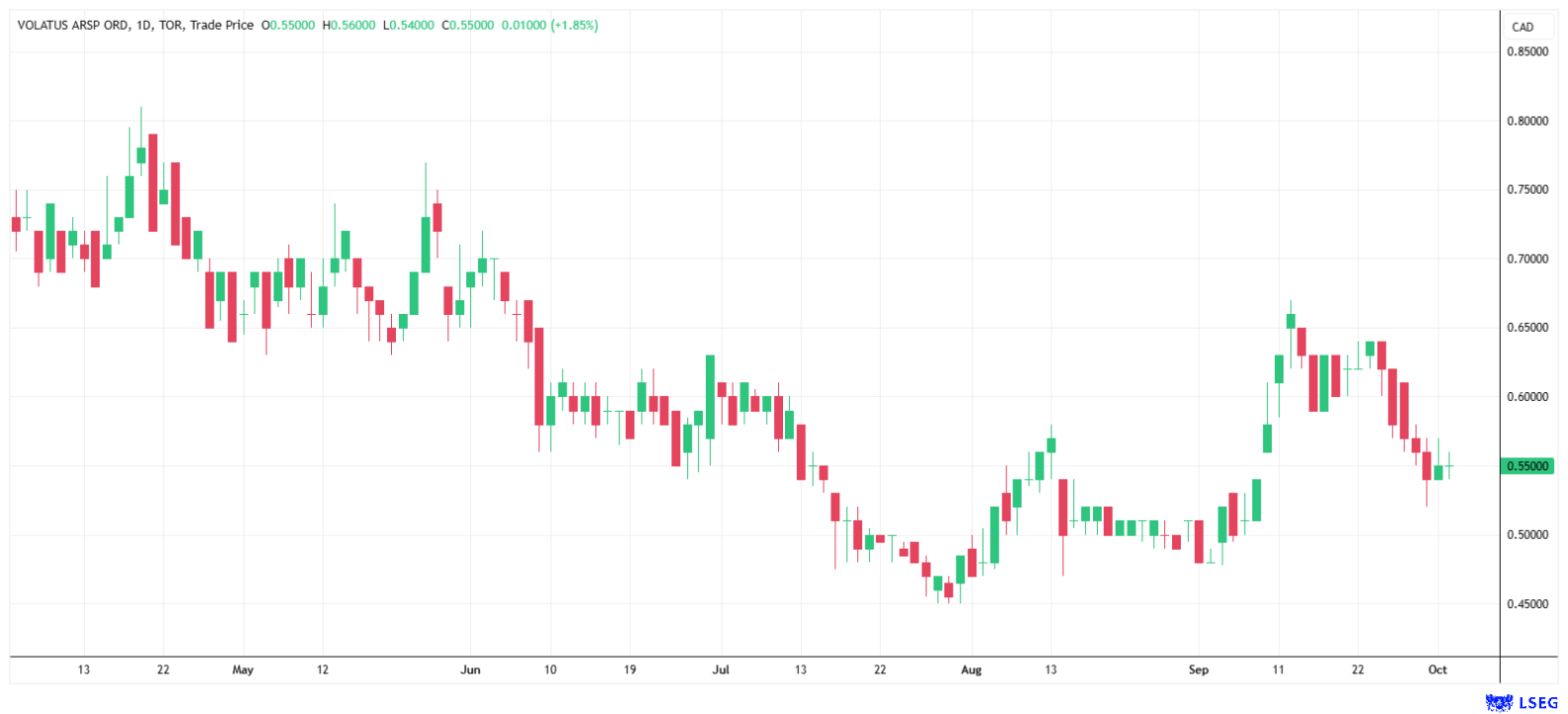
At the same time, Volatus Aerospace is reporting breakthroughs in control systems. The AI control system V-Cortex navigated during initial flight tests without satellite signals, relying solely on standard onboard sensors and without additional sensors or high-performance computers. This is intended to ensure it functions even in areas with hostile jammers. This saves weight and reduces the cost per unit. Also in September, Volatus secured a 5-year framework agreement with the Canadian Armed Forces: An initial firm order is for 100 tactical reconnaissance drones, and Ottawa can call up to 4,900 more. With a price cap of CAD 5,000 per system, the maximum contract value is CAD 25 million. The initial order represents a maximum of approximately CAD 500,000 in revenue. Investors are therefore waiting for the first call-offs as evidence of scaling.
Volatus Aerospace: Civilian Cargo and Military Diversification
To reduce the risk associated with individual military contracts, Volatus Aerospace is expanding into civilian logistics. Through its US subsidiary, the company has currently filed an exemption application with the Federal Aviation Administration (FAA). The goal: The FB3 heavy-lift drone from Italian manufacturer FlyingBasket is intended to perform commercial cargo flights in the future with an operating weight of just under 400 pounds. On the military side, existing agreements are supporting the business. Volatus Aerospace is currently fulfilling a NATO contract worth up to CAD 9 million for reconnaissance training systems. In addition, there is a memorandum of understanding with Sentinel R&D to develop a Canadian interceptor drone and another training contract. The company ended the second quarter of 2026 with cash reserves of CAD 59.2 million. Operationally, however, Volatus remained in the red with revenue of CAD 8.4 million; adjusted EBITDA was approximately minus CAD 4.4 million. Global supply chain issues also slowed progress. Battery and motor shortages delayed delivery of a defence contract worth about CAD 2.6 million. The revenue forecast for 2026 is now approximately CAD 50.6 million, down from the previous estimate of CAD 56 million.

Volatus Aerospace: Tailwind from Canada’s Billion-Dollar Initiative
Canada’s defence industry is receiving a strong boost from the new defence industry strategy. It promises domestic companies procurement contracts totaling approximately CAD 180 billion over 10 years, to be administered by the new Defence Investment Agency (DIA). Defence Minister David McGuinty’s policy is clearly aimed at supporting domestic capabilities. Awarding framework contracts also shows that Ottawa is placing its trust in multiple manufacturers and seeking to avoid monopolies. In addition to Volatus, Draganfly also received a similarly structured framework contract; a total of six suppliers were selected. Nevertheless, the path to scaling up places significant operational demands on Volatus Aerospace. Success depends on robust supply chains and the ability to thrive despite initially small production volumes. However, the underlying dynamics in the drone sector provide a positive environment: If Volatus Aerospace delivers the first batch of tactical reconnaissance drones, the door to further large-scale government contracts should be wide open.
Conflict of interest
Pursuant to §85 of the German Securities Trading Act (WpHG), we point out that Apaton Finance GmbH as well as partners, authors or employees of Apaton Finance GmbH (hereinafter referred to as “Relevant Persons”) currently hold or hold shares or other financial instruments of the aforementioned companies and speculate on their price developments. In this respect, they intend to sell or acquire shares or other financial instruments of the companies (hereinafter each referred to as a “Transaction”). Transactions may thereby influence the respective price of the shares or other financial instruments of the Company.
In this respect, there is a concrete conflict of interest in the reporting on the companies.
In addition, Apaton Finance GmbH is active in the context of the preparation and publication of the reporting in paid contractual relationships.
For this reason, there is also a concrete conflict of interest.
The above information on existing conflicts of interest applies to all types and forms of publication used by Apaton Finance GmbH for publications on companies.
Risk notice
Apaton Finance GmbH offers editors, agencies and companies the opportunity to publish commentaries, interviews, summaries, news and the like on news.financial. These contents are exclusively for the information of the readers and do not represent any call to action or recommendations, neither explicitly nor implicitly they are to be understood as an assurance of possible price developments. The contents do not replace individual expert investment advice and do not constitute an offer to sell the discussed share(s) or other financial instruments, nor an invitation to buy or sell such.
The content is expressly not a financial analysis, but a journalistic or advertising text. Readers or users who make investment decisions or carry out transactions on the basis of the information provided here do so entirely at their own risk. No contractual relationship is established between Apaton Finance GmbH and its readers or the users of its offers, as our information only refers to the company and not to the investment decision of the reader or user.
The acquisition of financial instruments involves high risks, which can lead to the total loss of the invested capital. The information published by Apaton Finance GmbH and its authors is based on careful research. Nevertheless, no liability is assumed for financial losses or a content-related guarantee for the topicality, correctness, appropriateness and completeness of the content provided here. Please also note our Terms of use.
Stockhouse does not provide investment advice or recommendations. All investment decisions should be made based on your own research and consultation with a registered investment professional. The issuer is solely responsible for the accuracy of the information contained herein. For full disclaimer information, please click here.