
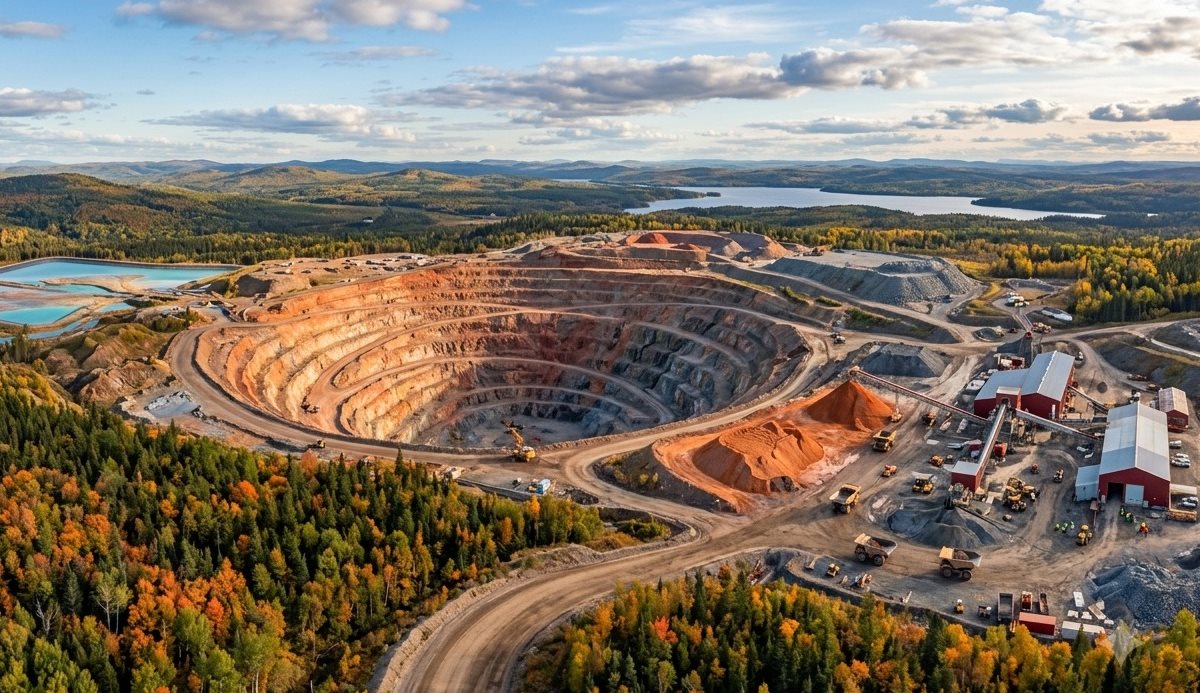

BHP: Mounting Concerns at Escondida
The fact that BHP’s copper production is coming under pressure is no surprise to industry experts. However, challenges have mounted in the current fiscal year—and the company is not always to blame. The world’s largest mining company is grappling with geological challenges at its flagship Escondida mine, the world’s largest copper mine.
BHP has been struggling with declining ore grades at Escondida for quite some time. The deposit in the Atacama Desert in northern Chile was first discovered in 1981, and commercial operations have run since December 1990. As a result, signs of ageing are becoming apparent. Over the past three and a half decades, miners have already extracted the highest-grade ore. The average grade has now fallen to just 0.70%.
To extract the same amount of copper, the company must mine, transport, and process significantly more rock.Because processing plant capacity is limited, lower metal content directly reduces total copper production. For this fiscal year, BHP therefore expects consolidated copper production to decline to between 1.65 and 1.80 million metric tons. Last year, production was still nearly 2 million metric tons. Adding to this are temporary disruptions from collective bargaining negotiations, which led to brief strikes.
BHP is now investing heavily in infrastructure at Escondida. For example, it will build a new processing plant and expand the desalination plants. During the renovation, operations cannot run at full capacity continuously.
BHP will therefore have to contend with these circumstances, at least this year. However, the high copper price could offset some of the production shortfalls. This is why BHP’s stock continues to trade at a high level and has maintained the gains it made since last year. Investors who believe copper prices will keep rising, and the market will remain tight, can gradually build their positions.
Power Metallic Mines: A Second Chance
Power Metallic Mines’ stock posted a strong run-up ahead of the resource study published in early September for the NISK polymetallic project in northern Québec, Canada. The stock rose 50% from its August low of CAD 1. However, following the study’s release, the stock plummeted as investors took profits. This presents an opportunity for new investors to get a foot in the door at a lower price level.
The resource estimate itself applied only to a portion of the property, specifically the Lion deposit. The indicated resource now comprises 4.145 million metric tons of ore with an average grade of 3.86% copper equivalent and 2.03% nickel equivalent. The lower-tier Inferred category includes an additional 0.601 million metric tons of ore, with 4.01% copper equivalent and 1.61% nickel equivalent. This means that more than 85% of the total resource falls into the higher-tier Indicated category. Notably, in addition to copper and nickel, the deposit also contains platinum, palladium, gold, and silver. Another advantage for future mining is that the majority of the metals are located in the near-surface zone. Incidentally, the resource is based on drill results from the ongoing 100,000-meter drilling program and includes data only through mid-April.
When it comes to copper or polymetallic deposits, size is the most important factor. In this regard, it is equally important for the company that the resource can be expanded further. Exploration of the Lion Zone is continuing at greater depths, as are further discoveries in the immediate vicinity. The latest drilling results show that drilling deeper is particularly worthwhile. At a depth of 845 m in drill hole PML-26-125, the team intersected an interval containing 14% copper equivalent over a length of 5.70 m.
Investors will likely focus on the next milestone. Based on the initial resource estimate, Power Metallic Mines is currently preparing a preliminary economic assessment (PEA). The company expects to release this economic analysis in the first half of 2027.
Analysts at GBC Research have recently updated their assessment of Power Metallic Mines. They recommend buying the stock and have set a price target of CAD 3, implying potential upside of nearly 200%.
Southern Copper: A Historic Turning Point
This year is likely to go down in the history books, and the global commodities market is no exception. For years, BHP and Rio Tinto ranked among the world’s most valuable mining companies by a considerable margin. Now, however, Rio Tinto has lost its position as the industry’s second-largest player by market capitalization. Southern Copper, a mining company focused primarily on copper, has overtaken the British-Australian group. The company is now valued at the equivalent of EUR 150 billion, while Rio Tinto stands at about EUR 102 billion.
Southern Copper’s stock has roughly quadrupled in value over the past four years. It currently trades just below its all-time high of nearly USD 220. What sets Southern Copper apart is its structure. The company was founded in the US in 1952, is headquartered in Phoenix, Arizona, and is listed on the NYSE. However, its main mines are located in Peru and Mexico, and the group is controlled by the Mexican mining and infrastructure company Grupo México.
In purely financial terms, Southern Copper continues to perform very well. In the first half of the year, net revenue rose by 38% to USD 8.54 billion. Net income reached USD 3.25 billion, up about 69% from the same period last year. Since Southern Copper has very low production costs thanks to valuable byproducts such as silver and molybdenum, it achieved a high EBITDA margin of 65% for the first six months. The stock is currently trading only slightly below its all-time high. Long-term investors who believe in persistently high copper prices can use corrections to build positions.
BHP is grappling with several issues and is in a transitional year for its copper business due to the Escondida expansion. Power Metallic Mines has released its first resource estimate; attention now turns to new drilling results and the planned 2027 PEA. Southern Copper is generating high margins from copper and has its costs under control.
Conflict of interest
Pursuant to §85 of the German Securities Trading Act (WpHG), we point out that Apaton Finance GmbH as well as partners, authors or employees of Apaton Finance GmbH (hereinafter referred to as “Relevant Persons”) may hold shares or other financial instruments of the aforementioned companies in the future or may bet on rising or falling prices and thus a conflict of interest may arise in the future. The Relevant Persons reserve the right to buy or sell shares or other financial instruments of the Company at any time (hereinafter each a “Transaction”). Transactions may, under certain circumstances, influence the respective price of the shares or other financial instruments of the Company.
In addition, Apaton Finance GmbH is active in the context of the preparation and publication of the reporting in paid contractual relationships.
For this reason, there is a concrete conflict of interest.
The above information on existing conflicts of interest applies to all types and forms of publication used by Apaton Finance GmbH for publications on companies.
Risk notice
Apaton Finance GmbH offers editors, agencies and companies the opportunity to publish commentaries, interviews, summaries, news and the like on news.financial. These contents are exclusively for the information of the readers and do not represent any call to action or recommendations, neither explicitly nor implicitly they are to be understood as an assurance of possible price developments. The contents do not replace individual expert investment advice and do not constitute an offer to sell the discussed share(s) or other financial instruments, nor an invitation to buy or sell such.
The content is expressly not a financial analysis, but a journalistic or advertising text. Readers or users who make investment decisions or carry out transactions on the basis of the information provided here do so entirely at their own risk. No contractual relationship is established between Apaton Finance GmbH and its readers or the users of its offers, as our information only refers to the company and not to the investment decision of the reader or user.
The acquisition of financial instruments involves high risks, which can lead to the total loss of the invested capital. The information published by Apaton Finance GmbH and its authors is based on careful research. Nevertheless, no liability is assumed for financial losses or a content-related guarantee for the topicality, correctness, appropriateness and completeness of the content provided here. Please also note our Terms of use.
Stockhouse does not provide investment advice or recommendations. All investment decisions should be made based on your own research and consultation with a registered investment professional. The issuer is solely responsible for the accuracy of the information contained herein. For full disclaimer information, please click here.