


SAP and ServiceNow: Is the Market Already Turning Here?
Now it is getting interesting! The extreme euphoria of the past two decades has given way to a palpable sense of disillusionment in the software segment, as abstract dreams of an AI-driven future are now being rigorously measured against concrete financial figures. Former industry darlings SAP, ServiceNow, and Oracle have recently undergone significant price corrections of up to 70% as shareholders sought tangible evidence of the commercial application of intelligent algorithms rather than speculative promises. Industry experts point out that the tech giants’ traditional, user-based billing systems must be rapidly replaced by volume- and value-oriented pricing models. Market analysts even predict a transformation process lasting several years before the actual penetration of the new AI tools among major providers is fully factored in and a well-founded revaluation takes effect. Recent surveys also underscore this skepticism, as a large proportion of local companies are making a concerted effort to reduce their dominant reliance on American cloud providers. This tectonic shift is once again bringing European software companies into sharper focus for investors when compared directly with major US platforms.
In line with this, the Walldorf-based software company SAP sent a strong signal of vitality with its latest interim report. Currency-adjusted cloud revenue, a key metric, rose by a remarkable 24% to EUR 6.28 billion. Operating profit also improved by a solid 7% to EUR 2.74 billion, impressively demonstrating the fundamental earnings power of this German DAX heavyweight and forcing skeptics to reconsider their stance. ERP specialist ServiceNow, whose valuation had taken a significant hit ahead of the earnings release, significantly exceeded Wall Street estimates with its latest report. The popular US platform reported 24% revenue growth to USD 3.99 billion and impressed investors with an adjusted earnings per share of USD 0.90. Driven by dynamic demand for agent-based AI workflows, management raised its full-year forecast for recurring subscription revenue to as much as USD 15.78 billion, despite skeptical analyst comments. The core business centred on the automated orchestration of business processes is thus proving to be completely intact and remains firmly anchored in the digital backbone of global corporations.
The latest results from both tech giants demonstrate that the need for modern cloud architectures is very real. It therefore remains extremely intriguing to see whether these strong performance metrics will be enough to trigger a lasting trend reversal across the entire software landscape. Analysts on the LSEG platform expect average 12-month price targets of EUR 209.50 and USD 143.7 for SAP and ServiceNow, respectively. Berenberg rates SAP as “Buy” and sets a target price of EUR 250—which sounds rather optimistic again given current prices around EUR 140.
Oracle: Completely Out of Sync
About 10 months ago, Oracle was virtually unstoppable, with its share price surging to USD 345. The software company founded by Larry Ellison reached a market capitalization of USD 1 trillion for the first time, and Ellison himself became a Forbes star with a net worth of over USD 400 billion. Loyal investors were betting that the cloud infrastructure business would play a central role in supporting AI applications. In the past fiscal year alone, the technology company invested USD 55.7 billion as part of its aggressive AI expansion. It raised USD 43 billion in new debt on the bond market, bringing its total debt to USD 167 billion. This resulted in a negative free cash flow of USD 23.7 billion, which recently led S&P Global to downgrade its credit rating to BBB-, the lowest “investment grade” rating. To continue financing the immense upfront investments for future AI data centers, Oracle plans to raise an additional USD 40 billion in new funds during the current fiscal year 2027. As with Alphabet, investors fear significant dilution and are likely staying away from new investments. The stock fell to a new two-year low of USD 114.78 at the end of last week.
Miivo AI: Growth Through Innovative AI Concepts for Mid-Sized Companies
The innovative software provider Miivo AI does not face the same challenges as the “big players.” As the AI market increasingly shifts from spectacular technology demonstrations toward measurable business benefits, the focus is shifting to companies that can directly translate AI into higher margins, more efficient processes, and better decisions. This is where the Canadian company comes into play. It is meticulously pursuing the goal of providing small and medium-sized enterprises with tools that were previously reserved primarily for large corporations with IT budgets in the millions. At the heart of the strategy is an AI-powered platform that intelligently consolidates financial data, operational metrics, customer information, and sales data to derive concrete recommendations for action. Instead of isolated software solutions, this creates a digital control center that helps smaller companies reduce costs, identify growth potential early on, and make decisions based on reliable real-time data. This ecosystem is complemented by automated tools for lead generation, sales support, and process automation, which increasingly eliminate time-consuming routine tasks. The platform can be flexibly integrated with existing ERP, CRM, accounting, or point-of-sale systems, rather than forcing companies to make costly system changes. This is catching the industry’s attention!
With the recently introduced Customer Insights Tool, Miivo is now expanding its offering with another component that has high scalability potential. This fully automated, self-service product analyzes reviews and customer sentiment on platforms such as Google Reviews, Instagram, and Reddit in near real time, identifies recurring trends, and generates AI-based recommendations for action, including automated responses. A particularly attractive feature is that neither a complex implementation nor external software solutions are required. Especially for small and medium-sized businesses, for whom online reputation often determines the outcome of the first customer interaction, this provides a cost-effective tool that significantly simplifies brand management and customer communication. Miivo is thus expanding its business model into the high-growth area of customer experience management and tapping into additional recurring SaaS revenue.
Technologically, the company is deliberately taking a different approach than established software giants such as SAP, Oracle, or Salesforce. Instead of universal standard models, Miivo relies on specialized small language models that work exclusively with each customer’s data, thereby significantly enhancing both data privacy and the quality of analysis. At the same time, Miivo’s in-house development team uses modern AI programming tools to accelerate the entire software development process. It passes on a portion of the resulting efficiency gains to its customers through attractive pricing. This approach gives Miivo access to a market segment with millions of potential customers that has so far been inadequately addressed by traditional enterprise providers. Miivo is a revenue-stage AI company that has already onboarded a few thousand users to its platform. Customer retention is particularly noteworthy, as many companies gradually shift toward more comprehensive, higher-margin service packages after initial success. These range from affordable entry-level solutions to comprehensive managed services, in which Miivo effectively acts as an outsourced AI-powered CFO and business advisor.
The management team led by founder and CEO Alexander Damouni is pursuing an agile “buy-and-build” strategy aimed at integrating existing consulting firms and combining their cash flows with Miivo’s own software platform. The recently approved acquisition of the established consulting firm Tandem Partners fits perfectly into this concept while also expanding the company’s international sales base. Furthermore, Miivo is consistently investing in expanding its market presence in North America and strengthening its sales operations in key economic hubs such as Toronto and Vancouver. The newly launched Customer Insights product could serve as a gateway to attract additional customers to the platform at a low cost and subsequently transition them into the overall ecosystem, which offers significantly higher margins. With 39.35 million shares available, new investors can still jump on the bandwagon at a low market valuation of approximately CAD 18 million.

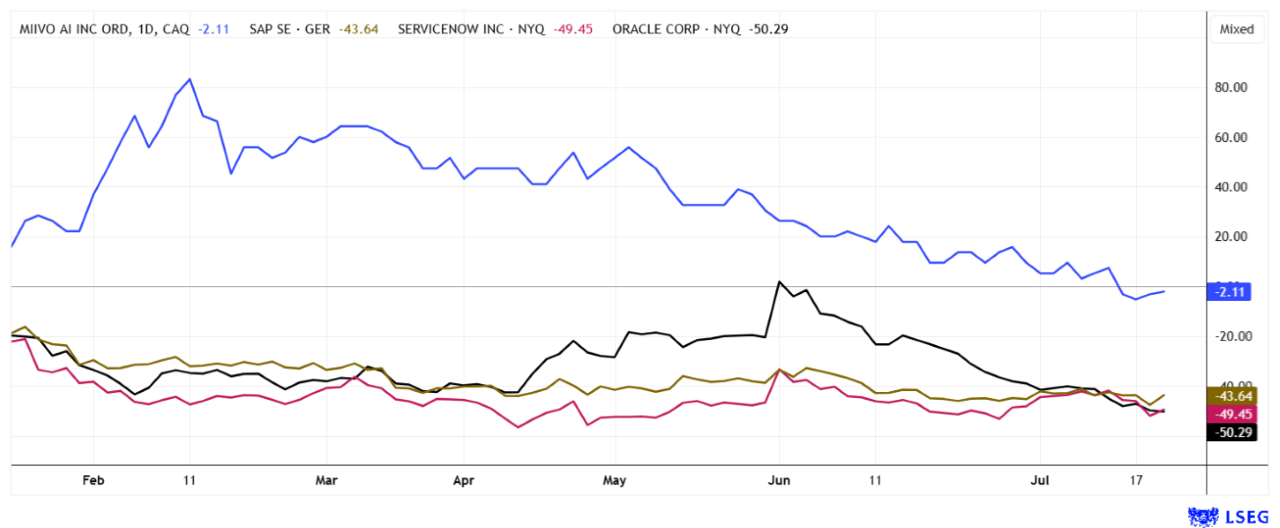
Many investors bet early on the comeback of software stocks—too early, as it turned out. The entire sector needed another period of consolidation before showing the first signs of renewed momentum. For SAP, the triple bottom around EUR 130 provides strong technical support, while ServiceNow has successfully defended the USD 85–92 range. Oracle, however, remains the outlier, having fallen about 50% from its highs while continuing to make new lows. Miivo AI’s innovative business model is particularly compelling. With a market capitalization of approximately CAD 18 million and no debt, the outlook is favourable for a rapid rise in value.
Conflict of interest
Pursuant to §85 of the German Securities Trading Act (WpHG), we point out that Apaton Finance GmbH as well as partners, authors or employees of Apaton Finance GmbH (hereinafter referred to as “Relevant Persons”) currently hold or hold shares or other financial instruments of the aforementioned companies and speculate on their price developments. In this respect, they intend to sell or acquire shares or other financial instruments of the companies (hereinafter each referred to as a “Transaction”). Transactions may thereby influence the respective price of the shares or other financial instruments of the Company.
In this respect, there is a concrete conflict of interest in the reporting on the companies.
In addition, Apaton Finance GmbH is active in the context of the preparation and publication of the reporting in paid contractual relationships.
For this reason, there is also a concrete conflict of interest.
The above information on existing conflicts of interest applies to all types and forms of publication used by Apaton Finance GmbH for publications on companies.
Risk notice
Apaton Finance GmbH offers editors, agencies and companies the opportunity to publish commentaries, interviews, summaries, news and the like on news.financial. These contents are exclusively for the information of the readers and do not represent any call to action or recommendations, neither explicitly nor implicitly they are to be understood as an assurance of possible price developments. The contents do not replace individual expert investment advice and do not constitute an offer to sell the discussed share(s) or other financial instruments, nor an invitation to buy or sell such.
The content is expressly not a financial analysis, but a journalistic or advertising text. Readers or users who make investment decisions or carry out transactions on the basis of the information provided here do so entirely at their own risk. No contractual relationship is established between Apaton Finance GmbH and its readers or the users of its offers, as our information only refers to the company and not to the investment decision of the reader or user.
The acquisition of financial instruments involves high risks, which can lead to the total loss of the invested capital. The information published by Apaton Finance GmbH and its authors is based on careful research. Nevertheless, no liability is assumed for financial losses or a content-related guarantee for the topicality, correctness, appropriateness and completeness of the content provided here. Please also note our Terms of use.
Stockhouse does not provide investment advice or recommendations. All investment decisions should be made based on your own research and consultation with a registered investment professional. The issuer is solely responsible for the accuracy of the information contained herein. For full disclaimer information, please click here.