

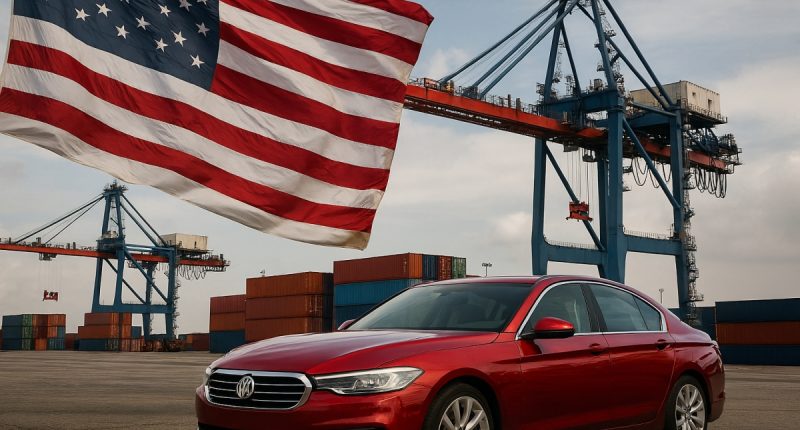
- A new 25 per cent U.S. tariff on E.U.-made cars and trucks has reignited global trade concerns, immediately pressuring European auto stocks and injecting volatility into equity and currency markets
- Autos are a macro risk, not just a sector story, because tariff impacts can ripple through supply chains tied to steel, semiconductors, energy, and global manufacturing
- Inflation fears are resurfacing, as higher vehicle import costs could feed into consumer prices and complicate the interest‑rate outlook for central banks
- Investors are now focused on next steps, including potential E.U. retaliation, guidance from auto makers and suppliers, and whether tariffs expand beyond the auto industry
Global markets woke up to renewed trade‑policy risk after the United States announced a 25 per cent tariff on European‑made cars and trucks, a move that immediately rippled through equities, currencies, and commodities. The decision marks a sharp escalation in transatlantic trade tensions and arrives at a moment when global stocks are already hovering near record highs, leaving investors unusually sensitive to macro shocks.
By early trading, the tariff announcement had displaced earnings and economic data as the dominant market narrative. For investors, the key question is no longer whether trade friction is returning—but how far it could go and which sectors are most exposed.
This article is a journalistic opinion piece that has been written based on independent research. It is intended to inform investors and should not be taken as a recommendation or financial advice.
Markets react as trade risk returns
European auto stocks were among the first casualties. Shares of major manufacturers with heavy U.S. exposure slid in early trading, as investors began to model higher costs, potential demand destruction, and the risk of retaliatory measures from Brussels.
U.S. equity futures were mixed, reflecting a sense that while domestic automakers could gain marginal price advantage, broader market indices are vulnerable if trade conflict spreads beyond autos. Historically, tariffs tend to compress valuation multiples by increasing uncertainty around earnings and global growth, a pattern investors appear to be revisiting.
Currency markets also reacted swiftly. The euro weakened modestly against the dollar, consistent with expectations that European exporters could face pressure if access to the U.S. market becomes more restricted.
Why autos matter more than they first appear
While the auto sector itself is deeply globalized, its importance goes far beyond car makers. Vehicles sit at the centre of a sprawling supply chain that includes steel, aluminum, semiconductors, logistics, chemicals, and energy. Any disruption to vehicle trade therefore risks cascading effects across industrial sectors.
Auto manufacturing also has symbolic weight in trade negotiations. Previous tariff episodes have shown that measures aimed at vehicles often trigger counter‑tariffs on politically and economically sensitive exports, including agriculture and industrial machinery, increasing the economic footprint of what begins as a targeted policy move.
For investors, that makes autos less a sector‑specific issue and more a macro signal—one that trade relations could again become a drag on global growth.
Inflation, rates, and the federal reserve connection
One of the most immediate market implications lies in inflation expectations. Higher tariffs typically raise import prices, and in the auto sector that can feed quickly into consumer price indices, particularly in durable goods.
This matters because markets are currently calibrated to a rate environment where central banks are cautious about easing too quickly. Any tariff‑driven price pressure could complicate the policy outlook, limiting flexibility for rate cuts and reinforcing the “higher for longer” narrative around interest rates.
Bond markets reflected this concern, with yields showing sensitivity to headlines around both tariffs and energy prices, another inflation‑linked variable closely tied to geopolitical developments.
Lessons from prior trade disputes
History offers a clear takeaway: markets can absorb tariffs temporarily, but prolonged or escalating trade disputes tend to hit earnings growth. During earlier tariff cycles, companies often warned that they could not simply pass higher costs to consumers indefinitely, leading to margin compression and downward earnings revisions.
Equity volatility typically rises during such periods, especially when markets are already richly valued. With major indices near or at all‑time highs, investors have less tolerance for shocks that threaten forward guidance and global demand assumptions.
What investors are watching next
The policy announcement itself may not be the final word. Markets are now watching several critical developments:
- European Union response: Any signal of retaliatory tariffs would widen the economic impact and elevate global risk sentiment.
- Corporate guidance: Auto makers and suppliers may address tariff exposure directly in earnings calls, influencing near‑term sector performance.
- Broader trade scope: Investors are alert to whether tariffs remain confined to autos or expand into other strategic industries.
The road ahead
For now, the tariff announcement serves as a reminder that policy risk has returned to centre stage. At a time when optimism around technology, AI investment, and earnings growth has driven markets higher, trade uncertainty injects a note of caution.
Whether this development becomes a temporary volatility spike or the opening chapter of a broader trade slowdown will depend on the next steps from policymakers on both sides of the Atlantic. Until then, investors are likely to remain defensive, selective, and sharply focused on headlines that could redefine the global growth outlook.
Join the discussion: Find out what the Bullboards are saying about auto stocks and check out Stockhouse’s stock forums and message boards.