

- Air Canada (TSX:AC) posted record Q1 2026 operating revenues of C$5.8 billion, supported by strong and resilient demand across its network, delivering operating income of C$117 million and record adjusted EBITDA of C$623 million
- The airline generated C$1.8 billion in operating cash flow and C$1.6 billion in free cash flow, while maintaining a net leverage ratio of 1.4x.
- Due to geopolitical instability and volatile jet fuel prices linked to conflict in the Middle East, Air Canada suspended full-year 2026 guidance and provided only second‑quarter guidance for near-term visibility
- Air Canada stock (TSX:AC) opened trading at C$18.40
Air Canada (TSX:AC) reported record operating revenues for the first quarter of 2026, reflecting continued strong demand across its domestic and international network, even as geopolitical developments and fuel price volatility weigh on the airline’s outlook.
The carrier posted first-quarter operating revenues of C$5.785 billion, marking the highest first-quarter total in its history. Performance was supported by solid passenger demand across regions, which the company said remained resilient despite elevated global instability.
Operating income for the quarter reached C$117 million, compared with operating expenses of C$5.668 billion, resulting in an operating margin of 2.0 per cent. Air Canada also recorded a first-quarter high for adjusted EBITDA, which rose to C$623 million, representing an adjusted EBITDA margin of 10.8 per cent.
On a bottom-line basis, the airline reported income before income taxes of C$123 million and net income of C$48 million, translating to diluted earnings per share of C$0.16. On an adjusted basis, Air Canada posted a net loss of C$16 million, or an adjusted loss per diluted share of C$0.05, reflecting the company’s use of adjusted metrics to account for specific items.
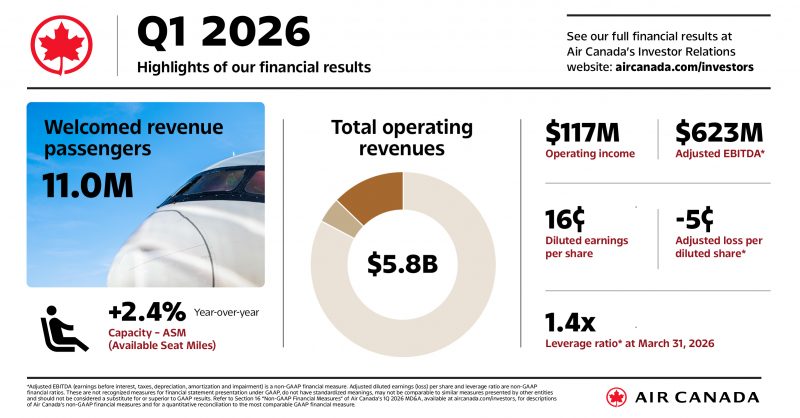
Cash generation remained strong. Net cash flows from operating activities totaled C$1.798 billion, while free cash flow reached C$1.604 billion during the quarter. As of the end of the period, Air Canada reported long-term debt and lease liabilities of C$12.301 billion, with a net leverage ratio of 1.4x.
Unit cost performance also showed improvement, with adjusted cost per available seat mile (CASM) of 16.11 cents.
“In the first quarter, Air Canada built on the momentum of our best-ever fourth quarter to launch strongly into 2026,” Air Canada’s president and CEO, Michael Rousseau, said in a news release.
Despite the solid first-quarter results, Air Canada revised its forward-looking disclosures. The company announced that it has suspended its full-year 2026 financial guidance, citing increased uncertainty stemming from disruptions in global energy markets. Recent developments in the Middle East, including ongoing conflict involving Iran, have contributed to significant volatility in jet fuel prices, reducing the reliability of fuel cost forecasts for the second half of the year.
In place of full-year guidance, Air Canada introduced financial guidance for the second quarter of 2026, which it said is intended to provide investors with near-term visibility while allowing flexibility in a rapidly changing environment.
The airline noted that while demand trends remain robust, the current geopolitical and commodity price landscape adds complexity to planning for the remainder of the year. Management indicated it will continue to monitor market conditions closely and adjust capacity and cost controls as needed.
Air Canada’s first-quarter results highlight both the strength of travel demand entering 2026 and the challenges airlines face amid external economic and geopolitical pressures.
Air Canada is Canada’s largest airline with a presence in more than 180 airports in Canada, the United States and internationally across six continents.
Air Canada stock (TSX:AC) opened trading at C$18.40 and has ascended 24 per cent since this time last year.
Join the discussion: Find out what the Bullboards are saying about Air Canada and check out Stockhouse’s stock forums and message boards.