

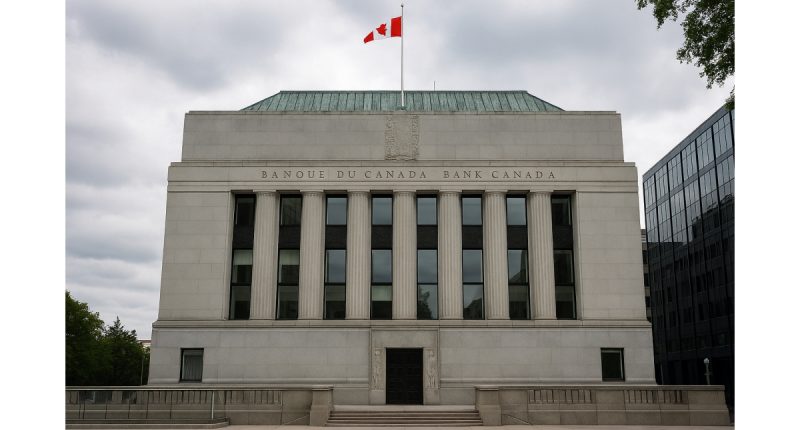
- Bank of Canada keeps its policy rate at 2.25 per cent amid ongoing global uncertainty
- Rising oil prices and geopolitical tensions continue to pressure growth and inflation
- Canada’s economy shows weakness with a slight contraction and soft labour market trends
- Inflation remains near 3 per cent in the short term but core measures suggest easing underlying pressures
The Bank of Canada on Wednesday held its benchmark policy rate unchanged at 2.25 per cent, maintaining the Bank Rate at 2.50 per cent and the deposit rate at 2.20 per cent, as policymakers balance persistent global uncertainties with signs of softness in the domestic economy.
The decision comes as everyone sees this elevated geopolitical tensions and uneven economic momentum both globally and at home. The ongoing conflict in the Middle East, now in its fourth month, continues to exert upward pressure on energy prices and disrupt global supply chains—factors that are complicating the inflation outlook while dampening global growth prospects.
At the same time, trade policy uncertainty remains high, particularly with continued tariff proposals from the United States, adding to the cautious tone among policymakers.
This article is a journalistic opinion piece that has been written based on independent research. It is intended to inform investors and should not be taken as a recommendation or financial advice.
Diverging growth and persistent risks
The Bank highlighted divergent economic conditions among major global economies. In the United States, growth remains resilient, driven by strong consumer spending and investment tied to artificial intelligence infrastructure and technologies. In contrast, the euro area is experiencing subdued activity, with higher energy costs acting as a drag on output.
China’s economy, meanwhile, continues to be supported by robust export performance, helping offset domestic pressures.
These cross-currents have contributed to volatile financial conditions globally, even as equity markets remain buoyant. Bond yields have fluctuated, reflecting shifting expectations around inflation and central bank policy paths.
In Canada, financial conditions have modestly loosened since the Bank’s April Monetary Policy Report. However, the Canadian dollar has weakened against the U.S. dollar and other major currencies, a development that could add to imported inflation pressures.
Domestic economy shows signs of slack
Recent data underscore a soft patch in the Canadian economy. Gross domestic product contracted by 0.1 per cent in the first quarter, falling short of the Bank’s earlier expectations. While consumer spending expanded by 1.4 per cent, declines in government spending and housing activity weighed on overall growth. Business investment also remained subdued.
Trade dynamics added further drag, with exports declining as imports surged due to inventory rebuilding.
Labour market indicators present a mixed picture. Employment rose in May, but underlying trends suggest limited momentum, with overall job levels largely unchanged since the beginning of the year. The unemployment rate continues to hover in the 6.5 per cent to 7 per cent range, most recently recorded at 6.6 per cent.
Looking ahead, the Bank expects economic growth to resume in the second quarter. However, officials cautioned that the economy is likely to remain in a state of excess supply, indicating persistent slack that could help ease inflationary pressures over time.
Inflation elevated but core measures stabilizing
Inflation dynamics remain a central concern for policymakers. Headline CPI rose to 2.8 per cent in April, largely driven by higher energy prices. The increase also reflects base effects from the removal of the consumer carbon tax from the year-over-year calculation.
Despite the uptick, the Bank noted limited evidence of broader pass-through from energy costs to other consumer prices. Measures of core inflation have eased to around 2 per cent, and the proportion of CPI components rising above 3 per cent is near its historical average.
Food price inflation has moderated but remains elevated, while shelter inflation continues to trend lower.
With global oil prices still roughly $10 per barrel above the Bank’s April assumptions, total inflation is expected to hover near 3 per cent in the near term before gradually declining toward the 2 per cent target.
Policy outlook
In its statement, the Bank emphasized that its Governing Council is “looking through” the near-term impact of the Middle East conflict on headline inflation. However, it underscored a firm stance against allowing higher energy prices to fuel sustained, broad-based inflation.
“The Governing Council will not let higher energy prices become persistent inflation,” the Bank said, signaling readiness to act if inflation expectations begin to drift.
At the same time, policymakers acknowledged that economic activity in Canada has been weaker than anticipated and that external risks—particularly related to global trade policy—remain significant.
The current policy stance reflects an effort to strike a balance between supporting a sluggish domestic economy and ensuring inflation returns sustainably to target.
Next steps
The Bank reiterated its commitment to maintaining price stability during a period of heightened global uncertainty. Market participants will look to incoming data on growth, labour markets, and inflation for clues on the future path of monetary policy.
The next scheduled interest rate announcement is set for July 15, 2026, alongside the release of the Bank’s updated Monetary Policy Report, which is expected to provide clearer guidance on the outlook for inflation and economic growth.
For investors, the Bank’s latest decision reinforces a cautiously neutral stance—holding steady for now, while keeping options open in an increasingly complex macroeconomic environment.
Join the discussion: Find out what the Bullboards are saying about the banks and check out Stockhouse’s stock forums and message boards.