


- The AI investment narrative is transitioning from raw infrastructure and model development to practical enterprise execution and digital market defence
- Legacy labour-based tech delivery models are being replaced by automated, six-person human-agent pods that match the output of traditional 30-person teams
- Traditional SEO is evolving into Generative Engine Optimization as advanced AI reasoning models shift consumer discovery from search links to synthesized answers
- Deploying agentic workflows requires robust machine-speed cybersecurity measures and collaborative industry initiatives like Project Glasswing to protect software infrastructure
For institutional investors tracking the generative AI boom, the narrative has officially shifted. The era of raw infrastructure land-grabs—characterized by skyrocketing GPU demand and frantic foundation model valuations—is maturing. In its place lies a far more complex, high-stakes battleground: enterprise execution and the defence of digital real estate.
As multi-billion-dollar enterprise AI budgets face intense scrutiny, Wall Street is asking a fundamental question: How do companies translate massive tech experimentation into repeatable, secure cash flows?
The answer is unfolding across two deeply intertwined frontiers. First, a radical overhaul of the enterprise operating model, highlighted by structural shifts in tech delivery from legacy IT giants. Second, the rapid evolution of Generative Engine Optimization (GEO) and AI reasoning models, which are completely rewriting how businesses maintain brand visibility in an automated economy.
This article is a journalistic opinion piece that has been written based on independent research. It is intended to inform investors and should not be taken as a recommendation or financial advice.
Part I: The operational moat — Moving from labour to agentic systems
Enterprise AI has hit a critical tipping point. While capital expenditure remains historic, deploying these systems into production at scale remains a stubborn bottleneck. For decades, scaling technology delivery followed a linear, labour-driven logic: to increase output, organizations simply added more human headcount.
As enterprises attempt to integrate advanced agentic workflows, this labour-first framework is fracturing. Output in the AI era is no longer a function of team size; it depends on an organization’s underlying operating model—specifically, how efficiently a company can coordinate autonomous agents, enforce strict data governance, and manage continuous workflows.
The signal vs. The solution: The rise of the FDE
To bridge this implementation gap, the technology sector has fiercely chased a specific job title: the Forward Deployed Engineer (FDE). Blending deep engineering capabilities with business consulting, the FDE operates directly within a client’s live environment to build in real time.
However, market analysts suggest that focusing entirely on a single role misses the broader systemic issue. No individual talent pool can single-handedly resolve fragmented enterprise data, complex hybrid-cloud architectures, and rigorous compliance requirements. The rise of the FDE is a signal that the tech delivery system itself must evolve.
The shift to structured pods
To bypass the limitations of individual roles, a structural transition toward hybrid delivery systems is underway. For example, IBM Consulting recently rolled out its Forward Deployed Units (FDUs) globally across the US, Europe, and Asia Pacific.
Rather than deploying solo engineers, this model utilizes integrated, six-person pods featuring domain specialists, architects, and engineers. What’s important to know is that these people work alongside a dedicated digital workforce of specialized AI agents that handle autonomous coding, testing, evaluation, and documentation.

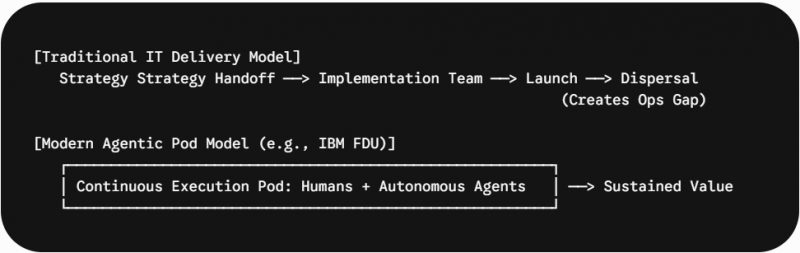
Early data from cross-industry deployments at firms like Nestlé, Heineken, Pearson, and Riyadh Air indicate that these highly automated pods can match the output of traditional 30-person teams. For investors, this structural shift directly alters service-sector margins, compressing time-to-market while turning one-off IT projects into continuous, long-term operational revenue.
Part II: The market real estate moat — Reasoning models and GEO
While enterprises restructure internally to deploy AI, their external revenue engines face an equally disruptive threat: the shift from traditional search engines to Reasoning Models and Generative Engine Optimization (GEO).
For twenty years, consumer discovery was governed by traditional keyword indexing. Brands poured billions into standard SEO to secure top placement on Google’s search engine results pages (SERPs). The monetization model was highly predictable.
Today, advanced reasoning models—such as Anthropic’s latest architectures and OpenAI’s reasoning series—are transforming discovery. Instead of returning a list of links, these engines autonomously synthesize, cross-reference, and evaluate vast amounts of web data to present the user with a single, definitive answer.
Why GEO matters to corporate valuations
If an enterprise’s products or services are not actively cited within these synthesized AI responses, its digital footprint effectively vanishes. This has given rise to GEO (Generative Engine Optimization), a technical marketing discipline focused on formatting corporate data, structured documentation, and brand sentiment so that LLMs recognize them as authoritative sources.
| Attribute | Legacy SEO | Generative Engine Optimization (GEO) |
| Primary Target | Web Crawlers & Keyword Algorithms | LLM Neural Networks & Reasoning Models |
| Format focus | Metadata, H1 tags, Keyword Density | Semantic Structure, JSON-LD, In-depth Citations |
| Discovery goal | Drive clicks to an external website | Secure inclusion within the AI’s synthesized response |
| Primary risk | Algorithmic ranking drops | Total digital invisibility inside AI summaries |
For institutional investors assessing retail, B2B software, or digital media portfolios, GEO is rapidly becoming a vital metric for evaluating market share defence. Companies failing to adapt their digital assets to handle reasoning-based search risk severe traffic compression.
Part III: The ultimate constraint — Defending the infrastructure
The ultimate success of both enterprise agentic deployment and AI-driven market discovery relies entirely on a foundational prerequisite: cybersecurity at scale.
As enterprises deploy hundreds of autonomous agents into live production networks, the corporate attack surface expands exponentially. Malicious actors are already weaponizing frontier AI models to automate vulnerability discovery, accelerate reconnaissance, and execute machine-speed exploits.
This growing risk has sparked massive, cross-industry defensive coalitions. A good example is Project Glasswing, a major security initiative uniting industry leaders, including Anthropic, Amazon Web Services, Apple, Google, Microsoft, NVIDIA, and CrowdStrike. IBM recently joined the coalition as part of a broader expansion of its AI-era enterprise security portfolio.

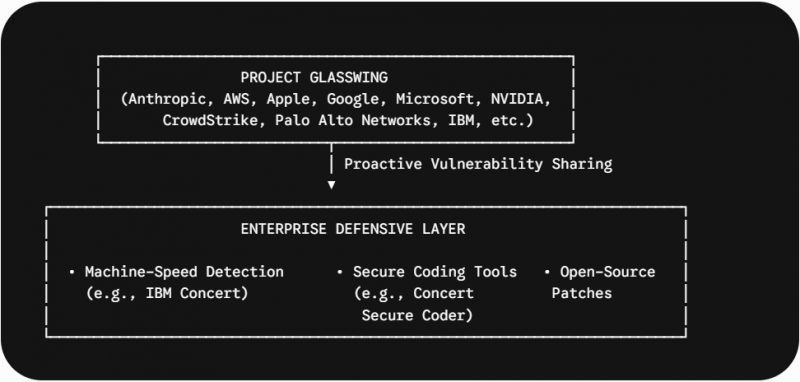
The defensive strategy centers on turning the underlying technology against the threat: utilizing the deep code-reasoning capabilities of frontier models to find and patch software flaws before attackers can exploit them.
- Preventive engineering: Software platforms like IBM Concert are being deployed to ingest application, network, and infrastructure signals into a single view, shifting defence from passive monitoring to automated risk prioritization.
- Inline remediation: Tools like Secure Coder inject security protocols directly into the developer’s integrated development environment (IDE), automatically generating secure code patches in real time as human engineers write software.
- The open-source battleground: Because modern enterprise software relies heavily on open-source repositories, coalition participants are actively contributing upstream patches to secure the broader digital supply chain.
Investor’s corner
The AI investment thesis has officially evolved past the infrastructure layer. The next chapter of market outperformance will likely be defined by execution architecture and digital defence.
When analyzing technology holdings or enterprise adoptions, the critical metrics are no longer just raw computing power or pilot programs. The alpha will be found in identifying organizations that seamlessly restructure their teams into automated, high-margin human-agent pods, aggressively optimize their digital assets for GEO reasoning engines, and rigorously harden their code infrastructure against the next generation of AI-driven threats.
Join the discussion: Find out what the Bullboards are saying about software infrastructure and check out Stockhouse’s stock forums and message boards.