
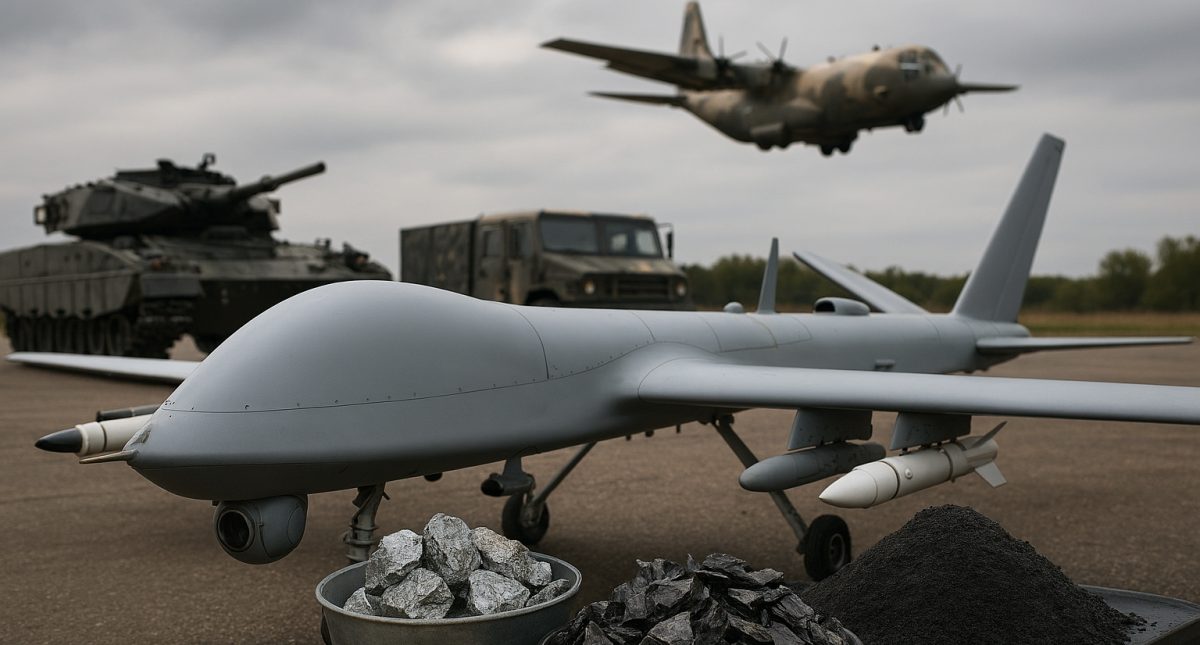

- Defence spending is structurally rising, with budgets shifting toward scalable, fast‑replaceable systems rather than legacy platforms
- Drones have become core military infrastructure, driving mass production and demand for electronic, battery and sensor components
- Strategic metals are emerging chokepoints, as drone and defence tech rely on minerals with highly concentrated global supply
- Governments are reshaping supply chains, backing domestic and allied sourcing—creating an investable, policy‑driven theme now
By aligning geopolitical risk, industrial policy and hard‑material constraints, a cross‑sector investment narrative is emerging that links defence spending, drone proliferation and strategic metals
A decade‑long defence upcycle, not a spike
Global defence spending is no longer reacting to a single conflict; it has entered a sustained uptrend driven by multi‑theatre instability and a reassessment of national security priorities. According to the Stockholm International Peace Research Institute (SIPRI), world military expenditure reached US$2.7 trillion in 2024, the 10th consecutive annual increase and the steepest real‑terms rise since the Cold War era. Europe and the Middle East accounted for a disproportionate share of incremental growth, while more than 100 countries raised defence budgets during the year, signalling breadth as well as scale.
For investors, the significance lies less in topline budgets and more in where money is now flowing. Procurement patterns are changing, with emphasis shifting from scarce, high‑cost platforms toward systems that can be produced at speed, replaced cheaply and adapted quickly. This evolution is reshaping defence supply chains—and creating demand signals far upstream.
This article is a journalistic opinion piece that has been written based on independent research. It is intended to inform investors and should not be taken as a recommendation or financial advice.
Drones move from edge capability to core doctrine
Nowhere is that shift clearer than in unmanned systems. The war in Ukraine has demonstrated that inexpensive drones can generate significant effects traditionally associated with far more expensive weapons. Ukraine has built a domestic ecosystem of hundreds of drone manufacturers, scaling production from a handful of firms before 2022 to several million units annually by 2024–25, outproducing NATO members combined.
While Ukraine is an extreme case, defence establishments globally are drawing similar conclusions. The US Department of Defense has allocated billions of dollars to unmanned and autonomous systems across FY2025‑26 budgets, while European states are accelerating parallel programs. The key lesson is economic: attrition warfare now favours mass‑manufacturable systems, compressing design cycles from years to months.
This dynamic benefits not only drone assemblers and software firms, but also component suppliers—electronics, sensors, batteries and propulsion. As one analysis from the Royal United Services Institute put it, “drones win battles, components win wars.”
From airframes to atoms: The hidden choke points
As drone production scales, attention is moving down the supply chain. Advanced electronics, power management and guidance systems rely on a narrow set of minerals—many of which have highly concentrated global supply.
China dominates processing capacity for several strategic metals critical to both defence and clean‑energy technologies, including gallium, germanium and graphite. Beginning in 2023, Beijing introduced export licensing regimes on these materials, citing national security considerations. Although framed as administrative controls rather than bans, the measures underscore how mineral supply has become an instrument of statecraft.
For defence planners, this is no longer a theoretical risk. Gallium and germanium are essential for compound semiconductors used in radar, communications and electronic warfare systems. Graphite highlights lithium‑ion batteries across drones, vehicles and grid storage. Supply disruptions would reverberate across both military and civilian industries.
Policy response: industrial strategy meets security
Western governments are responding with unusually explicit industrial policy. In Europe, the Critical Raw Materials Act entered into force in 2024, setting targets to extract, process and recycle a meaningful share of strategic materials domestically while reducing dependency on any single external supplier. The legislation accelerates permitting and financing for designated “strategic projects,” including mining and refining assets inside and outside the EU.
The United States is pursuing similar objectives through the Inflation Reduction Act and associated defence and trade initiatives, tying tax credits and procurement eligibility to mineral sourcing from domestic or allied jurisdictions. While originally framed around electric vehicles, these rules increasingly overlap with defence supply chains, particularly as battery and semiconductor capacity becomes dual‑use infrastructure.
For investors, the implication is that strategic metals are no longer a commodity cycle story; they are becoming policy‑supported assets with long‑dated demand visibility.
The investable narrative taking shape
Put together, these strands form a coherent trade: sustained defence outlays drive demand for unmanned systems; unmanned systems scale demand for components; components intensify competition for a narrow set of strategic metals; and governments respond by underwriting alternative supply chains.
This does not imply uniform upside. Execution risk, permitting delays and geopolitical volatility remain high. Nor does it mean all drone or mining equities benefit equally. Instead, it favours companies positioned between traditional defence primes and raw commodity producers—those enabling volume production, substitution, recycling or non‑Chinese processing capacity.
Crucially, this supply‑chain trade is being shaped now, not projected for the distant future. Capital allocation decisions made in the next few years—across defence manufacturing, battery materials and advanced processing—are likely to set competitive positions for the next decade.
Droning on ….
The convergence of defence, drones and strategic metals is not a headline theme but an infrastructure one. For investors with a medium‑ to long‑term horizon, the opportunity lies in understanding how modern warfare is reshaping industrial priorities—and how those priorities, in turn, are redrawing global supply chains.
Stockhouse does not provide investment advice or recommendations. All investment decisions should be made based on your own research and consultation with a registered investment professional. The issuer is solely responsible for the accuracy of the information contained herein. For full disclaimer information, please click here.