

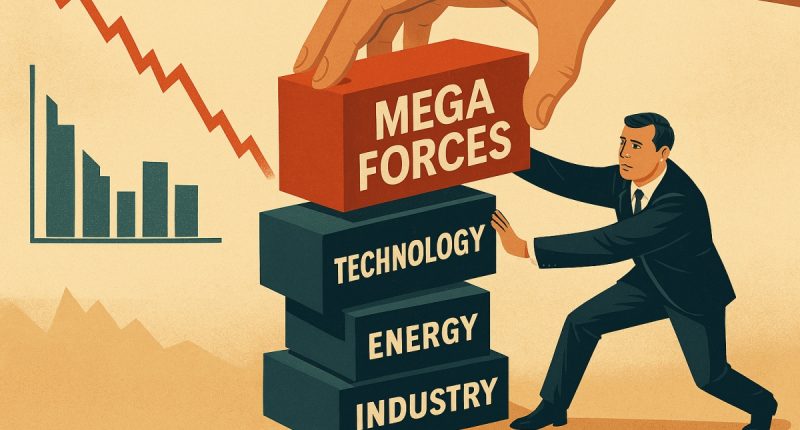
- Traditional diversification is becoming less effective because a few powerful “mega forces,” especially the AI buildout, are influencing many sectors at once
- These overlapping drivers create hidden correlations across portfolios, leading to what BlackRock calls a “diversification mirage” where risk appears lower than it actually is
- Investors can adapt by focusing on theme‑aware exposure, adding idiosyncratic assets, revisiting fixed‑income roles, and keeping portfolios nimble to handle sudden shifts
For decades, diversification has been one of the most widely accepted principles in portfolio construction. Spread your risk across sectors, countries, and asset classes, and you reduce volatility without sacrificing long‑term returns. But the world of 2026 is testing that idea. Structural “mega forces” — including artificial intelligence, geopolitical fragmentation, and massive infrastructure investment — are concentrating market drivers into fewer, more dominant themes. As a result, traditional diversification may not be doing the job investors expect.
This doesn’t mean diversification is dead. It means investors need a more intentional, theme‑aware approach to building resilient portfolios.
This article is a journalistic opinion piece that has been written based on independent research. It is intended to inform investors and should not be taken as a recommendation or financial advice.
Why diversification is becoming less effective
1. A handful of mega forces are driving markets
BlackRock’s 2026 outlook warns that a few “mega forces” — especially the rapid, capital‑intensive AI buildout — are shaping markets to an extent that makes it difficult to find neutral exposure. When the same forces influence multiple sectors simultaneously, simply owning more sectors does not meaningfully reduce risk.
AI investment is especially concentrated among a small group of large firms deploying unprecedented capital. Their spending patterns now have macro‑level effects, blurring the lines between micro and macroeconomics and influencing broad indexes that investors once viewed as reliably diversified.
2. Traditional sector balancing isn’t working as well
In theory, spreading allocations across sectors should reduce correlation. But 2026 analysis from Fidelity shows that multiple sectors — including technology, communication services, and even parts of industrials — are riding the same AI‑driven growth factors. This creates synchronized performance across sectors that historically behaved differently.
Meanwhile, Morgan Stanley reports that geopolitical and supply‑chain realignment (their “Multipolar World” theme) is impacting diverse industries simultaneously, from defence to energy to manufacturing. This overlap further reduces the independence of sector movements.
3. Infrastructure, energy, and compute cycles are converging
AI’s massive power demand is driving a related boom in energy infrastructure, utilities, data centers, and semiconductor supply chains. iShares notes that themes such as “compute & conflict” and “pipes & power” are converging, pulling multiple asset classes into the same narrative arc.
This means that even portfolios diversified across tech, utilities, and industrials may be more correlated than investors realize.
The hidden risks of a “diversification mirage”
When market forces concentrate, the biggest risk is a false sense of security. Investors may believe they are diversified because they hold many positions across various sectors. But if those sectors are powered by the same mega themes, the underlying exposures can behave similarly during stress periods.
BlackRock calls this the “diversification mirage”, where broad allocations inadvertently become “big active bets” on a small number of dominant forces.
This creates several risks:
- Higher drawdowns if a dominant theme reverses (e.g., an AI slowdown).
- Unexpected volatility as correlations spike across sectors.
- Reduced protection from traditional safe havens like long‑term Treasuries, which BlackRock suggests may be vulnerable in stressed, highly levered environments.
What investors can do about it
The good news: diversification still matters — but it needs an upgrade. Here’s how investors can adapt.
1. Focus on exposure, not just holdings
Instead of counting sectors, examine what actually drives them. If AI spending influences both your tech stocks and your utility holdings, you may not be as diversified as you think.
Using thematic analysis helps identify whether your portfolio is overweight certain mega forces, regardless of sector labels.
2. Incorporate idiosyncratic opportunities
BlackRock recommends seeking idiosyncratic exposures — investments whose performance depends on company‑specific or niche factors rather than major global trends. This includes:
- Select private markets
- Niche hedge fund strategies
- Specialty credit or infrastructure assets not directly tied to AI or geopolitics
These can reintroduce genuine diversification.
3. Reevaluate fixed income’s role
Bond markets are returning to more normal conditions, according to J.P. Morgan, offering renewed diversification benefits — especially in balanced portfolios.
However, long-duration Treasuries may be vulnerable in high‑leverage environments, so consider a mix of:
- Shorter-duration bonds
- High-quality credit
- Uncorrelated fixed income strategies
4. Consider global and emerging market differentiation
Emerging markets such as Taiwan, Korea, and India have drivers that are not always synchronized with U.S. mega‑cap performance. J.P. Morgan sees improving conditions for EM investing overall.
Meanwhile, S&P Global notes that regions like Africa are developing along separate economic trajectories, potentially offering diversifying growth dynamics.
5. Stress‑test portfolios for theme concentration
Ask:
- If AI investment temporarily slows, how would my portfolio react?
- If geopolitical fragmentation intensifies, where am I most exposed?
- If energy prices spike, how would my holdings correlate?
Scenario testing can reveal hidden concentrations.
6. Stay nimble
As BlackRock stresses, today’s environment requires active navigation, not autopilot. Portfolios should be adaptable, with contingency plans (“Plan B” allocations) ready if a dominant theme shifts direction.
Diversification isn’t dead — It’s evolving
The stock market in 2026 is defined by powerful structural themes that blur the boundaries between sectors, geographies, and asset classes. Traditional diversification is not broken — but it is less effective when mega forces drive multiple parts of the market in the same direction.
Investors who embrace theme‑aware diversification, emphasize idiosyncratic exposures, and remain nimble and intentional can still build resilient portfolios — even in a world where everything seems connected.
Stockhouse does not provide investment advice or recommendations. All investment decisions should be made based on your own research and consultation with a registered investment professional. The issuer is solely responsible for the accuracy of the information contained herein. For full disclaimer information, please click here.