


Crisis-Proof Million-Dollar Pipelines: Volatus Aerospace Shapes Modern Security Architecture
It is heating up—the skies and investors are in demand! For several years now, the global security situation has been steering capital flows toward a future market worth billions: unmanned aerial systems. According to expert estimates, this highly innovation-driven sector is expected to grow from its current level of approximately USD 77 billion to around USD 160 billion by 2034. In addition to securing critical infrastructure through AI software and drone defence systems (Counter-AUS), Volatus Aerospace is currently making an evolutionary quantum leap from traditional drone ecosystems into the highly profitable large-aircraft class. Through a new strategic partnership with Singular Aircraft, Volatus is becoming the exclusive Canadian operator of the FlyOx 1, an autonomous, amphibious heavy-lift aircraft with a takeoff weight of 4,000 kg and a firefighting capacity of 1,560 litres.
This system addresses Canada’s acute wildfire crisis, where insured damages recently exceeded CAD 8.5 billion, while the traditional firefighting aircraft fleet is aging and suffers from an acute shortage of personnel. The FlyOx 1 requires no pilots on board, minimizes the risk to emergency responders, and enables highly efficient, continuous early detection and initial suppression of fire outbreaks. Since traditional manned firefighting aircraft cost approximately USD 80 million per airframe in government procurement, Volatus offers an unbeatably affordable, additive capacity. The commercial “Services-First” strategy relies on a government-funded availability model, in which the government pays for mission execution without having to bear the enormous investment costs of asset ownership. An illustrative calculation model shows that even a small fleet of three FlyOx 1 aircraft generates revenue potential of CAD 15 to 20 million. The majority of these revenues come from recurring seasonal service contracts, maintenance, and training, whose lifetime value significantly exceeds the initial acquisition costs of the aircraft.
Volatus also benefits from Canada’s strict aviation regulations, which create a significant regulatory moat, as commercial unmanned aerial services must be operated by Canadian-controlled companies. The company’s long-term roadmap envisions the gradual localization of its value chain through Canadian-based final assembly and deeper systems integration, leveraging synergies at its modern 53,000 square foot facility in Mirabel. In addition to its already robust commercial project pipeline of approximately CAD 500 million, Volatus has now added a highly resilient, government-funded large-aircraft business focused on long-term infrastructure and mission-critical service contracts. Given this fundamental transformation and the company’s successes in the US defence sector, the current market valuation of just CAD 350 million seems almost like a historical miscalculation when compared to the industry. Despite these prospects, the stock is trading at only around CAD 0.50, while the consensus among analysts forecasts a price target of CAD 1.07. At this level, Volatus Aerospace thus offers significant revaluation potential, underpinned by real large-scale orders.
CFO Abhinav Singhvi outlined the company’s medium-term strategy at the recent 19th International Investment Forum.
DroneShield: Is a Rally Next After the Sell-Off?
After Australian drone defence specialist DroneShield lost nearly 50% of its market value in July due to disappointing revenue forecasts, a massive rebound is now taking off on the stock markets. The stock jumped more than 12% during yesterday’s trading session after it was announced that the major US bank JPMorgan Chase had significantly increased its voting stake in the company from 5.15% to 6.68%. However, the Australian company has not yet met analysts’ expectations for the first half of 2026. Nevertheless, revenue climbed 74% to AUD 125.8 million. After several years of development, management now feels it is in a position of market leadership. It has announced the confirmation of a new AUD 23.2 million major order for vehicle-mounted defence systems from a European military customer. Technologically, the company is taking the next step forward with the introduction of RFAI-3, a third-generation AI-powered radio reconnaissance engine. Now, NATO defence systems can identify even completely unknown drone signals in real time. With a firm order backlog of AUD 206 million already secured for the full year, the downside potential is fundamentally likely limited. With yesterday’s shift in momentum, the rally could continue!
Lufthansa: Are the Poor Numbers a Setback?
A 7% plunge! The quarterly figures presented yesterday by Deutsche Lufthansa reveal a drastic gap between revenue strength and operating profit. Although revenue climbed 8% in Q2 to a robust EUR 11.1 billion thanks to unbroken global demand for flights, adjusted operating EBIT plummeted by 56% to EUR 383 million, causing the stock to temporarily drop by double digits on the MDAX. The main drivers of the sharp decline in profits were external shocks such as the fallout from the Middle East conflict, which, despite hedging transactions, led to approximately EUR 750 million in kerosene-related additional costs. Nevertheless, the company’s fundamentals remain sound, as the high-yield premium classes are operating at full capacity and the highly profitable divisions Lufthansa Technik and Lufthansa Cargo are robustly cushioning the operational headwinds in the passenger business. CEO Carsten Spohr adjusted the annual profit forecast to a more conservative range of EUR 1.7 to 2.2 billion, but emphasized the ongoing normalization of fuel supplies. At this level, the stock offers a 2027 P/E ratio of 6.4—the “Crane Line” has rarely been this cheap.
SpaceX: The Moment of Truth
Things got really exciting last night. Just two days before the expiration of a lock-up period on approximately 12% of SpaceX’s issued shares, the first twist occurred in Elon Musk’s vision paper. With a loss of about 30% in just under two months, SpaceX is not only the largest but also one of the most loss-ridden IPOs on the Nasdaq in the last 24 months. The allocation of the heavily oversubscribed stock took place at USD 135; the stock rose to USD 215 in its first week, followed by a brutal 50% crash. However, the stock quickly broke out of the USD 106 range again. It is reasonable to expect that the flamboyant entrepreneur and book-value billionaire will not let the short sellers get the better of him any more than he did with Tesla about six years ago. It will also be fascinating to see how the roughly 5,000 employees who have just become millionaires will react now that the lock-up period has expired.

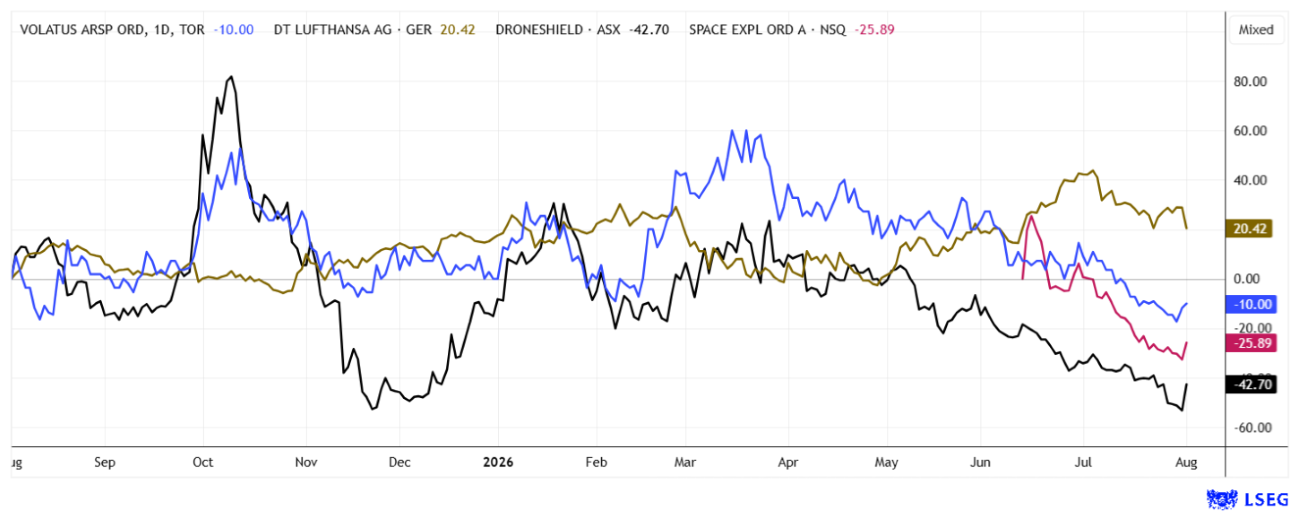
While high-tech and chip stocks are currently staging a technical rebound, the ongoing tensions in the Middle East and the air war in Ukraine are driving a new wave of buying in drone stocks. Volatus Aerospace, in particular, has consolidated significantly and is now in an attractive technical support zone. The Australian company DroneShield is regaining noticeable momentum. Keep an eye on the path SpaceX takes from here. This could signal the direction of growth markets for the coming weeks.
Conflict of interest
Pursuant to §85 of the German Securities Trading Act (WpHG), we point out that Apaton Finance GmbH as well as partners, authors or employees of Apaton Finance GmbH (hereinafter referred to as “Relevant Persons”) currently hold or hold shares or other financial instruments of the aforementioned companies and speculate on their price developments. In this respect, they intend to sell or acquire shares or other financial instruments of the companies (hereinafter each referred to as a “Transaction”). Transactions may thereby influence the respective price of the shares or other financial instruments of the Company.
In this respect, there is a concrete conflict of interest in the reporting on the companies.
In addition, Apaton Finance GmbH is active in the context of the preparation and publication of the reporting in paid contractual relationships.
For this reason, there is also a concrete conflict of interest.
The above information on existing conflicts of interest applies to all types and forms of publication used by Apaton Finance GmbH for publications on companies.
Risk notice
Apaton Finance GmbH offers editors, agencies and companies the opportunity to publish commentaries, interviews, summaries, news and the like on news.financial. These contents are exclusively for the information of the readers and do not represent any call to action or recommendations, neither explicitly nor implicitly they are to be understood as an assurance of possible price developments. The contents do not replace individual expert investment advice and do not constitute an offer to sell the discussed share(s) or other financial instruments, nor an invitation to buy or sell such.
The content is expressly not a financial analysis, but a journalistic or advertising text. Readers or users who make investment decisions or carry out transactions on the basis of the information provided here do so entirely at their own risk. No contractual relationship is established between Apaton Finance GmbH and its readers or the users of its offers, as our information only refers to the company and not to the investment decision of the reader or user.
The acquisition of financial instruments involves high risks, which can lead to the total loss of the invested capital. The information published by Apaton Finance GmbH and its authors is based on careful research. Nevertheless, no liability is assumed for financial losses or a content-related guarantee for the topicality, correctness, appropriateness and completeness of the content provided here. Please also note our Terms of use.
Stockhouse does not provide investment advice or recommendations. All investment decisions should be made based on your own research and consultation with a registered investment professional. The issuer is solely responsible for the accuracy of the information contained herein. For full disclaimer information, please click here.