


BP and Shell: The Secret Beneficiaries of the Energy Crisis
While the real economy groans under the weight of energy costs and supply bottlenecks, the integrated oil majors are having a field day. Geopolitical shocks, blocked sea lanes, and a tight gas supply situation in Europe are driving crude oil and LNG prices to record levels—and with them, the margins of the old energy world. British Petroleum (BP) is confidently capitalizing on the turbulent environment and reported an adjusted net profit of approximately USD 4.2 billion in the second quarter of 2026, well above analysts’ expectations. The results were driven primarily by record-high refining margins, which catapulted the downstream business into the black, as well as by highly profitable LNG trading, which benefited from European shortages and volatile spread conditions. With gas shortages looming on the Old Continent, BP’s broadly diversified portfolio acts as a buffer against economic risks. Management is consistently converting robust free cash flow into shareholder returns: USD 1.75 billion is being allocated to additional share buybacks, and the dividend is being raised. Despite a long-term transformation toward renewables, the traditional fossil fuel segments are currently keeping the stock at a high level. Analysts on the LSEG platform, however, see limited upside potential or have not yet reacted to the new oil price paradigm.
Shell, the significantly larger competitor, is underscoring its role as a global LNG player and is benefiting disproportionately from the current energy crisis. For Q2 2026, the company reported adjusted earnings of USD 6.3 billion, driven primarily by exceptional performance in gas and electricity trading. Free cash flow climbed to an impressive USD 10.2 billion for the quarter, a clear sign of the group’s enormous financial strength. Shell, like BP, is using this liquidity for an aggressive share buyback program totalling an unprecedented USD 3.5 billion. While the industry suffers from soaring electricity prices, Shell is positioning itself as an indispensable, highly profitable energy supplier in uncertain times. On the LSEG Refinitiv platform, both stocks remain rated “Buy”, but after a price gain of over 35% in just 12 months, critics are already anticipating an impending correction—especially if international conflicts ease.
Siemens Energy: Orders Well Beyond 2030
The energy technology group Siemens Energy is responding to the global energy crisis with a consistent focus on worldwide electrification and efficient gas turbines. With rapidly rising demand driven by energy-intensive infrastructure such as artificial intelligence and data centres, the company is strategically expanding its global manufacturing capacity. In addition, the group is addressing current geo-economic tensions by strategically restructuring its portfolio to secure long-term profitability and operational flexibility. The group’s latest financial results impressively underscore the success of this transformation strategy. In the past fiscal year, the company returned to profitability with a net income of EUR 1.685 billion. In terms of margins, this means the EBIT margin once again exceeded 6%, while free cash flow before taxes surged to EUR 4.66 billion, securing a planned dividend of EUR 0.70 per share for shareholders.
Despite ongoing challenges in the wind power division, management is extremely optimistic about the future thanks to well-filled order books for conventional energy technology. CEO Christian Bruch, whose contract was extended early through 2030, has set clear priorities for the second half of the decade. Regarding the medium-term growth targets through the end of the decade, he emphasized in a statement on the outlook: “We have confidently raised our medium-term targets and are exceptionally well-positioned, as we firmly believe that the energy transition and the global demand for electricity guarantee a sustainable double-digit margin business for our core divisions.” Some customers currently have to wait more than 4 years for new gas turbines. After a 30% correction from its peak of around EUR 195, the stock now stands at EUR 138; 22 out of 28 experts on the LSEG platform expect it to reclaim previous highs within 12 months. Let’s see if the company can continue its recent transformation successes.
Standard Uranium: Corvo Meets Massive Energy Demand
Trouble in the fossil fuel sector provides arguments for a new uranium story. In the current environment, the topic is gaining strategic importance worldwide, as the nuclear energy renaissance coincides with a highly concentrated supply of raw materials and a significant need for new mining projects. The latest IEA study, “Global Critical Minerals Outlook 2026”, warns of growing bottlenecks along the nuclear fuel chain and points out that the three largest countries already account for nearly three-quarters of global uranium production. At the same time, global nuclear power generation is expected to continue growing strongly through 2030, while China alone will bring approximately 30 GW of additional nuclear power capacity online in the coming years.
For exploration companies in Canada’s Athabasca Basin, this environment creates particularly attractive leverage, and Standard Uranium now has a portfolio of more than 95,000 hectares. The operational focal point is currently Davidson River, where the company resumed drilling in 2026, for the first time since 2022, and has expanded the program to more than 8,000 m across the three corridors: Warrior, Bronco, and Thunderbird. What is particularly exciting is the combination of historical drilling data and modern geophysics. The ExoSphere multiphysics surveys have provided new 3D information on structures and potential hydrothermal alteration zones, thereby significantly refining the selection of drill targets. Davidson River is also located only about 25 to 30 km west of the significant Arrow and Triple-R deposits and follows the same regional structural trends. A geological advantage that lends the project considerable exploration potential.
IIF host Lyndsay Malchuk speaks with CEO Jon Bey about the progress of the drilling program in the Athabasca Basin.
Progress at Corvo is even more concrete, as the first drilling campaign in over 40 years has identified uranium anomalies in all nine successfully completed holes and has identified a total of 55 m with elevated uranium values. These include 23 m with more than 50 ppm and 13 m with over 100 ppm of uranium. Added to this are graphitic faults, highly deformed structures, and hydrothermal alteration across several target areas; thus, what matters is not a single drilling hit but the discernible pattern across the entire project. The well-known Manhattan Zone, with historical surface samples of up to 8.10% U₃O₈, remains an attractive anchor point; however, like all historical or selective samples, it must still be viewed as far from a robust resource definition.
The story is rounded out by the recent entry of a strategic investor from Southeast Asia, who is set to acquire approximately 19.7% of the company for CAD 3 million, thereby contributing not only capital but also potential access to international energy interests. Standard Uranium can use the funds, among other things, for further exploration at Davidson River. At the same time, the project generator model eases strain on the capital base, as partners cover exploration costs for selected projects. The stock market has so far reacted very cautiously to these developments, as the total valuation stands at just CAD 12 million. News in the coming weeks should bring a significant improvement.

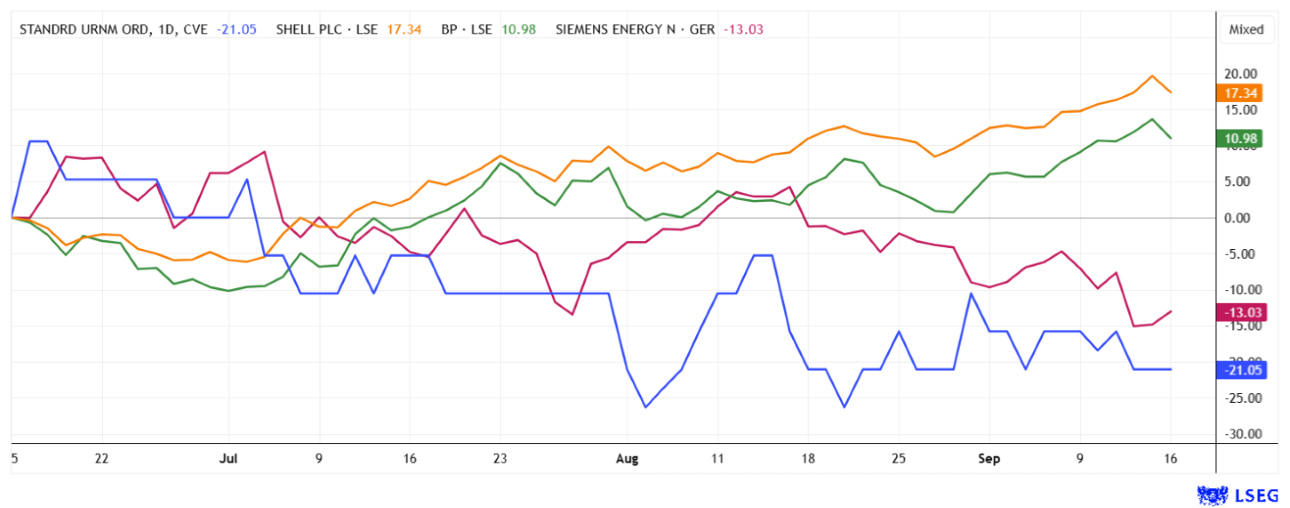
The stock market is on a roller coaster ride. As the major indices slowly slide into a correction phase, investors are keeping a close eye on high inflation and the parallel rise in capital market interest rates. Oil companies like BP and Shell are benefiting from the surge in oil prices, while Siemens Energy is taking a breather after a 2,000% rally over three years. The renewed focus on “NetZero” nuclear energy could prove highly interesting, as over 150 new reactors are planned worldwide. The uranium explorer Standard Uranium should be able to benefit significantly from the current situation.
Conflict of interest
Pursuant to §85 of the German Securities Trading Act (WpHG), we point out that Apaton Finance GmbH as well as partners, authors or employees of Apaton Finance GmbH (hereinafter referred to as “Relevant Persons”) currently hold or hold shares or other financial instruments of the aforementioned companies and speculate on their price developments. In this respect, they intend to sell or acquire shares or other financial instruments of the companies (hereinafter each referred to as a “Transaction”). Transactions may thereby influence the respective price of the shares or other financial instruments of the Company.
In this respect, there is a concrete conflict of interest in the reporting on the companies.
In addition, Apaton Finance GmbH is active in the context of the preparation and publication of the reporting in paid contractual relationships.
For this reason, there is also a concrete conflict of interest.
The above information on existing conflicts of interest applies to all types and forms of publication used by Apaton Finance GmbH for publications on companies.
Risk notice
Apaton Finance GmbH offers editors, agencies and companies the opportunity to publish commentaries, interviews, summaries, news and the like on news.financial. These contents are exclusively for the information of the readers and do not represent any call to action or recommendations, neither explicitly nor implicitly they are to be understood as an assurance of possible price developments. The contents do not replace individual expert investment advice and do not constitute an offer to sell the discussed share(s) or other financial instruments, nor an invitation to buy or sell such.
The content is expressly not a financial analysis, but a journalistic or advertising text. Readers or users who make investment decisions or carry out transactions on the basis of the information provided here do so entirely at their own risk. No contractual relationship is established between Apaton Finance GmbH and its readers or the users of its offers, as our information only refers to the company and not to the investment decision of the reader or user.
The acquisition of financial instruments involves high risks, which can lead to the total loss of the invested capital. The information published by Apaton Finance GmbH and its authors is based on careful research. Nevertheless, no liability is assumed for financial losses or a content-related guarantee for the topicality, correctness, appropriateness and completeness of the content provided here. Please also note our Terms of use.
Stockhouse does not provide investment advice or recommendations. All investment decisions should be made based on your own research and consultation with a registered investment professional. The issuer is solely responsible for the accuracy of the information contained herein. For full disclaimer information, please click here.