

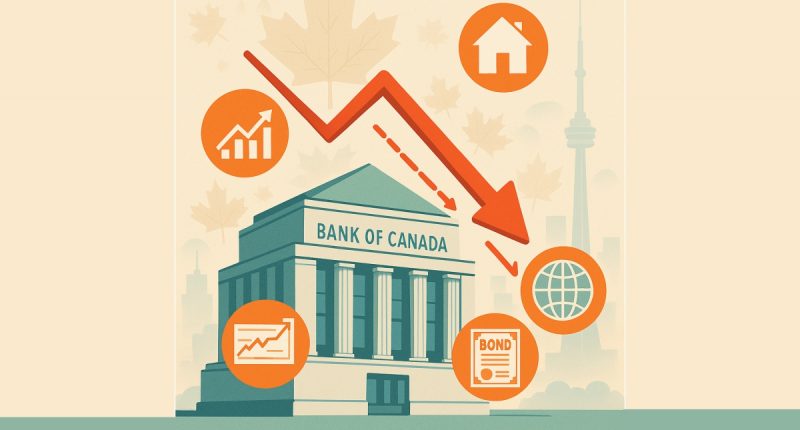
- After a prolonged period of rate hikes aimed at curbing inflation, the Bank of Canada has pivoted to rate cuts, reducing its policy rate to 2.75 per cent as of March 2025
- As rates fall, bond prices rise, increasing exposure to government and investment-grade corporate bonds, which benefit most from rate declines
- Rate cuts typically boost equity markets, especially growth stocks and dividend-paying stocks
- With the Canadian dollar under pressure and global central banks also easing
In a year marked by economic uncertainty and shifting financial tides, Canadian investors are facing a new reality: falling interest rates. After a series of aggressive hikes to tame inflation, the Bank of Canada has reversed course, ushering in a wave of rate cuts that are already rippling through markets. But what does this mean for your portfolio? Whether you’re holding bonds, eyeing real estate, or chasing growth stocks, the rules of the game are changing—and fast. In this article, we’ll explore how savvy investors are adapting their strategies to thrive in a lower-rate environment and what opportunities lie ahead.
This article is a journalistic opinion piece which has been written based on independent research. It is intended to inform investors and should not be taken as a recommendation or financial advice.
The shift: From tightening to easing
After a prolonged period of rate hikes aimed at curbing inflation, the Bank of Canada has pivoted to rate cuts, reducing its policy rate to 2.75 per cent as of March 2025. This marks a significant shift in monetary policy, driven by softening inflation, rising unemployment, and slowing consumer demand.
While the central bank remains cautious, economists expect at least one or two more cuts by year-end if economic data continues to weaken.
What this means for Canadian investors
Falling interest rates ripple across the financial landscape, prompting investors to reassess risk, yield, and growth potential. Here’s how strategies are evolving:
1. Bond market: A return to duration
As rates fall, bond prices rise, especially for long-duration bonds. Investors are:
- Shifting from short-term to long-term bonds to lock in higher yields before further cuts.
- Increasing exposure to government and investment-grade corporate bonds, which benefit most from rate declines
Tip: Consider bond ETFs with longer durations to capture capital appreciation.
2. Real estate: A rebound in sight
Lower borrowing costs are reviving interest in real estate:
- REITs (Real Estate Investment Trusts) are gaining traction as yields become more attractive relative to fixed income.
- Residential and commercial property markets are seeing renewed investor confidence, especially in urban centers like Toronto and Vancouver
Watch for: Sectors like multi-family housing and industrial REITs, which are more resilient to economic cycles.
3. Equities: Growth stocks back in favour
Rate cuts typically boost equity markets, especially:
- Growth stocks in tech, healthcare, and clean energy, which benefit from lower discount rates on future earnings.
- Dividend-paying stocks, which become more attractive as fixed-income yields decline.
Strategy: Rebalance toward sectors with strong earnings potential and pricing power in a low-rate environment.
4. Cash & GICs: Less attractive, more strategic
With high-interest savings accounts and GIC rates falling, investors are:
- Reducing cash allocations in favour of higher-return assets.
- Using laddered GIC strategies to maintain some liquidity while capturing better yields.
Caution: Avoid locking into long-term GICs at today’s lower rates unless you need capital preservation.
5. Global diversification: Hedging against domestic risks
With the Canadian dollar under pressure and global central banks also easing, investors are:
- Diversifying internationally, especially into U.S. and emerging markets.
- Using currency-hedged ETFs to manage FX risk.
Insight: Global equities may offer better growth prospects as Canada’s economy slows.
Looking ahead: Stay agile, stay informed
The current environment demands flexibility and vigilance. While falling rates can boost asset prices, they also signal underlying economic fragility. Investors should:
- Monitor inflation and employment data closely.
- Rebalance portfolios quarterly.
- Consult with financial advisors to align strategies with long-term goals.
Final thoughts
The Bank of Canada’s rate cuts in 2025 are reshaping the investment landscape. Whether you’re a conservative saver or a growth-oriented investor, now is the time to rethink your portfolio and position for the next phase of the economic cycle.
Stockhouse does not provide investment advice or recommendations. All investment decisions should be made based on your own research and consultation with a registered investment professional. The issuer is solely responsible for the accuracy of the information contained herein. For full disclaimer information, please click here.