

BASF Bets on Electric Furnaces and Hydrogen
Large corporations such as Ludwigshafen-based BASF also require comprehensive solutions. BASF is therefore converting existing sites to cleaner processes. In cooperation with industry partners, BASF is testing an electrically powered steam cracker in Ludwigshafen that processes approximately 4 metric tons of hydrocarbons per hour at a capacity of 6 megawatts. This pilot project, funded with EUR 14.8 million by the Federal Ministry for Economic Affairs and Climate Action, aims to reduce direct emissions from the cracking process by at least 90%. In addition, as part of the Hy4Chem project, the Ludwigshafen-based company has been operating a 54-megawatt electrolyzer for hydrogen together with partners since 2025. Supported by up to EUR 124.3 million in grants and approximately EUR 25 million in equity capital, the plant produces 8,000 metric tons of green hydrogen annually. Such scale underscores just how heavily the industry depends on functioning infrastructure and large-scale facilities.
Linde and the Build-Own-Operate Model
A similar picture emerges at the gas giant Linde, which, as a plant builder and operator, supplies major customers directly on-site. Linde estimates that a new facility using the DRYREF process, jointly developed with BASF and incorporating CO₂ imports, could generate operating cost savings of up to USD 20 million over its first five years of operation. With this technology, a special catalyst optimizes the dry reforming of methane, significantly reducing steam requirements and enabling the use of carbon dioxide as a feedstock. The dry reforming process converts these two greenhouse gases into usable synthesis gas. Linde relies on the Build-Own-Operate (BOO) model, in which the company constructs its own plants on customers’ sites. However, such projects tie up an enormous amount of capital and require large-scale customers or a direct connection to transportation networks. Linde has little to offer smaller customers or industrial parks that are not connected to such networks.
A.H.T. Syngas’s Dual-Fire Process Ensures Self-Sufficiency
While the industry giants are investing billions in centralized structures, there are also pragmatic alternatives. The Dutch company A.H.T. Syngas, operating out of Overath, Germany, focuses on the 200 kW to 15 MW segment, which many corporations do not serve. Instead of relying on scarce raw materials, the company uses low-grade organic waste materials such as wood waste, sewage sludge, rice husks, or hydrochar. At the heart of the technology is a proprietary dual-fire gasification reactor that suppresses tar formation and delivers synthesis gas with a hydrogen content of over 40% without the need for multi-stage purification. Together with partners, the company also acquired the patent for thermochemical hydrogen production from biomass using a fixed-bed reactor. According to the company, the planned operating models offer a profit margin of between 13% and 19% with an investment volume of approximately EUR 54 million.

Operating Models and International Expansion at A.H.T. Syngas
To realize the full potential of this decentralized approach, the mid-sized specialist is currently transitioning from a pure plant builder to a contracting operator. Construction of the first major hydrogen project in northern Germany is scheduled to begin in the coming months, with the first customers set to receive deliveries starting in 2028. At the same time, A.H.T. Syngas is expanding its international presence and has entered into an exclusive partnership with INNOTEC for the Polish market. Financially, however, the niche provider is still in the early stages of commercial scaling. With twelve-month revenue of EUR 2.25 million as of the end of 2025 and a net loss, its market capitalization most recently stood at around EUR 7 million. Over the past few quarters, however, the company has managed to win over investors by issuing a convertible bond and implementing capital measures to boost its equity.
A.H.T. Syngas in the Market Spotlight
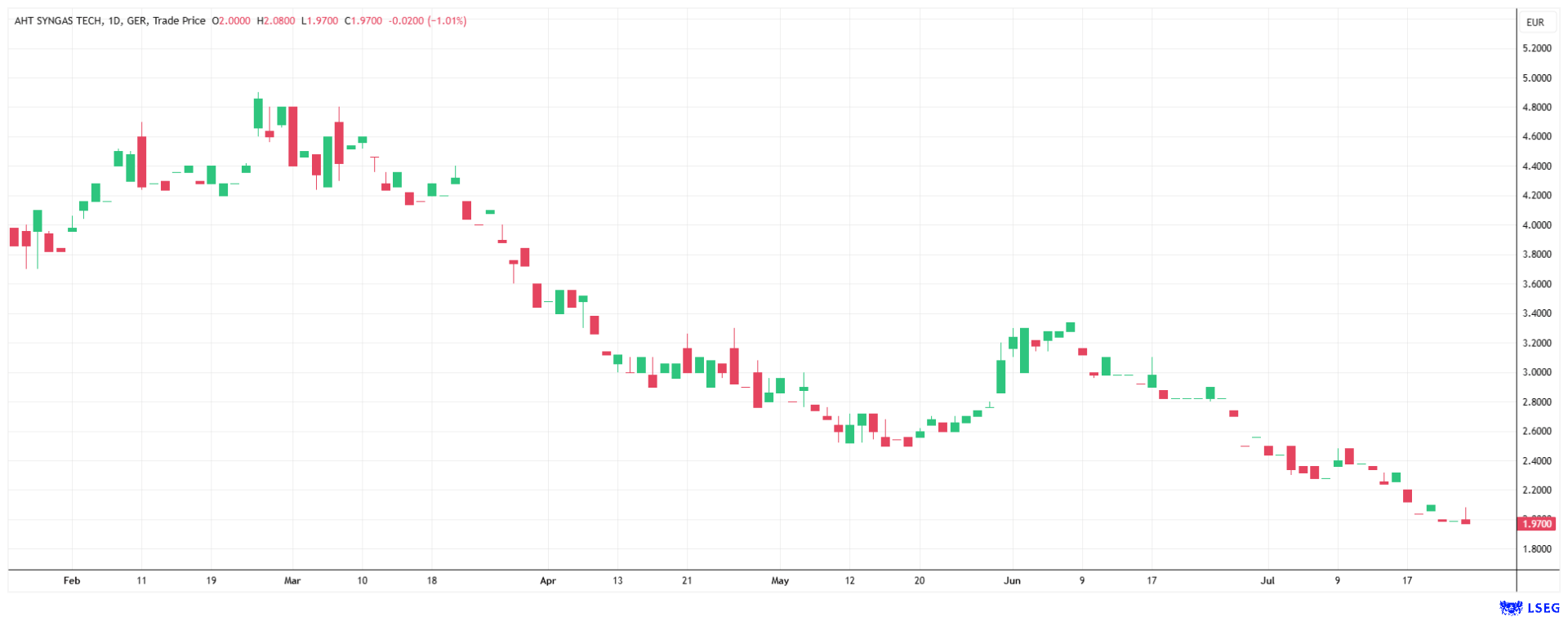
The opportunity for niche player A.H.T. clearly lies in its future role as a flexible supplier for businesses that lack access to the grid and are seeking self-sufficient solutions. Developments over the past few quarters suggest that the company can benefit from the current market environment. Nevertheless, A.H.T. is in the midst of a turnaround story. In December 2025, GBC analysts saw a price target of EUR 8.50. Following a rally at the start of the year, things have since quieted down for A.H.T.’s stock. That does not necessarily have to be a bad sign. If A.H.T. achieves further operational successes, the stock could resume the trend it began in early 2026.

Conflict of interest
Pursuant to §85 of the German Securities Trading Act (WpHG), we point out that Apaton Finance GmbH as well as partners, authors or employees of Apaton Finance GmbH (hereinafter referred to as “Relevant Persons”) may hold shares or other financial instruments of the aforementioned companies in the future or may bet on rising or falling prices and thus a conflict of interest may arise in the future. The Relevant Persons reserve the right to buy or sell shares or other financial instruments of the Company at any time (hereinafter each a “Transaction”). Transactions may, under certain circumstances, influence the respective price of the shares or other financial instruments of the Company.
In addition, Apaton Finance GmbH is active in the context of the preparation and publication of the reporting in paid contractual relationships.
For this reason, there is a concrete conflict of interest.
The above information on existing conflicts of interest applies to all types and forms of publication used by Apaton Finance GmbH for publications on companies.
Risk notice
Apaton Finance GmbH offers editors, agencies and companies the opportunity to publish commentaries, interviews, summaries, news and the like on news.financial. These contents are exclusively for the information of the readers and do not represent any call to action or recommendations, neither explicitly nor implicitly they are to be understood as an assurance of possible price developments. The contents do not replace individual expert investment advice and do not constitute an offer to sell the discussed share(s) or other financial instruments, nor an invitation to buy or sell such.
The content is expressly not a financial analysis, but a journalistic or advertising text. Readers or users who make investment decisions or carry out transactions on the basis of the information provided here do so entirely at their own risk. No contractual relationship is established between Apaton Finance GmbH and its readers or the users of its offers, as our information only refers to the company and not to the investment decision of the reader or user.
The acquisition of financial instruments involves high risks, which can lead to the total loss of the invested capital. The information published by Apaton Finance GmbH and its authors is based on careful research. Nevertheless, no liability is assumed for financial losses or a content-related guarantee for the topicality, correctness, appropriateness and completeness of the content provided here. Please also note our Terms of use.
Stockhouse does not provide investment advice or recommendations. All investment decisions should be made based on your own research and consultation with a registered investment professional. The issuer is solely responsible for the accuracy of the information contained herein. For full disclaimer information, please click here.