
Lahontan Gold – Production Outlook Through the End of the Decade in Nevada
CEO Kimberly Ann probably never even dreamed of this: over 700% share price growth in just one year! We are talking about Lahontan Gold from Nevada. The company is developing the historic Santa Fe project in Nevada, located in the heart of one of the world’s most productive gold regions with over 225 million ounces of historical production. Santa Fe covers 28.3 km², with historical production of 359,000 ounces of gold and 702,000 ounces of silver from 1988 to 1995. The property has good infrastructure, including water rights and its own power supply. The current resource totals approximately 1.9 million ounces of gold equivalent across all categories. An upcoming update could reveal additional material. The West Santa Fe satellite project delivers flat, oxidized mineralization from surface at 36.6 m at 3.11 g/t gold equivalent, allowing for low-cost open-pit mining.
Exploration currently encompasses over 700 approved drill holes; a second RC drilling rig will increase the drilling rate. With the capital raise of up to CAD 13.9 million at CAD 0.41 per unit and a half warrant at CAD 0.60, the company continues to secure high financial flexibility. With approximately 404 million shares outstanding, the market capitalization stands at around CAD 145 million, which appears attractive relative to the resource. Recent management additions and a clear focus on permits and resource expansion underscore the transition from explorer to project developer. If progress continues as planned, Santa Fe could resume production toward the end of the decade, giving Lahontan a classic development profile with potential for acquisition or self-production in the US gold sector. Yesterday, the stock traded between CAD 0.36 and 0.37, offering a slightly lower entry point for new investors. Very promising!
IIF host Lyndsay Malchuck gets to the bottom of the facts in Nevada and interviews CEO and founder Kimberly Ann.
BASF and Lanxess – Raw Material Flows Become a Decisive Factor
Many wars create a negative environment for industry and growth. The business models of BASF and Lanxess are structurally highly energy- and raw material-intensive, with natural gas serving as both an energy source and a chemical feedstock. The European chemical industry has long been considered particularly gas-dependent, as gas is directly incorporated into production processes and price fluctuations have an immediate impact on the cost structure. Direct physical import dependence, particularly on the Middle East, is comparatively low, as companies have been utilizing diversified gas and raw material sources since the last gas crisis. Operational dependence is therefore driven more by price and logistics than by volume.
A blockade of the Strait of Hormuz could nevertheless prove to be a showstopper, as it is considered a systemic risk factor for the entire industry. The reason: Globally significant commodity flows systematically pass through this strait and are an integral part of global supply chains. For BASF, this primarily means margin pressure and price adjustments, but in extreme cases, also production stoppages. The company has already implemented price increases of up to around 30% for certain product lines to pass on higher energy and logistics costs.
Lanxess is reacting similarly, though with greater earnings volatility, as its portfolio is less integrated and more cyclical.
In a scenario of persistently high energy prices, the earnings situation of both companies therefore remains structurally vulnerable, with Lanxess bearing the higher risk in the short term. Thanks to a positive report from JPMorgan, Lanxess has risen from EUR 11 to over EUR 16 since the start of the week, bringing it very close to the target range set by experts on the LSEG platform, with a 12-month forecast of EUR 18.15. With prices above EUR 50, BASF has already exhausted all of the analysts’ upside potential, but continues to shine with a 4.6% dividend.
E.ON – Analysts see a bright future
The electricity provider E.ON is currently benefiting from the current environment. This is because the company’s core revenue comes from owning and operating electricity and gas distribution networks and receiving regulated network fees in return, which ensures relatively stable, predictable cash flows. In addition, E.ON sells electricity, gas, and heat to residential, commercial, and industrial customers. This generates strong margins in the sales business, which are being further boosted by efficiency programs. A third pillar consists of energy-related services in the areas of energy infrastructure and storage, as well as efficiency and decarbonization solutions, complemented by highly profitable e-mobility offerings. Strategically, E.ON is focusing on expanding distribution networks, digitalization, and sustainable customer solutions to benefit from the energy transition and electrification in Europe over the long term.
With the stock having been on an upward trend for a good 12 months, analysts have now also begun issuing recommendations. Goldman Sachs, for instance, raised its target price from EUR 20.50 to EUR 23.00 with a “Buy” rating, while the British bank Barclays sees a target of only EUR 19 and recommends a “Neutral” rating. Overall, 11 out of 23 analysts are giving the stock a thumbs-up. With the current consensus price target of just under EUR 19, the market is clearly facing an important decision right now. Dividend policy, debt reduction, potential share buybacks, and discipline in M&A will determine whether E.ON is perceived more as a defensive dividend stock or as a moderate growth vehicle with a rising dividend yield. In the aggressive scenario, even more upside is likely following a 50% price increase since April 2025. The stock recently corrected from EUR 20.40 to EUR 18.80. The annual general meeting will take place on April 23.
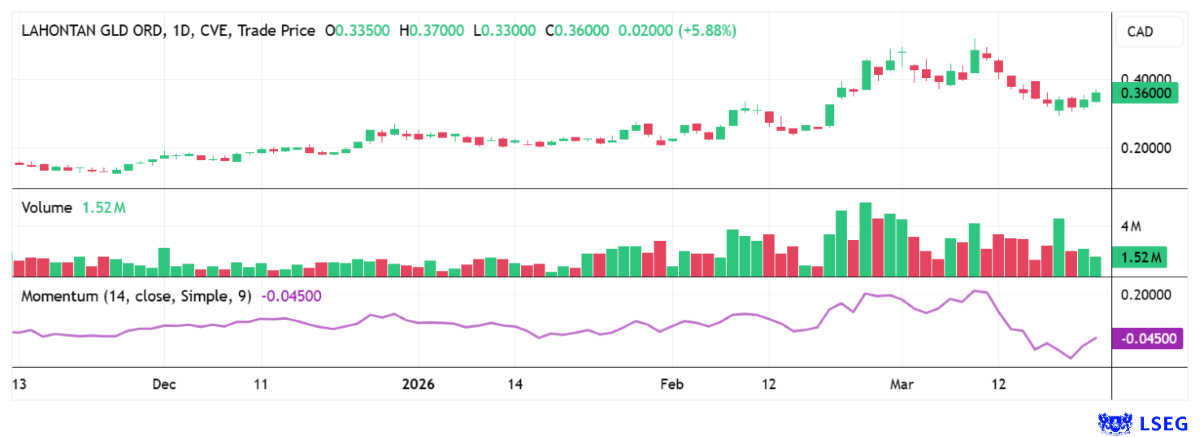
No easy task in these times: Amid the daily barrage of news, investors must tune out the terrible events if they want to maintain a return-oriented view of their portfolio. Our selection includes companies that are responding to the crises to varying degrees. Anyone who added Lahontan Gold to their portfolio alongside blue-chip stocks like BASF, Lanxess, and E.ON has been able to show a positive return over the past 12 months.
Conflict of interest
Pursuant to §85 of the German Securities Trading Act (WpHG), we point out that Apaton Finance GmbH as well as partners, authors or employees of Apaton Finance GmbH (hereinafter referred to as “Relevant Persons”) currently hold or hold shares or other financial instruments of the aforementioned companies and speculate on their price developments. In this respect, they intend to sell or acquire shares or other financial instruments of the companies (hereinafter each referred to as a “Transaction”). Transactions may thereby influence the respective price of the shares or other financial instruments of the Company.
In this respect, there is a concrete conflict of interest in the reporting on the companies.
In addition, Apaton Finance GmbH is active in the context of the preparation and publication of the reporting in paid contractual relationships.
For this reason, there is also a concrete conflict of interest.
The above information on existing conflicts of interest applies to all types and forms of publication used by Apaton Finance GmbH for publications on companies.
Risk notice
Apaton Finance GmbH offers editors, agencies and companies the opportunity to publish commentaries, interviews, summaries, news and the like on news.financial. These contents are exclusively for the information of the readers and do not represent any call to action or recommendations, neither explicitly nor implicitly they are to be understood as an assurance of possible price developments. The contents do not replace individual expert investment advice and do not constitute an offer to sell the discussed share(s) or other financial instruments, nor an invitation to buy or sell such.
The content is expressly not a financial analysis, but a journalistic or advertising text. Readers or users who make investment decisions or carry out transactions on the basis of the information provided here do so entirely at their own risk. No contractual relationship is established between Apaton Finance GmbH and its readers or the users of its offers, as our information only refers to the company and not to the investment decision of the reader or user.
The acquisition of financial instruments involves high risks, which can lead to the total loss of the invested capital. The information published by Apaton Finance GmbH and its authors is based on careful research. Nevertheless, no liability is assumed for financial losses or a content-related guarantee for the topicality, correctness, appropriateness and completeness of the content provided here. Please also note our Terms of use.
Stockhouse does not provide investment advice or recommendations. All investment decisions should be made based on your own research and consultation with a registered investment professional. The issuer is solely responsible for the accuracy of the information contained herein. For full disclaimer information, please click here.