

- AI data centres are consuming growing amounts of memory, leaving less supply available for consumer electronics
- Memory manufacturers expect supply shortages and elevated prices to continue through at least 2027, with relief possibly not arriving until 2028
- Higher DRAM costs could lead to more expensive PCs, smartphones, gaming consoles, and longer hardware generations for consumers
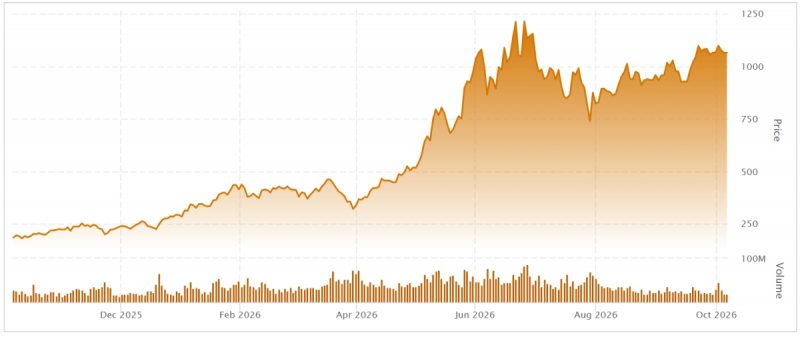
- Micron Technology stock (NASDAQ:MU) last traded at US$1,064.30
The global memory market could be heading into another prolonged period of shortages and rising prices, with industry leaders warning that supply constraints may persist through 2027 and potentially into 2028.
The growing demand for artificial intelligence infrastructure is increasingly consuming available DRAM and high-bandwidth memory (HBM), leaving fewer resources available for consumer electronics and raising concerns about future hardware costs.
Recent comments from executives at major memory manufacturers suggest the industry is struggling to keep pace with surging demand from data centre operators. Companies building massive AI clusters require enormous amounts of memory, particularly advanced HBM products used alongside powerful AI accelerators. As a result, a significant portion of future production capacity has reportedly already been committed years in advance.
Micron (NASDAQ:MU) and Samsung (OTC:SSNLF) said recently that the memory shortage will continue for at least the next couple of years.
The situation extends beyond enterprise technology. DRAM is a critical component found in virtually every modern electronic device, from smartphones and laptops to gaming consoles and networking equipment. When memory supplies become constrained, the effects ripple throughout the broader technology sector, contributing to higher manufacturing costs and ultimately more expensive products for consumers.
This article is a journalistic opinion piece that has been written based on independent research. It is intended to inform investors and should not be taken as a recommendation or financial advice.
Industry observers note that memory manufacturers have increasingly focused on serving high-margin enterprise customers, particularly those involved in AI and cloud computing. Data centre operators are often willing to pay premium prices to secure long-term supply agreements, creating a strong incentive for memory suppliers to prioritize those customers over consumer markets.
That shift has raised questions about whether sufficient investment is being made to expand overall production capacity. While memory makers have announced plans to increase output, demand from AI applications continues to grow at a pace that appears to be outstripping new supply. Critics argue that if shortages continue well into the latter part of the decade, the industry may face increased scrutiny over its production strategies and pricing practices.
For consumers, the most visible impact is likely to be higher prices for electronics. Memory is a key cost component in PCs, smartphones, graphics cards, and gaming systems. If DRAM and HBM prices continue climbing, manufacturers may have little choice but to pass those costs on to buyers.
Let’s not forget that a U.S. class action lawsuit was just filed against Samsung, SK Hynix (OTC Pink:HXSCL), and Micron, alleging the three dominant memory manufacturers coordinated to restrict output of legacy DRAM products, driving prices sharply higher amid a broader industry pivot toward HBM used in AI workloads.
The gaming industry could be particularly vulnerable. Future console generations from Sony (NYSE:SONY) and Microsoft (NASDAQ:MSFT) are expected to require substantial amounts of memory to support advanced graphics, AI-driven features, and higher-performance experiences. If memory costs remain elevated, new consoles could launch at significantly higher price points than previous generations.
Such conditions could also encourage platform holders to extend the lifespan of current hardware. Rather than rapidly transitioning users to next-generation systems, companies may choose longer cross-generation support periods, allowing existing consoles to remain relevant for years after new hardware arrives. This approach could help publishers reach larger audiences while limiting the pressure on consumers to upgrade immediately.
Nintendo (OTC Pink:NTDOF) may face similar challenges. Although the company has traditionally focused on lower-cost hardware compared to its competitors, sustained increases in memory pricing could make it more difficult to maintain affordable console pricing over the long term.
For now, consumers may find some comfort in the fact that existing devices remain highly capable. However, with memory suppliers and technology companies signalling continued supply constraints, the next few years could bring higher prices across much of the electronics market.
As AI investment shows little sign of slowing, the battle for memory supply is becoming one of the defining challenges facing the technology industry. Unless manufacturing capacity expands enough to meet booming demand, consumers could be facing a future where everything from gaming consoles to smartphones becomes noticeably more expensive.

About Micron Technology Inc.
Micron Technology Inc. designs, develops, manufactures, and sells memory and storage products in the United States, Taiwan, Singapore, Japan, Malaysia, China, India, and internationally.
Micron Technology stock (NASDAQ:MU) closed 0.99% lower at US$1,064.30 but has risen 272.78% since the year began.
Join the discussion: Find out what the Bullboards are saying about chip stocks like Micron and check out Stockhouse’s stock forums and message boards.