

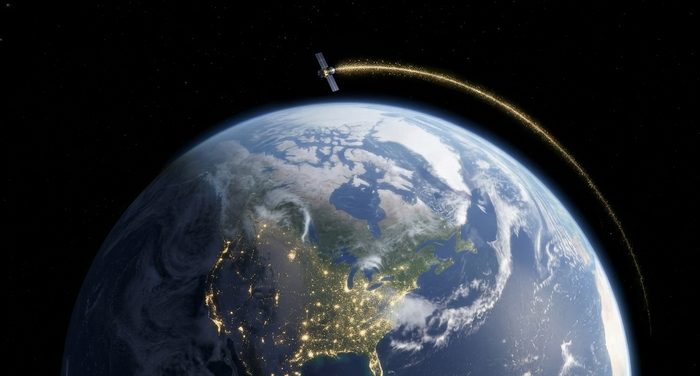
- Nvidia (NASDAQ:NVDA) introduced its Space‑1 Vera Rubin Module, delivering up to 25× more AI inferencing performance than the H100 GPU to support orbital data centres, geospatial intelligence and autonomous space operations
- The company expanded its space‑focused platform with IGX Thor and Jetson Orin, offering energy‑efficient, real‑time AI processing for on‑orbit edge computing in size‑ and power‑constrained environments
- Industry partners including Aetherflux, Axiom Space, Kepler Communications, Planet, Sophia Space and Starcloud plan to use Nvidia’s accelerated platforms as demand for real‑time orbital data processing grows
- Nvidia stock (NASDAQ:NVDA) last traded at US$184.05
Nvidia (NASDAQ:NVDA) has announced a suite of accelerated computing platforms designed to extend artificial intelligence capabilities into orbit, marking a significant step toward emerging AI‑driven space infrastructure. The unveiling took place during the company’s GTC 2026 conference, where leadership emphasized the growing importance of processing data directly in space.
The newly introduced Space‑1 Vera Rubin Module serves as the centrepiece of Nvidia’s expanded space‑focused portfolio. According to the company, the module delivers up to 25 times more AI inferencing performance than the Nvidia H100 GPU, enabling real‑time processing for orbital data centres, advanced geospatial intelligence and autonomous in‑orbit operations.
Engineered for size‑, weight‑ and power‑constrained environments, Rubin integrates a tightly coupled CPU‑GPU architecture and high‑bandwidth interconnects intended to handle the massive data streams generated by on‑orbit sensors. Nvidia said the platform allows large language models and other advanced AI systems to operate directly in space without relying on ground‑based processing.
Complementing the Rubin module are Nvidia’s IGX Thor and Jetson Orin platforms, both designed for energy‑efficient AI inference and sensor processing aboard satellites and spacecraft. Jetson Orin is optimized for ultra‑compact deployments, while IGX Thor provides industrial‑grade durability and real‑time AI capabilities for mission‑critical edge environments.
Nvidia also highlighted advances in its ground‑based data‑centre technologies, including the RTX PRO 6000 Blackwell Server Edition GPU, which the company says can provide up to 100× faster performance than legacy CPU‑based systems for large‑scale geospatial analysis. These systems are intended to support applications such as environmental monitoring, disaster response and climate modeling by processing extensive archives of satellite imagery.
Industry partners—including Aetherflux, Axiom Space, Kepler Communications, Planet, Sophia Space and Starcloud—are incorporating Nvidia’s platforms into upcoming missions. These companies aim to leverage both on‑orbit AI processing and accelerated ground‑based analytics as the commercial space sector rapidly expands and demand grows for real‑time data insights.
With these new platforms, Nvidia positions itself at the forefront of efforts to build AI‑enabled orbital data centres—an emerging technology field that aims to reduce reliance on terrestrial computing resources and harness the potential of space‑based power and sensing.
“Space computing, the final frontier, has arrived. As we deploy satellite constellations and explore deeper into space, intelligence must live wherever data is generated,” Nvidia’s CEO, Jensen Huang said in a news release. “AI processing across space and ground systems enables real-time sensing, decision-making and autonomy, transforming orbital data centers into instruments of discovery and spacecraft into self-navigating systems. With our partners, we’re extending Nvidia beyond our planet — boldly taking intelligence where it’s never gone before.”
Nvidia Corp. is a full-stack computing infrastructure company.
Nvidia stock (NASDAQ:NVDA) last traded at US$184.05 and is up 58 per cent since this time last year.
Join the discussion: Find out what everybody’s saying about this stock on the Nvidia Bullboard investor discussion forum, and check out the rest of Stockhouse’s stock forums and message boards.
Stockhouse does not provide investment advice or recommendations. All investment decisions should be made based on your own research and consultation with a registered investment professional. The issuer is solely responsible for the accuracy of the information contained herein. For full disclaimer information, please click here.