

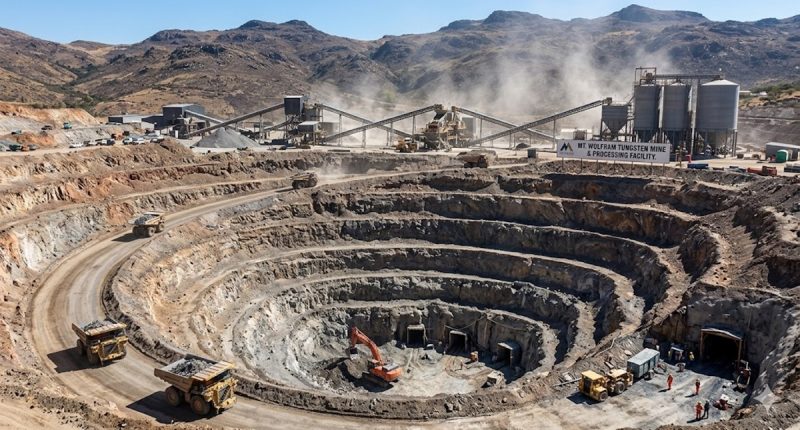
- Chinese buyers are snapping up U.S. tungsten scrap and bidding prices sharply higher, driving major market shortages
- China’s dominance in tungsten and rare earths gives it strong control over global pricing and supply chains
- Western governments are backing domestic projects like Fireweed Metals to secure critical mineral supply
- Fireweed Metals stock (TSXV:FWZ) opened trading at C$4.21
The return of strategic commodities
Rare earth elements (REEs) and tungsten have quietly shifted from niche industrial inputs into strategic weapons of economic influence. For investors, the most important takeaway is simple: pricing power in these markets is increasingly detached from traditional supply-demand cycles and driven by geopolitics, policy, and supply chain choke points.
Nowhere is this clearer than in tungsten—a critical defence metal—where recent developments signal a structural shift with meaningful implications for equities, commodities, and national industrial strategies.
Tungsten’s sudden price explosion: A supply shock in motion
Since early 2025, Chinese buyers have been aggressively sourcing tungsten scrap from across the United States, triggering what industry participants describe as a bidding war for strategic feedstock.
- U.S. sellers report Chinese traders offering up to 5x prevailing prices for scrap material
- The effort has intensified amid a shortage of tungsten outside China driven by declining supply and surging demand from aerospace, defence, and industrial tool manufacturing
This scramble has had a dramatic price impact:
- Tungsten prices in the U.S. have risen more than 200 per cent since May 2025
- Tungsten scrap prices have surged around 350 per cent over the same period
These are extraordinary moves for what is typically a stable, niche commodity. They reflect a core truth: when supply is concentrated and demand is inelastic—as in defence applications—prices can reset violently.
This article is a journalistic opinion piece that has been written based on independent research. It is intended to inform investors and should not be taken as a recommendation or financial advice.
Why tungsten has pricing power
Tungsten’s market structure gives it unique pricing leverage:
1. Extreme supply concentration
China controls over 80 per cent of global tungsten supply and dominates refining capacity
2. Limited substitutes
The metal’s physical properties—extreme hardness and heat resistance—make it irreplaceable in missiles, armour-piercing munitions, turbine components, and precision tools.
3. Defence-driven demand
- Military uses account for roughly 12 per cent of demand today, with expectations to rise meaningfully.
- Defence demand is projected to grow steadily, potentially overtaking other sectors long term.
4. Structural supply deficits
Years of underinvestment and declining ore grades—especially in China—have created a tight global market with limited new supply pipelines.
The result: tungsten behaves less like a commodity and more like a strategically constrained asset, with pricing power shifting toward those who control production or processing.
The hidden scrap war
One of the most underappreciated dynamics is the fight over scrap.
With few new mines and limited processing capacity outside China, recycled tungsten has become a critical feedstock for non-Chinese supply chains.
Chinese buyers targeting U.S. scrapyards highlight several themes:
- Scrap is no longer waste—it’s smart inventory
- China’s processing ecosystem allows it to outbid competitors
- Western markets risk losing feedstock unless export controls or incentives change
This is why some U.S. industry voices are calling for export bans, warning of a “secret war” over critical minerals.
For investors, this matters because it indicates:
- Supply tightness is real and accelerating
- Pricing can spike even without traditional mine disruptions
- Policy risk (export bans, tariffs) could reshape valuations quickly
The rare-earth parallel: Pricing power at scale
The tungsten story is not unique—it mirrors what has already happened in rare earth markets.
China controls:
- ~60 per cent of global mining output
- ~90 per cent of processing capacity and magnet production
This dominance enables Beijing to:
- Restrict exports
- Influence global prices
- Create supply shocks in downstream industries
For example, export curbs in 2025 caused sharp reductions in supply and dramatic price increases in key rare earth elements, with some materials rising multiples in value.
The lesson is clear: pricing power follows processing and supply chain control—not just resource ownership.
Stock market implications
1. Re-rating of critical mineral producers
Companies with exposure to tungsten and rare earths are being re-rated as:
- Strategic assets rather than commodity plays
- Beneficiaries of government subsidies, defence spending, and supply-chain reshoring
2. Policy-driven capital flows
Governments are injecting billions into:
- Domestic mining
- Processing infrastructure
- Strategic stockpiles
These investments can significantly de-risk projects and accelerate timelines, boosting valuations.
3. Volatility and optionality
Tungsten’s recent 200–350 per cent price surge demonstrates:
- High upside leverage in producers during supply shocks
- Extreme volatility tied to geopolitical developments
4. Supply chain winners vs. losers
- Winners: upstream miners, refiners, recyclers outside China
- Losers: manufacturers dependent on insecure imports
Case study: Fireweed Metals and the Mactung Project
With this in mind, Fireweed Metals Corp. (TSXV:FWZ) is emerging as a potential strategic beneficiary.
The company recently launched an updated Feasibility Study for its 100 per cent-owned Mactung Tungsten Project in Yukon, Canada—one of the largest high-grade undeveloped tungsten deposits globally. The team has also just launched its 2026 field program at the project.
Key highlights
- Engagement of internationally recognized engineering and technical consultants for the study
- Integration of updated:
- Geological modeling
- Metallurgical testing
- Mine design and infrastructure planning
Work programs underway
- Block model updates incorporating recent drilling
- Mine planning focused on early high-margin production
- Metallurgical and geometallurgical testing
- Execution planning
Strategic backing
Crucially, the project is supported by:
- A U.S. Department of Defense award under the Defense Production Act (DPA Title III) announced in December 2024
This signals that Mactung is not just a mining project—it is a strategic North American supply asset.
Timeline
- Environmental assessment completed in 2014
- Mine licensing targeted for 2027 submission
Investment takeaways
- Pricing power is shifting upstream
Control of scarce resources—especially those tied to defence—is becoming a primary driver of margins. - Geopolitics > fundamentals
Export controls, stockpiling, and strategic competition now influence prices more than traditional cost curves. - Supply scarcity is structural
New mines take years to develop, while demand—especially from defence and energy transitions—is accelerating. - Western projects are strategic assets
Companies like Fireweed Metals could benefit from:- Government funding
- Accelerated permitting
- Premium valuations as secure suppliers
On the tip of our tung(sten)
The quiet scramble for tungsten scrap in U.S. yards is not an isolated issue—it’s a signal. Alongside rare earths, it points to a world where critical minerals are becoming instruments of power, not just inputs.
For investors, the implication is profound: the next commodity supercycle may not be driven by growth alone—but by control.
Fireweed Metals stock (TSXV:FWZ) opened trading at C$4.21 and has risen 83 per cent since this time last year, while also being up 55 per cent since the year began.
Join the discussion: Find out what the Bullboards are saying about Fireweed Metals and check out Stockhouse’s stock forums and message boards.