

- Speculation around a potential multi‑trillion‑dollar SpaceX IPO is drawing renewed investor interest to the broader commercial space sector
- Intuitive Machines (NASDAQ:LUNR) is focused on lunar infrastructure, leveraging spacecraft expertise and valuable imaging data to support navigation and future Moon operations
- Maritime Launch Services (Cboe Ca: MAXQ) is building Canada’s first commercial spaceport with government backing, aiming to establish sovereign launch capability and steady long‑term revenue
- MDA Space (TSX: MDA) is scaling advanced satellite manufacturing to meet rising global demand for constellations, highlighting industrial growth across the space economy
Speculation surrounding a potential SpaceX initial public offering—sometimes floated in discussions at valuations approaching US$2 trillion—has reignited investor interest in the commercial space economy. While CEO Elon Musk has historically resisted taking SpaceX public, citing the long-term nature of its Mars ambitions and the volatility of public markets, the company’s rapid growth in satellite broadband (Starlink), launch services, and reusable rocket technology continues to fuel debate about when—or if—an IPO could occur.
This article is a journalistic opinion piece that has been written based on independent research. It is intended to inform investors and should not be taken as a recommendation or financial advice.
What investors are focused on, is not whether SpaceX lists tomorrow, but how its success highlights the expanding opportunity set across the broader space industry. From lunar infrastructure to sovereign launch capabilities and satellite manufacturing at scale, several publicly traded companies are positioning themselves to benefit from increased demand for access to—and operations in—space.
Below are three such companies operating in adjacent segments of this evolving ecosystem.
Building the backbone for lunar infrastructure
Houston-based Intuitive Machines Inc. (NASDAQ: LUNR) has emerged as one of the more visible players in lunar exploration infrastructure—a niche gaining traction as NASA’s Artemis program and commercial missions accelerate.
The company’s capabilities span spacecraft development, navigation, and infrastructure-as-a-service offerings. To date, it has built more than 300 spacecraft and delivered over 260 kilograms of payload to the lunar surface, underscoring its operational experience in deep space missions.
A key differentiator for Intuitive Machines lies in its data and imaging leadership. Through recent contracts, the company now serves as the prime contractor for both:
- The Lunar Reconnaissance Orbiter Camera (LROC)
- The ShadowCam instrument aboard Korea’s lunar orbiter
These contracts—valued at US$15.5 million and US$4.5 million respectively over three years—task the company with mission-critical activities including imaging operations, data analysis, and lunar mapping. The LROC program alone has amassed a massive dataset, with millions of high-resolution images that underpin modern lunar mission planning.
This data is particularly valuable in identifying landing sites, mapping terrain, and informing infrastructure development for both government and commercial missions. Intuitive Machines plans to integrate these datasets into its future lunar data relay satellite constellation, aiming to provide navigation and communication services across the Moon.
Operationally, the company continues to push forward despite setbacks. Its IM-2 lander crash near the lunar south pole illustrates the inherent risks in space exploration. Yet development remains active, with:
- IM-3 mission targeted for 2026
- IM-4 mission planned for 2027, launched via a SpaceX Falcon 9
Taken together, Intuitive Machines is working to establish foundational infrastructure for sustained lunar operations—an area that could see increasing investment if long-term Moon missions become routine.
Intuitive Machines stock (NASDAQ: LUNR) has risen 260 per cent since this time last year.
Canada’s emerging sovereign launch capability
While much of the space industry has historically been concentrated in the United States, Maritime Launch Services Inc. (Cboe Canada: MAXQ) is helping Canada make a name for itself in the launch market.
The company is developing Spaceport Nova Scotia, a commercial orbital launch complex designed to serve both civilian and defence-related missions. The site will support launches into low Earth orbit and accommodate a broad range of orbital inclinations—making it attractive for international customers.
A major milestone came with the Canadian Department of National Defence (DND) signing a long-term agreement to become a tenant at the spaceport. The deal includes:
- A 10-year lease for a dedicated launch pad
- Total contract value of approximately C$200 million
- Annual payments of C$20 million, supporting near-term cash flow
The agreement is significant for multiple reasons. It provides Maritime Launch with a stable revenue base as construction progresses, while also advancing Canada’s objective of achieving sovereign access to space.
The spaceport itself is expected to reach initial operational readiness by late 2026, with ongoing development that includes additional launch pads, payload facilities, and mission control infrastructure.
Strategically, the project aligns with broader defense and geopolitical initiatives. Canada has also signaled intent to participate in NATO’s STARLIFT initiative, which aims to create a responsive network of allied launch capabilities. Spaceport Nova Scotia could play a role in this ecosystem, offering a geographically distinct launch option within the alliance.
For investors, Maritime Launch represents a more speculative, infrastructure-focused play—one tied not only to commercial demand but also to national security priorities and government partnerships.
Maritime Launch Services stock (Cboe Canada: MAXQ) has risen 1,700 per cent since this time last year.
Scaling satellite manufacturing for a constellation-driven future
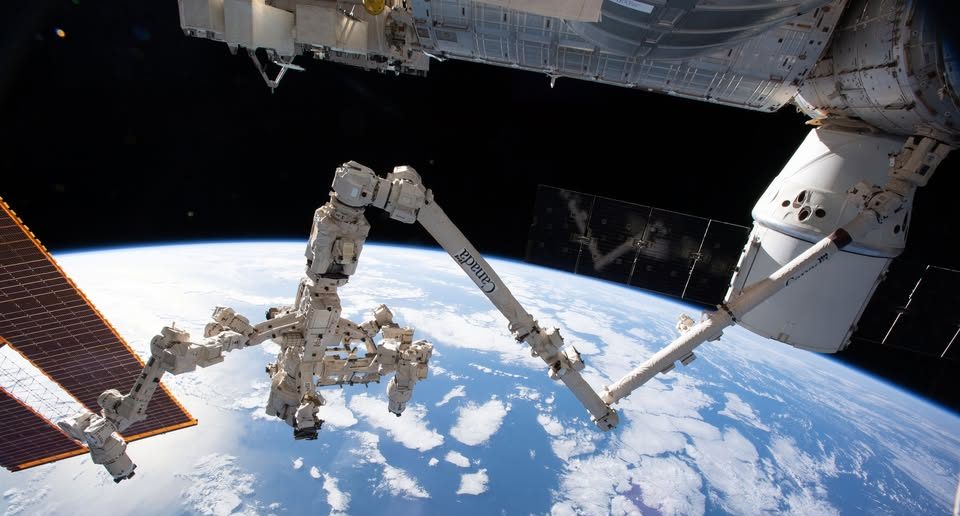
MDA Space Ltd. (TSX: MDA) brings a longer operating history than many newer entrants, with over 55 years of experience spanning robotics, satellite systems, and geointelligence. The company has contributed to more than 450 missions, including early Canadian satellite programs.
Its latest development reflects where the industry is headed: high-volume satellite production.
In Montréal, MDA recently inaugurated a 17,000-square-metre satellite manufacturing facility, effectively doubling its production capacity. The site is designed to support the assembly, integration, and testing of multiple satellites simultaneously—particularly its MDA Aurora digital satellite platform.
These next-generation satellites feature:
- Software-defined architectures
- Dynamic beamforming capabilities
- Greater flexibility for evolving network demands
The facility incorporates automation, augmented reality tools, and proprietary testing systems to improve efficiency. MDA indicates it could eventually support production of up to 400 satellites per year, positioning itself to capitalize on the rapid growth of satellite constellations for communications, Earth observation, and defense applications.
Beyond scale, the facility also reflects operational modernization. New engineering workflows and performance tracking systems aim to reduce production timelines while maintaining quality—key factors in an increasingly competitive market.
From an environmental standpoint, the site also targets LEED certification, incorporating features like solar panels and energy-efficient systems.
For investors, MDA represents a more established, diversified exposure to the space sector—one focused on the upstream manufacturing layer that supports both commercial constellations and government missions.
MDA Space stock (TSX: MDA) has risen 130 per cent since this time time last year.
Looking beyond SpaceX
While a potential SpaceX IPO would undoubtedly capture headlines and reshape public market access to the space economy, it is far from the only avenue for investor participation.
Companies like Intuitive Machines, Maritime Launch Services, and MDA Space illustrate the breadth of opportunity across the sector—from lunar data infrastructure and sovereign launch capabilities to mass satellite production.
Each carries its own risk profile and timeline to profitability, reflecting the capital-intensive and technically complex nature of the industry. Yet collectively, they underscore a broader trend: space is transitioning from a government-dominated domain to a multi-faceted commercial ecosystem.
For investors, the key takeaway may not be timing a single high-profile IPO but rather conducting deeper due diligence across the emerging value chain—identifying where long-term demand, technological differentiation, and strategic partnerships intersect in an industry that is still, quite literally, just getting started.
Join the discussion: Find out what the Bullboards are saying about aerospace and defence stocks, and check out Stockhouse’s stock forums and message boards.