

Author: Marc Davis, Capital Markets Media.
Stallion Uranium (TSXV:STUD) and its lead investors are so committed to a uranium discovery in the southwest Athabasca basin, the company assembled the largest land package in the area with over 1,700 square kilometres of prospective ground. In this area, considered the next frontier in the Basin, Stallion holds a strategic position bordering industry giants like NexGen Energy, Cameco, Orano, Atha Energy, and F3 Uranium.
With that amount of ground, how does Stallion make the best use of its shareholder’s exploration dollars towards a new uranium discovery? To prioritize and optimize exploration Stallion CEO Matthew Schwab and VP Exploration Darren Slugoski share an exploration mentality, and go through a regimented, 11-step ranking criteria for every square kilometer of ground Stallion has in the western Basin.
This article is being disseminated on behalf of Capital Markets Media, a third-party issuer and is intended for informational purposes only.
“It’s empirical and statistical,” says Schwab. “ It takes emotion out of the equation. We’ve done this before resulting in three separate discoveries in the Basin, Arrow, Spitfire and Gemini but the evaluation really comes down to four key criteria for success. Coyote meets all of these essential criteria, similar to NexGen’s Arrow target, yet in a target area five times the size. It’s clear to see why we’re so excited about Coyote right now.”
4 key features of similarity between Coyote and NexGen’s Arrow discovery:
1.The transition of magnetic signatures indicating favourable geological setting:
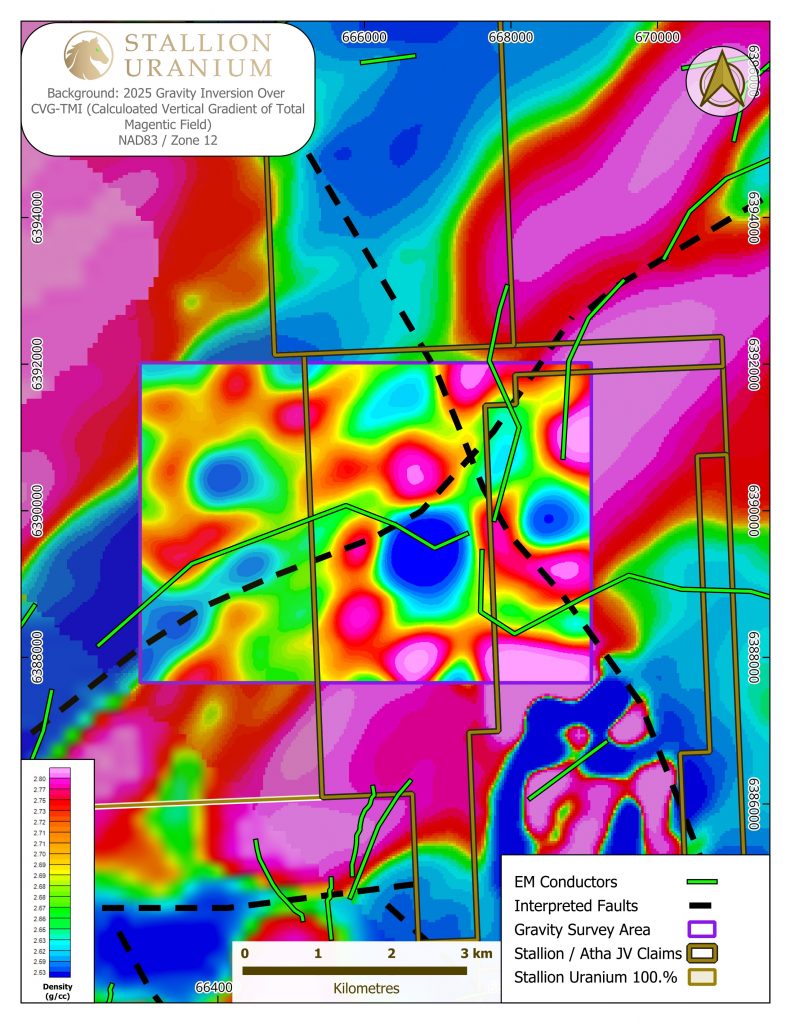
Through our Airborne Magnetics survey, we develop a property wide magnetic map showing the first key criteria: lithology. You need to have the right rock type. What you see in Fig 1 in those blues and greens are meta sedimentary packages.

2.Multiple strong conductive anomalies:
Mobile Magnetotelluric (MobileMT) and VTEM (Versatile Time-Domain Electromagnetic) are airborne electromagnetic survey technologies used to investigate subsurface conductivity and resistivity. Put simply, the survey methods are capable of detecting basement electromagnetic (EM) conductors and anomalous resistivity zones in the sandstone that may reflect alteration associated with uranium mineralization.
“We look for graphitic structures, represented by the green lines in Figure 1, that coincide with areas where faults converge.”
Those are the strong conductors that come from the graphite and sulphides in the metasediments. That’s the reducing environment required for the precipitation of uranium. So, as those uranium-rich fluids are coming across the unconformity and coming through those faults, they hit that reducing environment and they precipitate out. Most importantly, you want to see a break in those conductors as show in the green lines in Figure 1.
“At these breaks in the conductors, a chemical reaction takes place. It reflects alteration and partial destruction of graphite by uranium mineralizing fluids. You don’t want to see conductivity anymore.”
According to our consultants who interpreted the survey, “The spatial correlation with interpreted conductors, observed alteration patterns, and interpreted shear zones further support the interpretation that the Coyote project hosts the ideal geological pathfinders for a significant uranium system.”
3. Structural trends interpreted from the geophysical data:
The Coyote target sits on an interpreted regional intersection of fault zones identified by a combination of magnetics, EM (electromagnetics), and gravity data. In Figure 1 it is represented by the dotted black line. Gravity, electromagnetics and magnetics provides a more detailed structural interpretation of the ground, providing for drill targeting.
4. Multiple alteration halos discovered in 3D gravity inversion study:
The 3D gravity inversion shows the interpreted distribution of density variations beneath the survey area in three dimensions, helping visualize how the gravity anomalies may extend into the basement rocks that may be associated with uranium mineralization.
The inversion results visualize subsurface density variations, with the anomaly’s geometry and intensity suggesting prolonged fluid movement and alteration; critical vectors toward uranium mineralization. The alignment of the gravity-low with previously defined conductive trends and interpreted structural corridors underscores a compelling geological model. Highlights of the recent survey:
- Identified multiple gravity-low anomalies along a major conductive corridor
- A prominent, coherent gravity-low feature interpreted as a zone of alteration along an interpreted structural corridor
- Strong correlation between the gravity anomalies and conductive breaks identified from the electromagnetics surveys.
“The robustness of the geophysical anomaly, in conjunction with the structural and lithological setting, provides compelling evidence supporting Coyote as a high-priority target for drill testing.”
“This type of geophysical signature is commonly associated with deep-seated structural zones and extensive hydrothermal alteration; both key indicators in targeting basement-hosted uranium deposits in the Athabasca Basin.”
“We want to see complexity across the board because it just more elements in motion. The more ‘chaos’ the better. There’s more fluids moving around. There’s more interaction between those different horizons. Everything comes together, and that’s why the Athabasca Basin is so unique, it has all of these factors. Most places do not. So, at Coyote alone, we now have five priority targets across an eight-and-a-half-kilometre anomaly.”
In August the Stallion Uranium announced its drilling hit the highest levels of radioactivity to date, with a gamma reading of 1,400 counts per second (CPS). CPS measures the rate of the intensity of radiation hitting a detector. In the first 6 holes drilled at Coyote, 4 hit elevated levels of radiation.
“Successful uranium drill programs typically don’t achieve this level of radioactivity until at least two dozen holes, often hundreds,” says Schwab.
See Prospector Podcast: Matthew Schwab: Stallion Uranium’s 80% Hit Rate in the Athabasca Basin
Encouraged by the progression of the 2026 drill program and the geological information generated to date, Stallion has extended its current 5,500-metre program to approximately 6,750 metres before the end of the exploration season. Phase 1 drilling is ongoing with another 3 holes planned in Q4 – 2026, with camp mobilized and drill ready in the Q1 2027 for Phase II.
THE END
This article is disseminated in partnership with Stallion Uranium’s media advisor, Capital Markets Media. It is intended to inform investors and should not be taken as a recommendation or financial advice.