

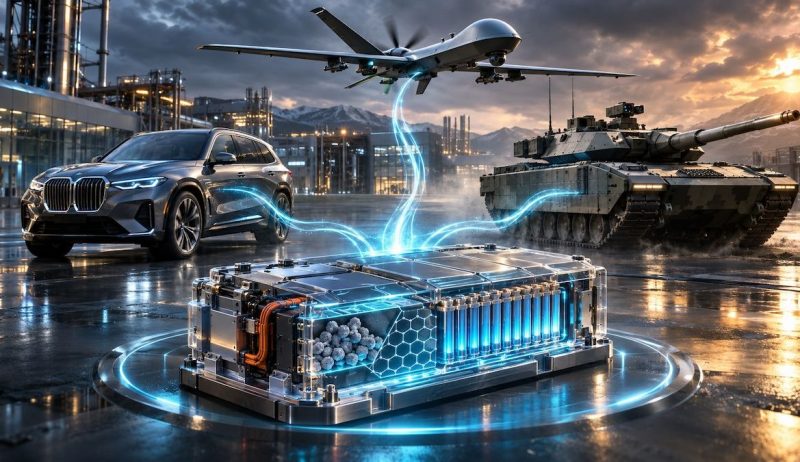
HPQ: Shares set for a re-rating?
More power, higher energy density and a longer service life. Canadian technology company HPQ Silicon aims to help shape the next generation of lithium-ion batteries with innovative anode materials. Together with its French partner Novacium, HPQ is developing a technology in which silicon is mixed with the graphite currently used in anodes. This is intended to significantly increase storage capacity without battery manufacturers having to fundamentally modify their production facilities. Tests with the GEN3 anode material delivered promising results. With the ENDURA+ product range, the company has also already developed battery cells with capacities of 4,000 and 6,000 mAh. The focus is now shifting to commercialisation. In October 2026, Novacium delivered battery prototypes for French army radios, which are expected to offer twice the energy capacity of the batteries currently in use. US electric vehicle developer Aptera Motors is also evaluating the use of the technology.
In its home country, HPQ Silicon benefits from the Canadian government’s support for the development of a domestic battery industry to reduce dependence on foreign suppliers. Under the government’s Energy Innovation Program, HPQ was awarded up to CAD 3 million in funding in September 2025. The money will go toward a project to produce silicon-based battery materials, with a total value of around CAD 5.7 million. A production facility with an annual capacity of 50 tonnes is initially planned. According to the company, this quantity would be sufficient to equip up to 40 million lithium-ion battery cells with the novel anode material. With government support, HPQ can finance a substantial proportion of the planned investments and advance the scaling of its technology. If the transition to economically viable series production succeeds, the company could establish itself as a supplier to the growing North American battery industry.
The direct stake in Novacium could also become increasingly valuable for HPQ Silicon. In March 2026, the Canadians increased their stake in the French technology company from 28.4% to 36.8% and have the option to increase it further. Since then, Novacium has made several commercial advances. In September, the company received an initial order from European drone manufacturer Alta Ares for more than 100 battery packs for an interceptor drone. In addition, customised battery systems are in the final testing phase at other European drone manufacturers. The collaboration with Tokai COBEX, a subsidiary of Japan’s Tokai Carbon group, also opens up new prospects. Together, the companies are exploring the development of high-performance anode materials that combine silicon with synthetic graphite produced with particularly low emissions. Novacium is not focusing solely on the battery market. At the end of October, a consortium led by Novacium received just under EUR 1 million in funding to develop a decentralised hydrogen production facility. The technology is intended to generate hydrogen directly at the point of use without relying on an external power supply. For HPQ, the stake thus opens up additional growth prospects beyond the battery business.
BMW: Neue Klasse in demand
Demand for electric vehicles with modern battery technology is prompting BMW to accelerate its model changeover. In early November 2026, the Munich-based automaker announced that it would phase out vehicles with older battery generations earlier than originally planned. This is driven by strong interest in the Neue Klasse models. For the new BMW iX3 alone, more than 100,000 orders were received from Europe within a year. To meet the high demand, BMW has introduced additional production shifts. This also allows the group to accelerate the phasing out of selected models with the existing Gen5 battery technology. The new generation is intended to impress with higher energy density and faster charging times. BMW also expects Gen6 to deliver lower production costs and therefore improved profitability.
However, the group’s electric vehicle sales still present a mixed picture. In the first nine months of 2026, the BMW Group delivered 314,552 all-electric vehicles worldwide. In the corresponding period of the previous year, the figure was 323,437 units. Sales therefore declined by 2.7%. Recently, however, the trend has improved significantly. In the third quarter, deliveries rose by 7.2% to 110,257 electric vehicles. Business in Europe developed particularly dynamically. There, sales of all-electric models rose by 37.5% to 81,941 vehicles between July and September. This meant that one in three vehicles delivered by the group in Europe during the period was all-electric. The figures show that electric propulsion continues to gain importance in key markets. At the same time, technological progress is increasing pressure on battery manufacturers to offer higher-performance, more cost-effective solutions.
Renk: Defence industry relies on high-performance batteries
In the defence industry, high-performance batteries are becoming increasingly important, not just for drones. Modern military vehicles require ever more energy for electronic systems, sensors and communications technology. At the same time, they need to be able to operate more efficiently and as inconspicuously as possible. One example of this development is the German defence group Renk. The specialist in drive systems is developing hybrid solutions for armoured vehicles in which conventional internal combustion engines are supplemented by electric drives and battery storage systems. One advantage is the ability to move vehicles almost silently over short distances. This can reduce the risk of detection. In addition, battery systems can supply power to the on-board electronics without the diesel engine running constantly. This saves fuel and enables low-noise operation when stationary.
With the ATREX hybrid drive, Renk has already developed a solution for main battle tanks weighing between 50 and 70 tonnes. The system combines conventional transmission technology with two electric drives or generators and a digital control system. Drive power can reach up to 1,500 kW. At the Eurosatory 2026 defence exhibition in Paris, Renk presented further technologies for the next generation of military vehicles. The focus was on electrifying drive systems and increasing digitalisation. For manufacturers of innovative battery technologies, this development opens up an additional sales market. In particular, energy storage systems with high power density, low weight and a long service life could see stronger demand in future. Companies such as HPQ Silicon, which are working on higher-performance battery materials, could also benefit.
Conclusion
The next generation of batteries opens up new prospects for the automotive industry and the defence sector. BMW and Renk show that higher-performance energy storage systems are increasingly in demand. For HPQ Silicon, this could create an attractive growth market. With government funding and initial commercial successes by its partner Novacium, important steps have been taken.
Conflict of interest
This article is an advertisement and has been produced and published by Apaton Finance GmbH („Apaton“) on behalf of HPQ Silicon Inc. („Issuer“) For this service, Apaton receives compensation from the Issuer in the amount of EUR 821,43.
Pursuant to §85 of the German Securities Trading Act (WpHG), we point out that Apaton Finance GmbH as well as partners, authors or employees of Apaton Finance GmbH (hereinafter referred to as “Relevant Persons”) may hold shares or other financial instruments of the aforementioned companies in the future or may bet on rising or falling prices and thus a conflict of interest may arise in the future. The Relevant Persons reserve the right to buy or sell shares or other financial instruments of the Company at any time (hereinafter each a “Transaction”). Transactions may, under certain circumstances, influence the respective price of the shares or other financial instruments of the Company.
In addition, Apaton Finance GmbH is active in the context of the preparation and publication of the reporting in paid contractual relationships.
For this reason, there is a concrete conflict of interest.
The above information on existing conflicts of interest applies to all types and forms of publication used by Apaton Finance GmbH for publications on companies.
Risk notice
Apaton Finance GmbH offers editors, agencies and companies the opportunity to publish commentaries, interviews, summaries, news and the like on news.financial. These contents are exclusively for the information of the readers and do not represent any call to action or recommendations, neither explicitly nor implicitly they are to be understood as an assurance of possible price developments. The contents do not replace individual expert investment advice and do not constitute an offer to sell the discussed share(s) or other financial instruments, nor an invitation to buy or sell such.
The content is expressly not a financial analysis, but a journalistic or advertising text. Readers or users who make investment decisions or carry out transactions on the basis of the information provided here do so entirely at their own risk. No contractual relationship is established between Apaton Finance GmbH and its readers or the users of its offers, as our information only refers to the company and not to the investment decision of the reader or user.
The acquisition of financial instruments involves high risks, which can lead to the total loss of the invested capital. The information published by Apaton Finance GmbH and its authors is based on careful research. Nevertheless, no liability is assumed for financial losses or a content-related guarantee for the topicality, correctness, appropriateness and completeness of the content provided here. Please also note our Terms of use.
Stockhouse does not provide investment advice or recommendations. All investment decisions should be made based on your own research and consultation with a registered investment professional. The issuer is solely responsible for the accuracy of the information contained herein. For full disclaimer information, please click here.