


Bayer: Crop Protection and Seed Business
When discussing global agriculture, there is no getting around Bayer. The Leverkusen-based conglomerate has taken quite a few hits in recent years, with the legal disputes in the US weighing heavily on the stock price. But when shifting the focus from the headlines to the core business, one can see that Bayer is now one of the most important players when it comes to securing the world’s harvests. Its seed business and crop protection division are global leaders. An interesting phenomenon is currently unfolding on the stock market. After its strong surge, with a price gain of more than 100%, Bayer shares have quickly consolidated. For some analysts, the current level already signals a possible end. It could still go as high as EUR 30 in an extreme scenario, but at the moment, it already looks like an attractive entry point around EUR 35.
At a time when food shortages are once again becoming a real specter due to global conflicts, Bayer’s expertise is in greater demand than ever. Farmers need solutions to produce more and more on ever-shrinking land. Bayer delivers exactly this technology. The fact that the company is now increasingly focusing on collaborations demonstrates its adaptability. In particular, collaboration with smaller, innovative players could prove to be a stroke of genius. It is clear that while this major DAX-listed company was once battered, it is now beginning to lick its wounds and flex its muscles again. Anyone betting on a new rally can hardly ignore this stock. The market appears to be slowly realizing that Bayer is systemically important for global food security.
K+S: White Gold in Times of Blockade
It is only a small step from seeds to fertilizer. This is where K+S comes into play. The Kassel-based company is a veteran of the industry and supplies potash and salt to global markets. The current geopolitical situation plays massively into K+S’s hands, even if that may sound cynical at first glance. We see that trade routes like the Strait of Hormuz are becoming increasingly unsafe. If transit through the route is severely restricted, global fertilizer supply chains could come to a standstill. Potash is a crucial raw material for plant growth. Without it, yields drop dramatically. In a world where fertilizers are becoming scarce, the value of domestic production rises. K+S holds a significant advantage here.
From a technical charting perspective, things are also getting extremely interesting at K+S right now. The stock is approaching a zone around EUR 16–18, which has often served as a springboard for strong upward movements in the past. One could say that the stock is currently lying in wait at EUR 15.50. An initial rise to EUR 18 was sold off again. But maybe it will work the second time around? As fears of supply shortages grow, companies like K+S automatically come into focus for institutional investors. It is this combination of tangible assets and the strategic importance of potash as a raw material that makes it so attractive. K+S does not make vague promises for the future, but delivers a product that is urgently needed today and tomorrow. Scarcity is driving prices up, and K+S is ready to meet this demand. The current price level, therefore, offers an opportunity that should not be ignored. Based on technical analysis, a potential price target is certainly in the range of EUR 25–30 following a sustained break above the EUR 18 mark.
MustGrow Biologics: The Revolution from the Mustard Seed
While Bayer and K+S represent the established pillars of agriculture, a young company is emerging in the background that aims to shake up the market with biological innovations – MustGrow Biologics steps in where chemical agents reach their limits or are simply banned. The idea is as simple as it is ingenious: the natural power of the mustard plant is harnessed to combat pests and diseases in the soil. This is not science fiction, but reality. MustGrow holds over 110 patents and is steadily expanding its platform. The key point is that they not only develop their own products but also market third-party products through their NexusBioAg division. This creates synergies and reduces distribution costs.

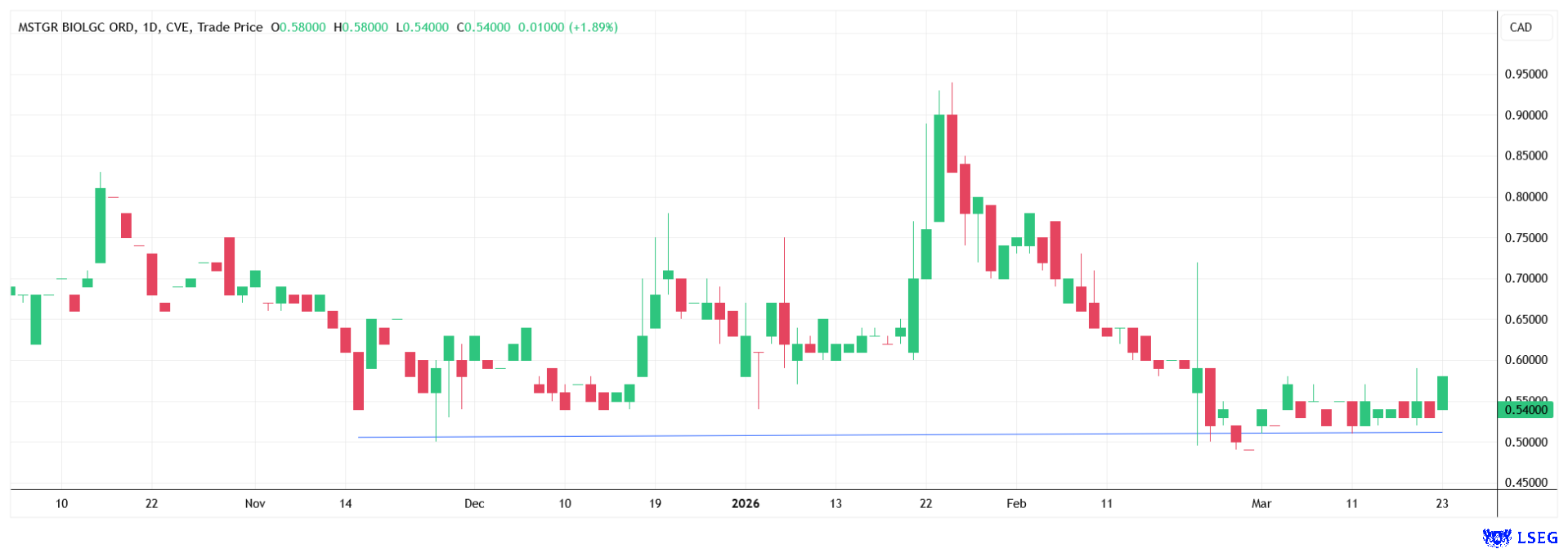
Two recent news items in particular are turning heads and show that the company is currently making a huge leap forward. In February 2026, MustGrow published the results of its two-year field trials in rapeseed cultivation. Rapeseed is a USD 14 billion industry in Canada. The problem facing farmers there is so-called clubroot, a parasitic disease for which there are currently few effective treatments. MustGrow’s biocontrol technology, TerraMG™, has performed phenomenally in this regard. In trials covering over 100 acres (1 acre = approx. 4,047 m²), disease spores were reduced by up to 95% during wet years. For farmers, this translates to an increased yield of up to 7 bushels (1 bushel of rapeseed ≈ 6 kg) per acre. In monetary terms, this translates to USD 91 in additional value per acre. This is a compelling argument for any farmer and could represent a breakthrough for this product.
The second important piece of news concerns the company’s financial foundation. In January 2026, MustGrow successfully closed a USD 2 million financing round. In the process, 4 million shares were issued at a price of USD 0.50. The great thing about this is that this capital flows directly into growth. It will be used to build an inventory of the soil conditioner TerraSante™. This product is already registered in key US states such as California. This demonstrates that MustGrow is making the transition from a pure research company to a commercial provider. The collaboration with Bayer for the markets in Europe, the Middle East, and Africa further underscores that even the major players have recognized the potential of mustard technology. With a lean capital structure of just 62.9 million outstanding common shares, MustGrow is a dynamic stock that is just beginning to realize its full potential.
COO & Director Colin Bletsky of MustGrow Biologics Corp. presented at the 18th IIF.
We are entering a period in which agriculture is once again taking center stage. As the industry leader, Bayer is showing signs of a potential rebound following its correction and could be on the verge of a new era of cooperation and innovation. K+S, as a solid raw materials supplier, is benefiting from global uncertainties and fertilizer shortages. Both stocks offer an exciting starting point at their current support levels. K+S should be on the watchlist above EUR 18.
MustGrow Biologics, on the other hand, is a small innovation gem for investors betting on the shift toward regenerative agriculture. The impressive field trials with rapeseed and the secured financing for the market ramp-up of TerraSante™ speak volumes. MustGrow operates in a niche that is growing worldwide due to stricter environmental regulations. Viewed objectively, the company offers an interesting combination of patented technology and initial commercial successes. Those who keep their eyes open and understand the importance of food security will find a balanced strategy for the coming years in this trio of Bayer, K+S, and MustGrow.
Conflict of interest
Pursuant to §85 of the German Securities Trading Act (WpHG), we point out that Apaton Finance GmbH as well as partners, authors or employees of Apaton Finance GmbH (hereinafter referred to as “Relevant Persons”) currently hold or hold shares or other financial instruments of the aforementioned companies and speculate on their price developments. In this respect, they intend to sell or acquire shares or other financial instruments of the companies (hereinafter each referred to as a “Transaction”). Transactions may thereby influence the respective price of the shares or other financial instruments of the Company.
In this respect, there is a concrete conflict of interest in the reporting on the companies.
In addition, Apaton Finance GmbH is active in the context of the preparation and publication of the reporting in paid contractual relationships.
For this reason, there is also a concrete conflict of interest.
The above information on existing conflicts of interest applies to all types and forms of publication used by Apaton Finance GmbH for publications on companies.
Risk notice
Apaton Finance GmbH offers editors, agencies and companies the opportunity to publish commentaries, interviews, summaries, news and the like on news.financial. These contents are exclusively for the information of the readers and do not represent any call to action or recommendations, neither explicitly nor implicitly they are to be understood as an assurance of possible price developments. The contents do not replace individual expert investment advice and do not constitute an offer to sell the discussed share(s) or other financial instruments, nor an invitation to buy or sell such.
The content is expressly not a financial analysis, but a journalistic or advertising text. Readers or users who make investment decisions or carry out transactions on the basis of the information provided here do so entirely at their own risk. No contractual relationship is established between Apaton Finance GmbH and its readers or the users of its offers, as our information only refers to the company and not to the investment decision of the reader or user.
The acquisition of financial instruments involves high risks, which can lead to the total loss of the invested capital. The information published by Apaton Finance GmbH and its authors is based on careful research. Nevertheless, no liability is assumed for financial losses or a content-related guarantee for the topicality, correctness, appropriateness and completeness of the content provided here. Please also note our Terms of use.
Stockhouse does not provide investment advice or recommendations. All investment decisions should be made based on your own research and consultation with a registered investment professional. The issuer is solely responsible for the accuracy of the information contained herein. For full disclaimer information, please click here.