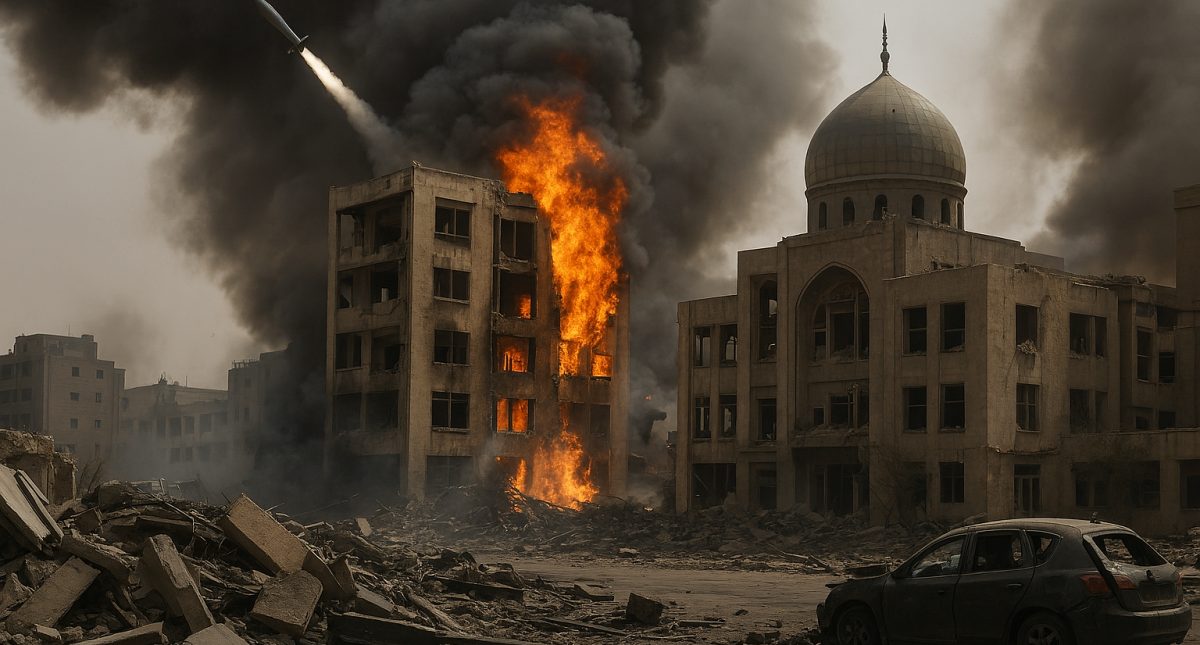

- The U.S. and Israel launched major strikes in Iran, killing Supreme Leader Ayatollah Ali Khamenei and escalating a regional conflict marked by missile and drone retaliation from Iran
- The U.S. has not “formally” declared war, but describes the campaign as “major combat operations,” creating uncertainty around the conflict’s duration and scope
- The Strait of Hormuz emerges as the key market risk, with shipping disruptions threatening up to one‑fifth of global oil supply and driving expectations of sharply higher crude prices
- Canadian markets may see energy and gold stocks outperform, as TSX‑linked oil producers benefit from tighter global supply while investors rotate into safe‑haven precious metals
Executive summary
- Event: The United States and Israel launched large-scale strikes inside Iran, which Iranian and international media say killed Supreme Leader Ayatollah Ali Khamenei and several senior security officials. A 40‑day mourning period has been declared as Iran enters a succession process managed by its clerical bodies.
- State of war? The White House described “major combat operations,” but the U.S. has not formally declared war on Iran; Congress has not issued a declaration.
- Near-term market anchor: Oil and LNG flows through the Strait of Hormuz—a corridor that carries roughly 20 per cent of global oil and a significant share of LNG—are the single most important price lever. Multiple shipowners have paused transits and Iran’s IRGC has issued VHF warnings, though the strait is not officially closed.
This article is a journalistic opinion piece that has been written based on independent research. It is intended to inform investors and should not be taken as a recommendation or financial advice.
Below we map the macro, sector, and asset-class implications—then zoom in on Canadian equities (TSX), with watchlists and positioning ideas.
1) What’s actually happening?
Military escalation
- The U.S. and Israel struck Iranian military infrastructure and leadership targets; Khamenei’s death has been confirmed by multiple outlets. Iran has launched missiles and drones at Israel and U.S. facilities across the region.
- “Major combat operations” language is being used by Washington, but there is no formal U.S. declaration of war (constitutionally a Congressional power). This distinction matters for duration expectations and policy reaction functions.
Iranian succession mechanics
- Under the constitution, the Assembly of Experts selects the next Supreme Leader. Reports indicate an interim Leadership Council (President, Chief Justice, and a jurist) is managing duties; cleric Alireza Arafi has been named as the jurist member by state-linked outlets.
- Potential successors and timelines are fluid; a formal Supreme Leader election process is expected in 2026. Markets should expect headline volatility tied to names floated (e.g., Mojtaba Khamenei, senior clerics from the Guardian Council).
2) Macro channels: How shocks transmit to markets
Energy supply and price risk
- The Strait of Hormuz is the immediate channel: ~20 mb/d of crude moved through in 2024 (c. 20–31 per cent of seaborne oil). Tanker owners have temporarily suspended some voyages; analysts expect an opening gap up in Brent/WTI and warn of triple‑digit oil in a protracted disruption.
- Media and think‑tank scenarios now cite US$100–US$140 Brent in a worst‑case prolonged blockage or mining of the lanes; LNG flows from Qatar are also at risk, with spillovers to European gas benchmarks.
Global risk appetite, FX, and gold
- Expect a risk‑off tilt (equity drawdowns, credit spreads wider), bid for the U.S. dollar and gold, and rate‑cut bets to wobble if oil spikes raise inflation risk. Early analyses flag knee‑jerk selling in cyclicals with energy and defence as relative winners.
Duration and policy
- Because there’s no formal war declaration, the base case among some strategists is a multi‑day to multi‑week air/missile campaign with elevated retaliation risk rather than a long occupation—yet timelines are inherently uncertain.
3) Capital‑market scenarios (next 1–12 weeks)
Scenario A: Limited-duration strikes; Hormuz stays navigable (probable near‑term)
- Brent spikes to high‑US$90s/low‑US$100s, then settles back if shipping resumes and damage to energy infrastructure is limited. Global equities fade the shock after an initial selloff; gold holds a risk premium.
Scenario B: Rolling escalation; intermittent shipping halts
- Tanker traffic becomes “stop‑start.” Brent sustains US$100–US$110; inflation expectations rise. Central banks turn more cautious; defence, energy, shipping outperform; cyclicals and rate‑sensitive growth lag.
Scenario C (tail): Prolonged maritime disruption / mining
- Material and persistent cut to Gulf exports; Brent spikes toward US$120–US$140; LNG prices in Europe/Asia jump. Recession risk rises. Energy equities rally even as broad indices correct.
4) Sector takeaways (global)
- Energy (upstream and offer of sale): Positive beta to oil shock; watch names with Atlantic Basin barrels and minimal Hormuz exposure for cleaner upside. Offer of sale benefits if supply‑security capex rises.
- Refining and chemicals: Crack spreads can widen if product markets tighten; however, input cost volatility and potential feedstock constraints matter regionally. [allspringglobal.com]
- Defence and aerospace: Historically outperform during conflict escalations as procurement expectations rise.
- Airlines, logistics: Fuel cost headwinds; potential reroutes increase costs and reduce capacity.
- Gold/precious metals: Geopolitical hedge; inflows accelerate on risk‑off and DXY strength mix.
5) Canada focus: What it means for TSX investors
1) Energy producers (oil sands, E&Ps)
- Canadian heavy and synthetic barrels are outside Hormuz and thus gain relative value when Gulf supply is at risk. In prior Iran‑Israel flare‑ups, the TSX Energy Index cushioned broader drawdowns as crude and gold rallied; expect a similar pattern if Brent gaps up on Monday.
- Watch SAGD and mining‑to‑market oil sands names for torque to widening WCS–WTI differentials (potentially narrower if U.S. refiners prize secure North American barrels). Export logistics (Mainline, TMX ramp, U.S. Gulf Coast access) become critical catalysts.
2) Pipelines and midstream
- Stable fee‑based cash flows plus incremental volumes if North American barrels backfill global flows. However, interest‑rate sensitivity means a sustained inflation impulse could pressure multiples even as fundamentals improve. [allspringglobal.com]
3) Gold miners
- TSX’s global‑scale miners historically outperform on geopolitical spikes. Sensitivity to CAD/USD, energy input costs, and jurisdictional mix still matters, but the beta to bullion should dominate on a risk‑off bid.
4) Industrials and transports
- Airlines and cargo face jet fuel cost inflation and potential routing constraints (Middle East lanes, insurance premia), a relative headwind vs. energy and materials.
5) Banks and diversified financials
- Typically track domestic growth and broad equity risk appetite. Oil‑up/TSX‑defensive rotation can be neutral to slightly negative near term; credit quality watchpoints rise only if energy shock persists and filters into Canadian macro.
Positioning ideas (Canada)
- Overweight: Energy producers with strong FCF yields and operational leverage; senior/intermediate golds; selective midstream.
- Market weight to underweight: Rate‑sensitive defensives if inflation risk steepens curves; airlines/logistics near term until fuel hedging clarity emerges.
6) What to watch this week (checklist)
- Maritime evidence: AIS data trends and company statements on Hormuz transit resumptions/pauses; any mine‑warfare indicators or U.S. naval escort operations.
- Iran’s political pathway: Credible reporting on the Leadership Council and the Assembly of Experts’ timetable; emergence of consensus successor figures.
- Energy price action: Whether Brent gaps into US$95–US$110 (sustained) or fades after initial spike; LNG forward curves in Europe/Asia.
- Gulf infrastructure: Any verifiable damage to export terminals (e.g., Kharg Island), pipelines, or naval assets that would extend disruption duration.
- Policy responses: OPEC+ rhetoric, SPR (U.S.) drawdown talk, shipping insurance market adjustments; Canadian government commentary on energy security.
7) Risk management and portfolio construction
- Barbell approach: Pair energy/precious‑metals overweights with quality large‑cap defensives and short‑duration cash or T‑bills to manage volatility and inflation risk.
- Hedge inflation: Consider commodity‑linked equities and inflation‑protected bonds where available; watch CAD correlation (often a petro‑currency on oil spikes).
- Event‑path humility: Without a formal declaration of war, path dependency is high. Scale in on weakness, use stops and options for tail‑risk hedges (e.g., calls on Brent proxies, puts on broad equity beta).
8) Bottom line
- This is the largest Middle East shock to energy security in years, with markets trading the probability and duration of Hormuz disruption above all else. Canadian portfolios are relatively advantaged by TSX’s energy/gold mix, but broad risk‑off, higher‑for‑longer inflation risk, and succession uncertainty in Iran will keep volatility elevated.
Sources and further reading
- Confirmation of Khamenei’s death and strike campaign dynamics: POLITICO, Military Times/AP, Al Jazeera, FRANCE 24
- War powers and legal status: Times of Israel (full text), Britannica explainer, USA Today
- Iran succession mechanics and interim arrangements: Al Jazeera, NDTV, Wikipedia overview of 2026 leadership election
- Strait of Hormuz risk and oil scenarios: Al Jazeera explainer, CNBC scenarios, The Independent, Times of Israel background
- Market reaction frameworks: CNBC market impact, Allspring equity implications
Join the discussion: Find out what the Bullboards are saying about this ongoing conflict on Stockhouse’s stock forums and message boards.
Stockhouse does not provide investment advice or recommendations. All investment decisions should be made based on your own research and consultation with a registered investment professional. The issuer is solely responsible for the accuracy of the information contained herein. For full disclaimer information, please click here.