

Part 3 of a 3-part investor series
In the first two installments of this series, we explored how U.S. Energy Corp. (NASDAQ:USEG) has evolved from a traditional E&P company into an emerging industrial gas and carbon management platform — and how its 2026 plan sets the foundation for multi‑stream, long‑duration value creation.
Part 3 zooms out. Because to understand the full scope of the U.S. Energy opportunity, you have to understand something bigger: industrial gases are becoming the critical materials of the modern world, every bit as essential as the minerals and metals that dominate commodity headlines.
This article is disseminated in partnership with U.S. Energy Corp. It is intended to inform investors and should not be taken as a recommendation or financial advice.
Silicon may have powered the information age.
But helium and CO₂ are increasingly powering the technologies shaping what comes next.
This is the era where industrial gases behave like scarce, strategic assets — the new gold of a digital, automated, space‑driven global economy.
The global helium crisis: The lifeblood of high technology
Helium is unlike any other industrial gas. It is non‑renewable, born not from manufacturing but from geological processes that take millions of years. Once vented into the atmosphere, it escapes into space. It cannot be recovered. And global production is concentrated in just a handful of regions worldwide.
At the same time, demand is rising in sectors that define the future:
Semiconductors
Helium is essential for chip fabrication — used to cool, purge, and stabilize advanced lithography systems. As AI accelerates and next‑generation chips grow more complex, helium demand becomes even more tightly linked to global computing capacity.
Medical imaging (MRI machines)
MRIs cannot function without liquid helium. Hospitals, diagnostic labs, and medical centres depend on secure, uninterrupted supply.
Aerospace and space launch
Companies like SpaceX, Blue Origin, and NASA rely on helium to pressurize rocket fuel tanks and enable safe launch operations. No helium, no modern commercial space industry.
Quantum computing
Ultra‑low‑temperature cooling environments — the core of quantum hardware — require high‑purity helium.
This creates a supply‑demand environment with a simple, profound implication: helium shortages are no longer temporary market disruptions; they’re structural.
That’s why helium reserves aren’t just valuable. They’re strategic.
And that’s why Kevin Dome — one of the few known helium resources of scale in North America — is increasingly viewed as a national‑interest asset hidden in plain sight.
CO₂: From liability to industrial powerhouse
For years, CO₂ has been framed almost exclusively as an environmental liability. But that story is incomplete.
CO₂ is also a critical industrial input — and an irreplaceable one in several large, stable sectors.
In everyday life, CO₂ keeps food cold, carbonates beverages, and preserves perishables. In advanced manufacturing, it’s indispensable in metal fabrication and welding. And in the energy sector, it plays an essential role in enhanced oil recovery (EOR), unlocking barrels that traditional methods leave behind.
What’s changed is not CO₂’s usefulness — but how society is choosing to manage it.
A molecule once viewed as a problem is now a recognized asset, enabling carbon‑neutral food systems, cleaner manufacturing, deep‑decarbonization infrastructure, and measurable climate progress.
For companies that control both CO₂ supply and sequestration pathways, this shift creates a new class of long‑duration revenue built on:
- Industrial sales
- Carbon management incentives
- EOR uplift
- Permanent geological storage
In other words, CO₂ has moved from liability to monetizable commodity.
And because Kevin Dome contains both massive CO₂ volumes and the geology required for storage, U.S. Energy sits at the centre of this new economic model.
The investment opportunity: The picks and shovels of the digital frontier
As investors increasingly chase AI, chips, quantum computing, and commercial space stocks, they often overlook the simple physics that underlie all of these industries: None of them function without helium.
And many depend on CO₂ as well.
Industrial gases aren’t competing with AI or space tech — they enable them. They are the “picks and shovels” of the technological frontier. And history has shown that betting on the infrastructure behind the boom often delivers more durable returns than betting on the boom itself.
Tech cycles fluctuate.
Industrial gas demand doesn’t.
It grows — and grows more essential.
For investors seeking exposure to the growth areas of the future, the case is increasingly clear: industrial gases represent a more stable way to participate in high‑tech mega‑trends without taking high‑tech risk.
The shift: How U.S. Energy Corp. is positioning itself to lead
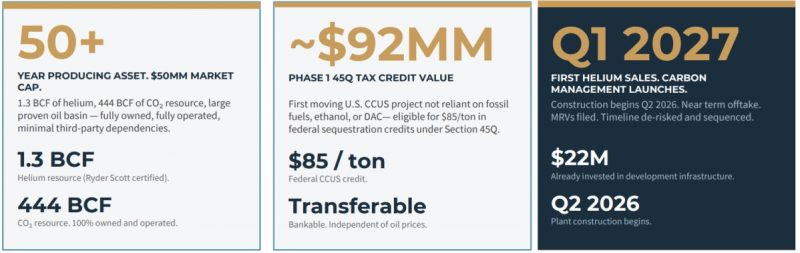
Few companies have pivoted as decisively as U.S. Energy.
Once a traditional oil producer, the company is now building a closed‑loop system that monetizes both helium and CO₂ — while using its own CO₂ to enhance production at its own oil fields and permanently sequester the remainder.
This integrated model matters because it creates:
- Multiple revenue streams
- Low decline rates and long‑duration output
- Infrastructure‑driven margins
- Deep optionality for future scaling
- Alignment with global decarbonization and digital manufacturing trends
In other words, U.S. Energy is constructing a platform, not a project.
And in a world where industrial gases are becoming major assets, platforms win.
Conclusion: The era of industrial gas has arrived
Across the semiconductor fabs of Taiwan, the launch pads of Texas and Florida, the MRI wings of modern hospitals, and the data centres powering AI, helium and CO₂ are no longer background materials. They are front‑line enablers of the technologies defining our century.
Investors who understand this shift early will see industrial gases not as commodities — but as the gold of the digital age, scarce, essential, and deeply intertwined with the highest‑growth sectors of the global economy.
For U.S. Energy Corp., this is not a distant vision. It is the business they are building today.
Further reading:
- Part 1: A multi‑platform industrial gas and carbon opportunity ready for long‑term value
- Part 2: The 2026 buildout that turns a resource into a platform
- Read the investor presentation here
Join the discussion: Find out what the Bullboards are saying about U.S. Energy and check out Stockhouse’s stock forums and message boards.
Stockhouse does not provide investment advice or recommendations. All investment decisions should be made based on your own research and consultation with a registered investment professional. The issuer is solely responsible for the accuracy of the information contained herein. For full disclaimer information, please click here.